Your Hard Drive Needs A Diamond Blade

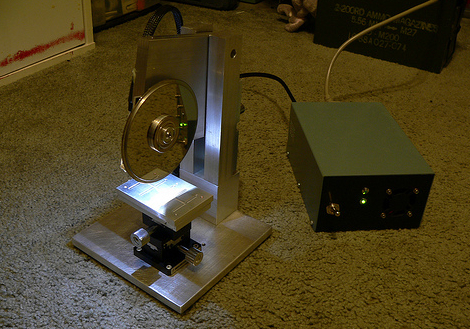
If you find yourself in need of a precision chop saw don’t overlook the value of adding a diamond blade to a spinning HDD platter. [Tony’s] four-part writeup of this build springs out of some very special design considerations for a ham radio that operates in the 47 GHz band. That frequency pretty much rules out using normal components in the circuit and in his case it even makes connecting the components together difficult. He’s using this chop saw to cut small pieces of a ceramic substrate with gold traces on them that will be used to route the signals on the circuit.

We’ve seen hard drives used in a couple of different clocks, and even as a set of speakers. This one makes for a nice addition as a way to reuse those defunct devices that litter your junk box.

[Thanks Thomas]
Flood Triggered Camera

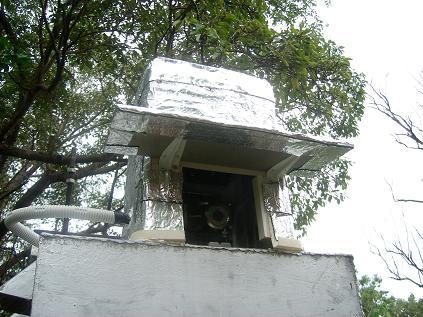
When the Department of Natural Resources of Australia decided that they needed to capture data about the natural flooding of a cave, they turned to a hacker to get results. The goal was to photograph the area during these floods with an automated system. In the end, they used a gutted Lumix digital camera mounted in a trash can, covered in aluminium foil. Though it sounds a bit silly, the final product turned out quite nice. You can see the build log, schematics, and results on the project page.

[via hackedgadgets]

Arduino IPod Library Work Continues

[David Findlay] has been hard at work on his Arduino iPod remote library and is now showing off some Wii Nunchuck control in the video after the break. When we looked in on his work in September he was using a Staples Easy Button to control the iPod. Now he’s added all of the functionality for iPod simple remote mode, and most of the advanced mode.

Advanced mode works well with his iPod Photo but the iPhone just returns errors. We know that Apple uses some tricks to keep unauthorized accessories out, so we hope that [David] finds a way to sniff out the necessary accessory protocols from an approved model.

Continue reading “Arduino IPod Library Work Continues”

I’m One Step Closer To Azeroth

While looking for a way to injure his neck and live in the World of Warcraft all at once, [Gavan Woolery] came up with the idea for this virtual reality setup. That monitor, residing just inches from his eyes, is putting out 1080p at 120Hz. His plan is to pair up the motion sensing seen in the video after the break with an NVIDIA 3D Vision Kit for something close to total immersion.

To be fair, [Gavan] never mentions WoW, but we all know where this is going right?

Continue reading “I’m One Step Closer To Azeroth”

How-to: Make A Mains Crossover Cable

Update: This How-To was written for April Fools’ Day. It is not advisedĀ  you attempt to make or even use this cable. The comments have made it very clear how dangerous to you and others using this cable can be. The image above is not of a full male-to-male cable, only the ground is connected, and the generator is not running.

We all know Ethernet has the crossover cable, cars have jumper cables, and RS232 has the null modem. Well, it is about time our wall sockets get their own crossover cable. This crossover cable is great for running power to a circuit disconnected from power. Maybe you are out of fuses, the breaker is broken or you just don’t want to go check the fuse box when there is a murderer about. This cable makes a great gift for even the most loathsome of acquaintances. Continue reading “How-to: Make A Mains Crossover Cable”

Core3Duino (April Fools?!) And XDuino

It’s inevitable. You knew it, we knew it, and while this is being posted on April 1st; its no joke. [johndavid400’s] Core3Duino. As we mentioned before, with the additional Arduinos you have now 3 separate processors, allowing 24digital IO, 18 PWM, 18 analog inputs, and more.

Now to keep flamers at bay (calm down), we’ve combined this post with the introduction of xDuino. Yet another attempt at porting Arduino to separate hardware platforms. For the price of a Duemilanove you can have 5 serial, 48 IO, 18 analog, 68Kbytes of Ram and more!

[Thanks Kamil]

CNC Plotter From Old Parts

[vimeo=http://vimeo.com/10479779]

Get a quick fix of CNC for the day with this plotter. [Francisco Dulanto] grabbed the cartridge carriage from an old inkjet printer and turned it into a gantry by mounting it on two drawer sliders. The optical head assembly from a cd-rom provides the Z-axis movement with the whole thing controlled by three RepRap boards. [Francisco] called his project a joke compared to the Turing Machine, but we like it and we’re glad he tipped us off. There’s something zen-like about the projects that are thrown together with what you have available. After all, he’s certainly achieve a clean-looking build that does what it’s intended to do.