DMX Keyboard Display

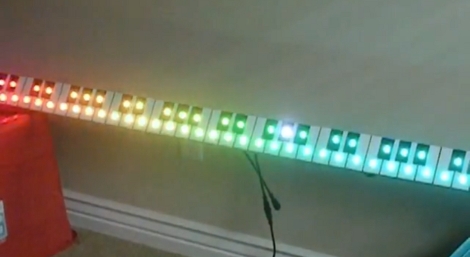
This keyboard display has an RGB LED for each key that is addressable through the common stage lighting protocol, DMX. The project video, seen after the break, does a good job of walking us through the concept. By using a MIDI to DMX converter box [John] can show MIDI signals coming from a keyboard on the appropriate key of the display. By further monkeying with the firmware in the converter box he shows a plasma effect on the whole keyboard, making the corresponding light for each pressed key pop out in bright white. Jump to about 3:45 to hear and see “Sweet Child o’ Mine”.

This isn’t the first time [John’s] been caught with a slew of blinking lights. He helped create the giant LED Christmas tree that brightened up our holiday.
Continue reading “DMX Keyboard Display”

Rotary Display Uses VCR Head And LEDs

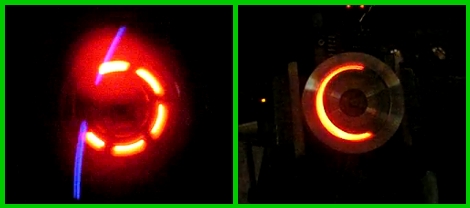
[Daniel Daigle] is developing a rotary display that uses persistence of vision to graph data. The hardware he used includes a spinning head from a VCR, some LEDs, and a timing circuit to display 360 degrees of data. His timing input uses a waveform so this will work with any application where you can generate a PWM signal.

Check out his videos after the break that demonstrate a graph with a single line and another with six display lines.

Continue reading “Rotary Display Uses VCR Head And LEDs”

(mini)How-To: Refill Your DTG Inks

The number one and number two things asked after presentation of our DIYDTG were…
“How does it hold up in the wash?”
and…
“How did you change out the inks?”
While we’ve explained the first several times (regular ink washes out, DTG ink gets a little lighter but survives) we can hopefully answer the second with a tutorial.

Continue reading “(mini)How-To: Refill Your DTG Inks”

Building A Glue Stick Flashlight

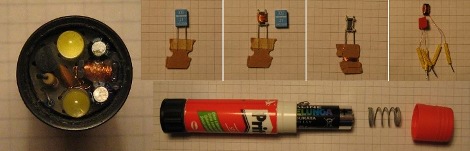
Building an LED flashlight is simple, right? Take a battery, connect it to an LED by way of a resistor. Alright wise guy, now make one that steps up the voltage for multiple LEDs and don’t use a boost-converter IC to do so.

[fede.tft] shares a flashlight built inside of a  used glue stick case. It’s the perfect size for one AA battery (we’re always on the lookout for good battery cases), and a shape that we’re familiar with as a flashlight. The problem is that he wants two white LEDs but with just one AA cell he’s never going to have more that 1.5V available. He licked that problem, getting to 7.2V by designing his own step-up converter using one transistor, an inductor, and three passive components. To get the inductor he needs, a stock part is disassembled and rewound to suit. Maybe you just end up with a flashlight when all is said and done, but then again, the Sistine Chapel is just some paintings on a ceiling.

Linux Tablet Built Around A BeagleBoard

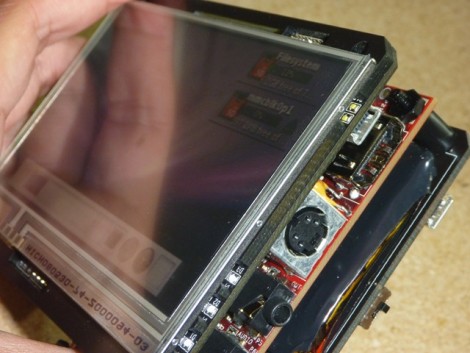
[Justin] shows us how to make a Linux tablet out of a BeagleBoard. You may remember [Justin’s] work at liquid cooling an Arduino. For this one he moved past the AVR hardware but took the idea of shields along for the ride. The device above is something of a Linux tablet, with a touchscreen shield on top of the BeagleBoard, and one below it for power. He’s selling these as kits which include the 480×272 OLED display as long as you can handle the fine-pitch soldering for those headers. We’re not sure our hands are steady enough for the challenge.
[Thanks Will]

Resurrecting ISA Hardware

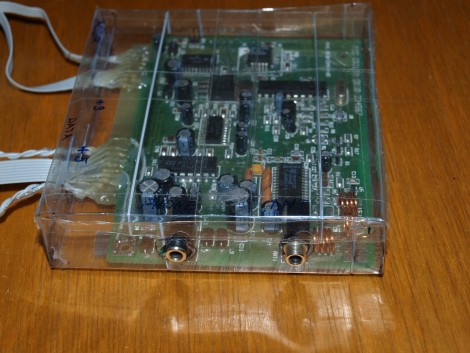
[Alex] had an old FM radio tuner card come his way. It used an ISA connector, a standard that went the way of the dodo in the mid-nineties. With the challenge of implementing an ISA-bus to configure the card he set out on his mission. What he came up with is a working radio using the ISA card and driven by a PIC 16F877. Join us after the break for schematic, code, and a few details. Continue reading “Resurrecting ISA Hardware”

Preserving Old Stuff With The Library Of Congress

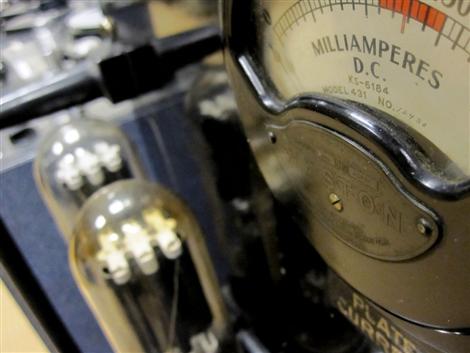
Take a few moments and browse this gallery from the Library of Congress. Tasked with the job of preserving the roughly 150 million historical items, they are constantly developing new methods using bleeding edge technology. There is an odd balance of some of the oldest documents in tandem with some of the newest technology evident in these pictures. From doing spectral scans of ancient books to laser mapping warped phonographs, everything must be preserved and documented.