Arm Mounted Light Cannon; Villains Beware

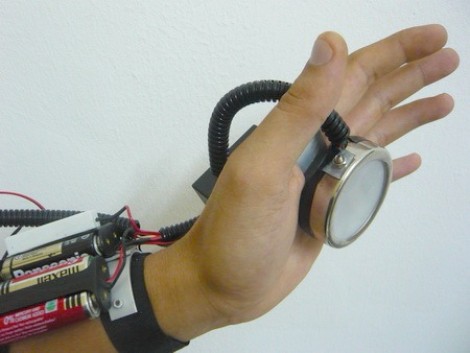
In a hack worthy of the flick Kick Ass, [Chein] built this arm-mounted light weapon. The lamp in the palm of your hand has a ring of LEDs for a nice glowing effect, but the real story is the xenon bulb at its center. The flash capacitor and charge circuit from a disposable camera are used to step up the battery voltage to 330V for an intense and slightly blinding discharge. The charging is started when you press a button on the back of the hand harness, with the flash coming when one of your fingers touches a conveniently positioned trigger. Check it out after the break.

This non-lethal weapon makes for a nice alternative to the dangers involve in playing with fire.

Continue reading “Arm Mounted Light Cannon; Villains Beware”
Making Glow Sticks At Home

[youtube=http://www.youtube.com/watch?v=tItOOpyJP5k]

Even if you have no interest in making these yourself, you might enjoy this educational instructable about making your own glow sticks. Comprised of a very short list of chemicals, all available online, the process is fairly simple. If you’re feeling like you want to take on a little more complicated chemistry project, you can also make the TCPO component your self, possibly saving some money as the individual components are cheaper than the final product. As they note, it is just cheaper and easier to buy a glow stick, unless you are making mass quantities.

Servo Controller Board

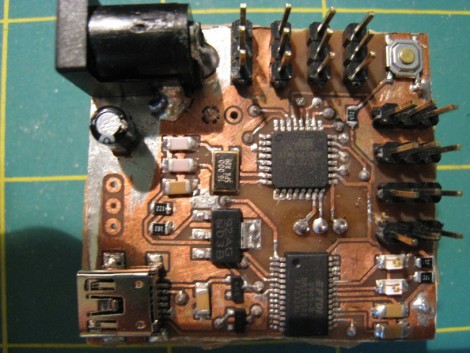
This board is [Eric Seifert’s] venture into working with AVR microcontrollers. He has worked with PIC microcontrollers in the past and used the goal of developing a servo controller board as his motivation to try the grass on the other side of the fence. He found he likes the AVR line for its ease of development under Linux, a feature we also appreciate. What he ended up with is a tiny board that controls up to eight servo motors. If you’ve got a project that is spilling over with servo-controlled limbs, maybe this will save you some development time.

Lolo’s (perfect Moment) Alarm Clock

[youtube http://www.youtube.com/watch?v=CphsgESZGcE&feature=player_embedded%5D

It seems everybody has a different interpretation of the perfect alarm clock. [Loic Royer’s] alarm clock is not the loudest, or the smartest, but does have some interesting features. By monitoring several environmental factors like temperature, air quality, humidity, dew point, and your own sleep patterns, this alarm clock can determine the best moment in the morning to wake you up.

The main sensor is a wireless accelerometer with the theory being: the more you move in your sleep, the closer you are to a conscious state. The other sensors assist in picking the perfect moment, and awaken you with the sound of birds chirping.

For now all we have is the source code and the list of hardware, but for anyone wanting to try, a circuit diagram wouldn’t be too hard to figure out on your own. Check after the rift for some more videos. Continue reading “Lolo’s (perfect Moment) Alarm Clock”

OpenWRT On A Seagate FreeAgent Dockstar

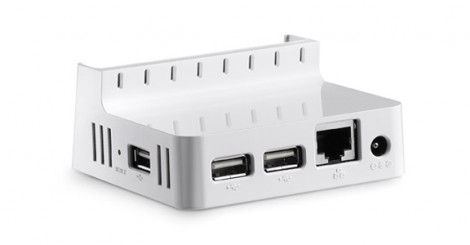
The Seagate FreeAgent Dockstar aims to make all of your stuff available online. It serves that purpose but sometimes you just want more options for controlling your hardware and running some scripts. [Eric Cooper] put together a guide for installing OpenWRT on the Dockstar by building your own kernel and loading it onto the internal storage. Once you have a kernel that will play nicely with the hardware, you can install it by tunneling in through SSH; the same method you would use if you wanted to run Linux on this hardware. If you have problems along the way, [Eric’s] also included a guide for cracking the Dockstar open and connecting a serial cable.

RFID Cat Feeder Helps With The Diet

[vimeo=http://vimeo.com/10896151]

When faced with having 2 cats with different dietary needs, [Landmanr] had to decide between manually stopping the cat on a diet from eating normal food, or building a dietary robot overlord. [Landmanr] chose the robot route. Using an old cd rom for the opening/closing mechanism, and RFID to distinguish between felines, [Landmanr] no longer has to stand guard while each cat eats. We particularly like the design of the antenna, so that the cat has to stick its head through it to activate the food opening. You don’t see that version in the video, but it is in the instructable.

SEGA Genesis Cloned With An FPGA

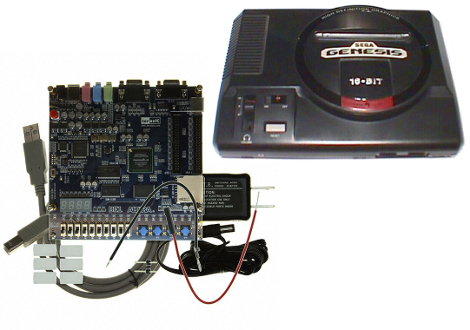
[Greg] managed to clone a SEGA Genesis using a field programmable gate array. He used a Terasic/Altera DE1 board, which will set you back about $160, during development. The onboard push buttons are currently used as the controller with VGA for the display. Who knows, maybe there’s enough programming space left to drive a PSP screen and turn this into a handheld?

You can see some gameplay footage after the break. If SEGA was never your thing don’t forget that there is an NES FPGA hack out there too.

Continue reading “SEGA Genesis Cloned With An FPGA”