Chest Freezer Temperature Controller

[Mikey Sklar] finds himself in need of a temperature regulated refrigerator for fermenting foods like yogurt, kimchi, bread, and beer. After some testing he found that by building his own controller he can get a chest freezer to outperform an upright refrigerator at this task by 2-to-1.

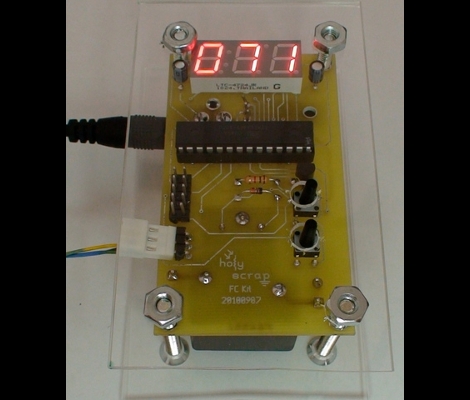
The controller is based around an ATmega48. It includes a remote temperature sensors which you can see connected to the lower left header in the image above. On the back of the board there’s a relay used to switch the freezer’s power on and off. [Mikey] is selling a kit but the hardware and software for the project are both open source so build it yourself if you have the know-how.

A chest freezer is a great place to store Cornelius kegs… we’ll keep our eyes open for one.
Making Point Contact Transistors

[youtube=http://www.youtube.com/watch?v=vmotkjMSKnI&w=470]

[Jeri Ellsworth] is back at it again. We seem to cover her work a lot here. Her latest video above covers how she created a point contact transistor from a 1N34 germanium cat whisker diode. After opening the glass casing on the diode, she uses sharpened phosphor bronze metal from common electrical connectors as the collector and emitter. A 330 microfarad capacitor charged to 20 volts and then discharged though a 680 ohm resistor to the base and collector leads forms the collector region. Her test jig is a simple oscillator circuit such that a properly formed transistor will start the circuit oscillating and make and audible sound. We look forward to more esoteric knowledge of electronic devices being brought to our attention.

Racing Sim Cockpit Stores Inside An Ottoman

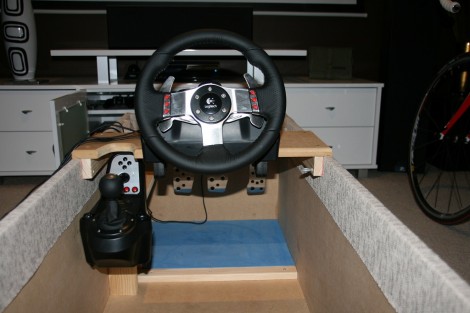
[Lyscho] built a racing simulator cockpit based on a PVC frame but it took up a lot of space when not in use. His second generation is built inside the frame of an ottoman, meaning it can be stored right under your feet.

The pedals are fixed in place, with some padding below to rest your heels on. The cockpit chair and steering wheel are both adjustable to suit different drivers. They use a routed groove along with wing nuts and bolts, making it easy to slide them for adjustments. The ottoman itself is [Lyscho’s] own creation, which just needs power and USB when in use, and has a padded top when not in use.

If you can’t use a real car as the simulator this is fantastic alternative.

[via Make]

Have You Ever Wanted To Be On (Internet) TV?

Are you an independent inventor? It might just be your lucky day. The fine folks at Independent Inventor TV, a new show currently filming for Revision3, is looking for home and garage based inventors to present their inventions for the camera. Currently they are based out of San Francisco, CA and are looking to film people in person, or by Skype if you are out of town.

To apply to be on the show, send an email to Independent.Inventor.tv(at)gmail.com with the details, photos, and videos of your inventions. The shooting date of the show is November 15th, so make sure to have all submissions in well before then. The selected inventors will get to meet the hosts, Comedian Jonah Ray, as well as fellow hacker [Joe Grand] (who is the creator of many of the DefCon Badges we have covered before). Be sure to let them know Hackaday sent you!

Kilobuck Open Kinect Project Prize

Full of video and audio sensors, the newly released Kinect is Microsoft’s answer to Nintendo’s Wii MotionPlus and Sony’s PlayStation Move. Now there is money up for grabs to hack it. Adafruit is offering up a one thousand dollar prize to open source the driver for the Kinect. What do they want this driver to do? They want RGB and distance values. We’re excited to see the hacks that will come around because of this product, and now that prize money is involved, everything has been turned up a notch.

Update: The bounty has been raised to $2000 after a Microsoft response to CNET:

But Microsoft isn’t taking kindly to the bounty offer. “Microsoft does not condone the modification of its products,” a company spokesperson told CNET. “With Kinect, Microsoft built in numerous hardware and software safeguards designed to reduce the chances of product tampering. Microsoft will continue to make advances in these types of safeguards and work closely with law enforcement and product safety groups to keep Kinect tamper-resistant.”

Update: Progress toward a driver
Update: Winner of the Open Source Kinect contest

Apple Studio Display Connector Ports

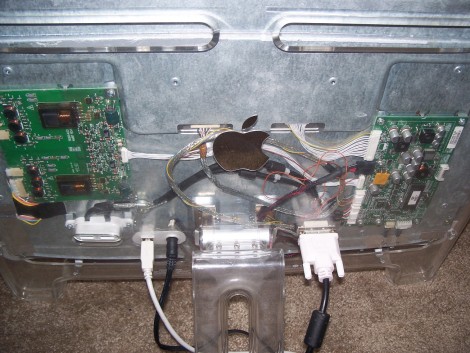
[Warrior_Rocker] pulled off his own Apple Studio Display hack by removing the cable and adding ports. As we saw in Wednesday’s post, these displays use a cable with a proprietary connector that combines DVI, USB and Power. Instead of altering the cable, [Warrior_Rocker] removed it completely. By wiring up a standard barrel jack for power, a USB type-B socket, and a DVI port, he can now use standard video, power, and USB cables to connect to the monitor.

This project was actually submitted to us on May 25th and we missed it. It’s sad that sometimes tips fall through the cracks, and we’re sorry that we missed this particularly well-executed hack. [Warrior_Rocker] wrote in asking why his project didn’t qualify after seeing the similar post on Wednesday. So please don’t take it personally if your project doesn’t get posted. If you think it fits right in here at Hackaday and haven’t heard anything after two weeks or so, consider sending to us again.

Mac SE Reborn As A Server And Mac Emulator

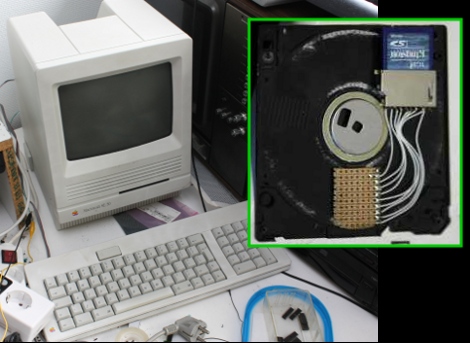
[Sprite_TM] cooked up an amazing hack by resurrecting a Mac SE using a Dockstar and ARM processor. The retro hardware had a bad mainboard thanks to the corrosive properties of a failed backup-battery. He had been wanting to do something with the Seagate Dockstar and decided it would find a nice home in the Mac. But what fun is a dead machine housing a headless server? To add to the fun he included an ARM processor running a Mac emulator, along with all the bits to make the screen, keyboard, and peripherals work. When the Mac is off the Dockstar still runs as a server.

But one of the best parts is the floppy drive. It still takes floppies, but there’s no magnetic media inside of them anymore. Instead, he’s added an SD card slot and some protoboard in the space for the read head. The drive itself has had the read head transplanted for some pogo pins (hey, we saw those earlier today). When you insert the floppy, the pogo-pins raise up and contact the protoboard, connecting the SD card to a Teensy microcontroller.

There’s so much going on with this project we just can’t cover it all here. Things like a chemical cleaning to return the original color of the classic case, and building a converter so that the peripherals are USB compatible are just some of the pleasures awaiting you in [Sprite_TM’s] post. He’s also filmed a demo video that we’ve embedded after the break.

Continue reading “Mac SE Reborn As A Server And Mac Emulator”