ATtiny85 Sketch Flashing Rig

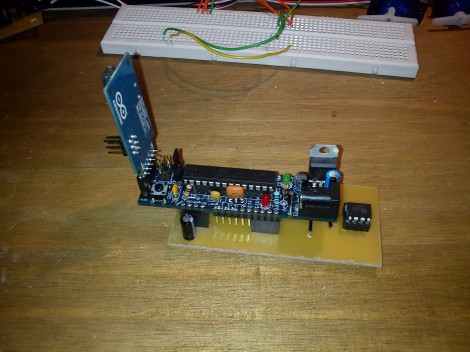
We’re happy to see Arduino enthusiasts championing the use of smaller hardware when the need for a full-blown ATmega-based board just isn’t there. [Chris] has been doing just that, using ATtiny85 chips in his projects. But he’s tired of hooking jumper wires to flash the sketches. He finally got around to etching this ATtiny85 programming adapter.

If the project is not pin hungry, an ATtiny85 can run Arduino sketches without the need to port the code. The best news is that the Arduino board you used to prototype the project can be used as the programmer for the standalone chip. Here that’s a Boarduino, and [Chris] laid out a double row of female pin headers for quick plug-in. To the right you can see the DIP socket for the target chip. Although this works perfectly well, we would have liked to also see the inclusion of a 2×3 AVR ISP programming header which could be used with the full range of AT chips.


Hackerspace Intros: Freeside Hackerspace In Atlanta Georgia

When I announced that I would be traveling through some areas of the southeast this summer, [Slade] from Freeside Atlanta emailed me to set up a stop at their hackerspace. I am very happy he did too, because this place was really cool. [Steven Sutton] agreed to walk us through the facility and did a great job of being the tour guide.

Continue reading “Hackerspace Intros: Freeside Hackerspace In Atlanta Georgia”

All-in-one All Grain Brewing For Your Kitchen Counter

All grain brewing is a labor and equipment intensive endeavor, but it produces the highest quality beer compared to partial mash or extract brewing. [Jeff Karpinski] started out with the latter two methods, but as his enthusiasm for the hobby mounted he found himself brewing all-grain batches with just an electric kettle. He developed the system seen above as an easy method of automating the all grain process, and he managed to make it tidy enough to do in the kitchen.

All-grain brewing usually involves five or ten gallon (or more) boils. This type of volume is usually what demands that the brewing process move out of the kitchen. But since [Jeff] is the only beer drinker in the house he limits his sessions to three gallons. This means all of the equipment takes up less room. Here he’s got a five-gallon bucket, cooler, and brew kettle on just one small piece of the counter. In between the kettle and bucket you can see the controller box he built. This is responsible for switching power to the heating element in the brew kettle, and the electric pump in the bucket. The bucket has a permanent counterflow chiller which brings the wort down to a suitable temperature before pitching the yeast. It’s pretty amazing how well contained the liquid is from start to finish!

[Thanks ScottInNH]

Kilonode: How To Test A Huge Xbee Mesh Network

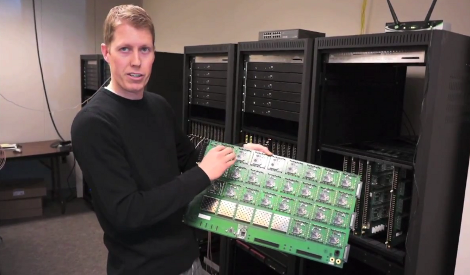
So let’s say that you’re a developer on the Xbee team. You need to test the extremes of what the RF radio modules can do when in a large network. But in addition to numerous nodes, you also need to test the effects of distance on the radios. Since it’s not reasonable to distribute hundreds of the devices (each with their own power source) throughout town, you build a test setup like the 1 kilonode Xbee rig which the project manager, [Jared Hofhiens] is showing off.

He’s holding one blade from the rack-mounted system. Each of those squares is an Xbee module, there’s 32 etched onto the board. On the edge furthest from him there are a set of connectors which mate with the rack connectors, hooking the blade up to a set of terminal servers. These servers allow developers to ssh into individual modules. On the near side of the blade there’s a set of attenuation adjustment circuits. They allow adjustments of 0-40 dB of attenuation in 10 dB increments to adjust how strong the RF signals are, simulating distance between modules.

Thirty-two of these cards are mounted in the three racks seen above to make up the 1024 module node. We really appreciate this look behind the scenes and think you’ll enjoy the video tour after the break. If it leaves you wanting more check out how one company builds cloud storage. Continue reading “Kilonode: How To Test A Huge Xbee Mesh Network”

3d Printing, The New Frontier Of Piracy?

We’ve all heard the countless arguments about piracy in digital media. However, it appears that 3d printing or other rapid prototyping systems are bringing legal issues to a more physical world. The story goes like this: [Thomas]  bought a 3d printer. He’s a big fan of warhammer figurines. He spends tons of time creating some custom warhammer figures, and uploads them to thingaverse. Games Workshop, the owners of Warhammer, unleashed the lawyers and had the items removed.

There are so many angles to this story, the mind boggles. If I were an artist, and someone else was uploading copies of my work, essentially stopping my revenue, it would suck. Then again, if I were lucky enough to have a fanatical fan base that spread the love for my product with excitement and zeal, I might want to encourage them. Neither of those thoughts however, cover the legal issue at the base here. We don’t have an answer for you. Sorry. You’ll probably be seeing this issue pop up more and more often in the future.

We encourage you to make our logo. Though we haven’t bothered to ask our lawyers.

Dot Matrix Printer Spits Out Any Tweet Mentioning @KWF

Earlier this month, [Kenneth] picked up an old dot matrix printer at the Silicon Valley Flea Market and subsequently found two cases of tractor feed printer paper. It’s a marriage made in heaven for a dot matrix twitter printer.

[Kenneth] used a BeagleBone – a tiny single board computer running Linux – to connect to the Internet and fetch any new tweets mentioning KWF every minute or so. The BeagleBone spits out these tweets over the USB port which is connected to the ancient printer by means of a cheap adapter cable.

Interestingly, [Kenneth] wrote the code for this project as a shell script. A lot of effort went into scrubbing the input of any escape characters, but he still implores his admirers to not attempt to break his project.

In case you’re wondering, at couple Twitter accounts announced this post’s headline to the Twitterverse when this story was published. This should have immediately sent [Kenneth]’s printer into motion, recording that harsh mistress that is sending a build log of a Twitter connected device into Hackaday.

After the break you can see [Kenneth]’s demo. Be sure to share this post on Twitter!

The Biggest CNC Machine Can Build A House


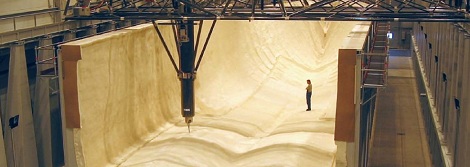
If it’s true that those with the biggest toys win, a few lucky engineers over at EEW Maschinenbau in Germany just earned a gold medal; they have access to a gigantic CNC machine that is large enough to machine a house.

This machine was originally built to manufacture molds for fiberglass wind turbines that are over 50 meters in length. Because building a 50-meter-long CNC machine wasn’t overkill enough, engineers at EEW Maschinenbau settled on a design that is 151 meters long, or almost 500 feet. Of course the HSM-Modal, as this machine is called, can only make parts 151 meters long in the x dimension. The y-axis has a span of 9 meters while the z-axis goes from 0 to 4.25 meters off the ground. Large enough to build cars, ship hulls, and even houses out of a single block of material.

There’s a bunch of technical documentation on the EEW website and a PDF going over the specs. Not only can this gigantic mill machine molds much like an embiggened desktop CNC router, this thing can do drilling, sawing, grinding, plasma cutting, and even extrusion just like a Makerbot.

If you’ve got the cash, EEW Maschinenbau will build you one of these gigantic machines. We can’t imagine how much that would cost, though.

via the Adafruit blog