Data Logging Directly To Google Docs (Google Drive)

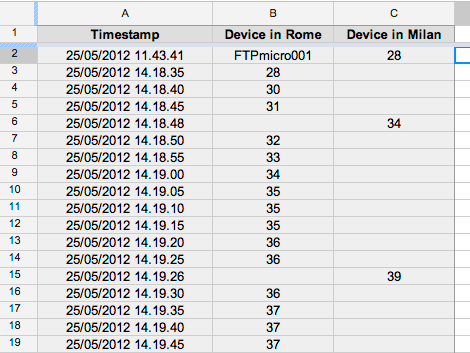
[Emanuele] is using Google Docs to log his temperature sensor data automatically (translated). We can see a few benefits gained by using this system. One is that you don’t have to visit the site of the logging hardware to harvest the data, another is that Google will automatically graph the data for you. Of course this means you need some way to connect your logger to the Internet, but we’ve seen buckets of different techniques for doing so. In this case, [Emanuele] is using PIC hardware that has a NIC on the board. But the technique could be used from a computer just as easily as from a microcontroller.

The meat and potatoes of the hack is sniffing out the HTTP header and syntax for writing to cells on a Google Docs (soon to be Google Drive) spreadsheet. After making a new spreadsheet and copying the URL and key from the address bar, he loads up the page using a header-viewer web service. With all the pertinent info in hand he crafts about a dozen lines of code to assemble the HTTP packet, and rolls the timestamp and temperature reading into it dynamically. See the system in action after the break.

Continue reading “Data Logging Directly To Google Docs (Google Drive)”
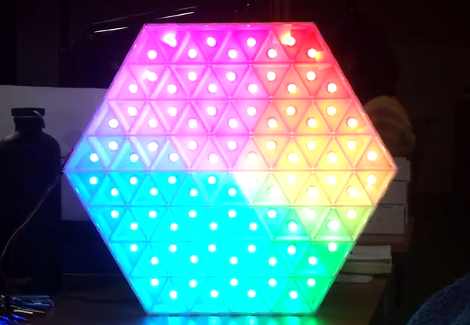
Triangle-grid LED Display

[Dearmash] put together this RGB LED display using triangles for each pixel. It’s an interesting deviation from the traditional grid layout. There are two video demos after the break. The first is a plasma-style pattern generated in Processing. The second is a spinning color wheel which would be perfect if synchronized with your Photoshop color spinner.

So the physical build is done, and now [Dearmash] is looking for a purpose for the device (isn’t that always the way it happens?). He mentions that the triangular layout looks cool, but makes text display almost impossible. Does anyone have any ideas on how to make this work? Right off the bat we could see side-scrolling a font similar to the Metallica logo’s M and A. Bu there must be some way to group these pixels together into readable characters. If you always use an upward and downward pointed triangle on the same row as a pixel it makes a parallelogram which would be used to display italicization characters.

Continue reading “Triangle-grid LED Display”

LED Bicycle Hack Makes Sure You’re Seen At Night

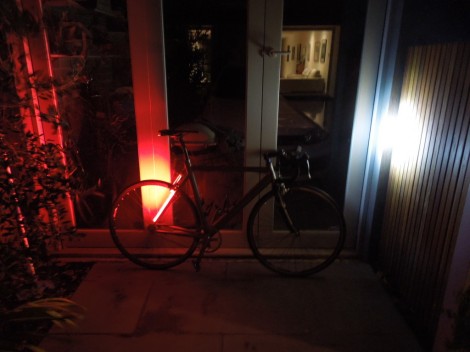
The bicycle tail and head lights that we’re accustomed to are small add-on modules. This take on the idea uses strips of LEDs to protect you from behind. They’re very bright, matching the pair of LED headlights that are attache to the handlebars.

Apparently [A.Davis12] had some LED strips laying around. There’s not what we’re used to seeing, but they have a similar footprint so you should be able to substitute the kind that come on a spool and may be cut to length. The majority of the build time was spent integrating the lights and their control wires with the frame of the bike. The frame already has holes in it for feeding the control wires for brakes and gear shifting inside the tubing. It sounds like it was a pain, but eventually he managed to get all of the routing done. Two red strips are zip-tied to the back of the seat stays. They are powered by a lithium battery inside the project box which mounts under the back of the saddle. A flip switch on the case lets you turn them on without stopping.

[Thanks Arpad]

Dollar Store Arc Reactor Build

Some people have a real knack for sourcing parts at the dollar store. [James] is one of those people, having built this Arc Reactor replica using mostly dollar store goods.

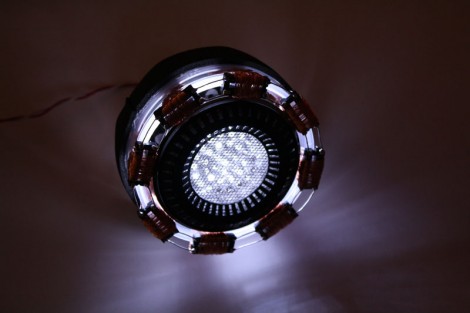
The light source is an LED disk light that was removed from its enclosure. A sink strainer, the plastic holder from a package of sewing pins, and some wire mesh go together to make the first layer of the bezel. The push-pin holder is what has the ring of narrow rectangles around the bright center. It was painted black and attached to the sink strainer which provides the concentric holes in the center of the device.

For the detail around the outside [James] went with some clear-plastic drinking cups. By cutting off the top centimeter of each and stacking three together he gets the clear base he was after. The rest of the parts were gathered from his electronics supplies. DIP sockets straddle the drinking glass rims, and are wound with copper wire for the look seen here.

We put this near the top of the dollar store builds along with this Blade Runner umbrella.

Remote Shutter Module Uses LCD Screen For Setup

Here’s a full-featured remote shutter project which [Pixel-K] just finished. It seems that he’s interested in taking time-lapse images of the cosmos. Since astrophotography happens outside at night, this presented some special design considerations. He wanted something that he could configure in the dark without zapping his night-vision too much. He also wanted it to be easily configured with a pair of gloves on.

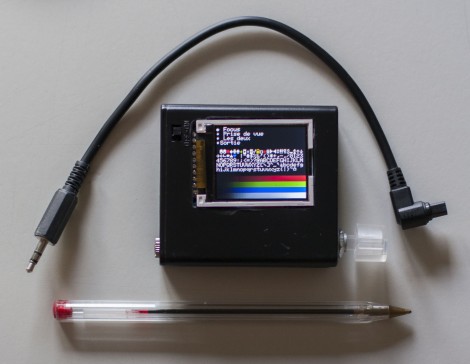
The project enclosure is a 4x AA battery box. He removed the partitions between each cell, leaving plenty of room for the guts. Inside you’ll find a lithium battery and a micro-USB recharger board. It powers the Arduino mini pro which drives the 1.8″ LCD screen and actuates the optoisolator which is responsible for triggering the camera. On the right you can see the clear knob of the clickable rotary encoder. All of the user settings are chosen and selected using just this one knob.

He’s already tried it out on a 6-hour shoot and had no battery life problems or other issues.

A Personal Manufacturing Stack Exchange

Over on Stack Exchange, there’s a proposal for a new CNC/3D printer site. It’s a personal manufacturing stack exchange, and hopefully we’ll see some awesome discussion when it’s eventually created.

Stack Exchange is already well-known for hosting the most useful programming site as well as awesome sites/forums covering everything from LaTeX to grammar. The proposed Personal Manufacturing site is sure to provide a ton of advice and discussion covering the hardware, software, electronics, and toolchains of CNC routers, RepRaps and mills.

The personal manufacturing stack exchange hasn’t been created yet – a few more people still need to commit to use it. Once that’s done, though, we’re sure to see a lot of very helpful advice and discussion from the Stack Exchange community.

Kudos to [Michael] for sending this in.

Pimp My Scooter

[Glen] built this shiny party machine out of a pretty sad-looking scooter. We’d bet you’re wondering why we think it’s a party machine when it looks so common? The only real giveaway in this photo is the custom exhaust, but hidden in the body of the beast is 720 Watts of party power plus a whole bunch of extras.

When he gets where he’s going, [Glen] parks his ride and lifts up the seat to unfold the entertainment. Attached to the underside of the saddle is a 720 Watt audio amplifier. It drives one big speaker under the seat, as well as two tweeters and two mid-range speakers that were fitted into the front console. But these days a party isn’t a party without some video, and that’s why you’ll also find a 7-inch LCD screen suspended from the upright seat. Tunes and videos are supplied by an iPod touch up front, or the PC he built into the ride. All it’s missing is a gaming console!

Continue reading “Pimp My Scooter”