Physical Email Box — Mail Flag And All

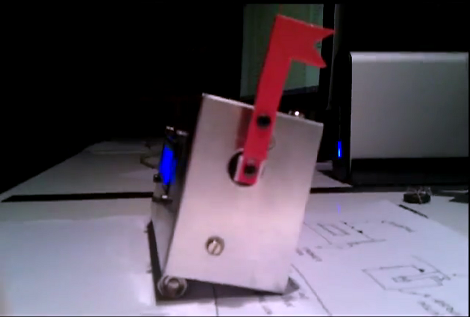
We gave you a side view because we really like the red new-mail flag. Sure it works the opposite of how USPS boxes do (where the flag tells the letter carrier there is outgoing mail to be picked up) but it’s still a fun touch. What you can’t see here is that this physical email box has a character LCD screen to read your messages and a set of buttons on the top to send back replies.

[Eraclitux’s] project puts an Arduino, LCD, a few buttons, and a servo motor inside of a metal project box. It connects to his computer and takes commands over the USB cable. The Python script is where most of the magic happens. This is a good reference project if you’re interested in using POP and SMTP packages to interface your Python scripts with an email server. You’re pretty limited on responses, with preprogrammed messages to reply “Yes”, “No”, or “Read”. But it’s journey that matters, not the destination.

Continue reading “Physical Email Box — Mail Flag And All”

New IOIO In The Works

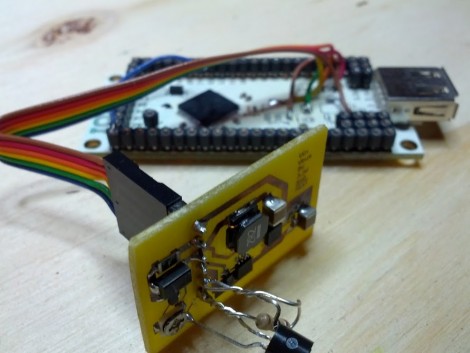
There’s a new version of the IOIO on the way and we think you’re going to like the goals this redesign aims to achieve. If you’re not familiar, the IOIO is an Android accessory board. It connects to the phone via USB and is aimed at making it easier to build your own hardware peripherals for the handhelds. Just look around here for a while and you’ll find a bunch of projects that are built around this board (for instance: adding MIDI control to your phone).

With [Ytai’s] announcement that the second generation IOIO is in the works he touches on price and functionality improvements. Certainly the $50 cost of the original board is pretty low, but if you’re just planning on hacking for giggles it’s a roadblock. Although no number has been quoted, the plan is to make the new rendition more affordable. As for functionality, the next generation will be a USB On-the-Go device. This means it can be a master when connected to the phone, or a slave when plugged into a computer. There are also a smattering of electrical design improvements.

WebKit On Chumby Lets Developers Avoid Flash

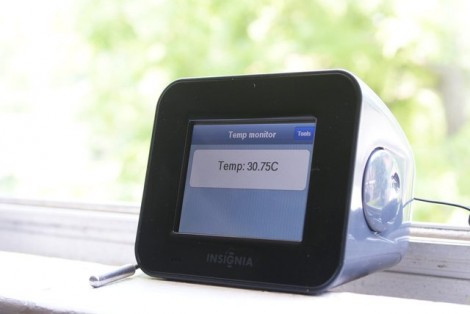
[Huan Truong] was looking for an Internet interface for one of his projects. In this case it’s a temperature logger, but it could be just about anything. He decided to give the Chumby a try, but was turned off by its use of Flash as the app framework. He decided to open up more options by running WebKit via his custom Chumby’s firmware.

In the video after the break he shows the boot sequence and demonstrates his first app. The device runs through a screen calibration as it powers on. When the app comes up it looks and responds much more like an Android or iPhone app than the Chumby interfaces we’re accustomed to. This technique gives you pretty wide range of app development languages. That’s because all the Chumby really cares about is the index.cgi file that serves as the interface. Development and debugging can be done on a desktop (not that it couldn’t before but Flash development under Linux was always a pain).

It looks like this idea isn’t new, but we don’t recall seeing any other projects that used WebKit as an alternative Chumby interface.

Continue reading “WebKit On Chumby Lets Developers Avoid Flash”

Hackerspace Introduction: Makers Local 256 In Huntsville Alabama

When I announced I would be traveling through Alabama and Georgia this summer, [Tim] from Makers Local 256 emailed me pretty quickly and asked if I’d like to swing by for a visit. Since I was planning to take my kids to the space center in Huntsville anyway, I thought it would be a perfect opportunity to tour another hackerspace.

Continue reading “Hackerspace Introduction: Makers Local 256 In Huntsville Alabama”

Making An Audio Spectrum Analyzer With A Microcontroller

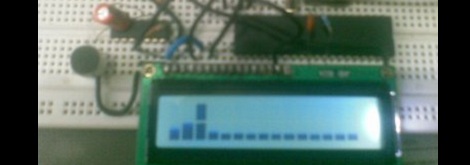
While [Vinod] says he’s not an expert in this sort of thing, we really like his audio spectrum analyzer build from a simple microcontroller and LCD display.

It is a well-studied fact that every audio waveform – a recording of your voice, for instance – is just the sum of many, many sine waves. These sine waves can be plucked out using Fourier analysis, using a Discrete Fourier transform. This is the principle that spectrum analyzers operate under; [Vinod] wrote a bit of code using DFT to take apart audio captured from a microphone and output their frequency on an LCD display.

To output the spectrum on his LCD, [Vinod] stacked horizontal bars up into 8 custom characters in his display. Like [Vinod]’s previous audio on an ATMega32 experiment, an LM324 amplifier is connected to the ATMega through an analog pin. [Vinod] has a very clever build on his hands with his spectrum analyzer, and a great answer to the perennial ‘how do I build a guitar tuner’ questions we’re constantly asked.

After the break, you can see [Vinod]’s spectrum analyzer in action. Be forewarned; you may want to turn down the volume.

Continue reading “Making An Audio Spectrum Analyzer With A Microcontroller”

Hackaday Links: May 29, 2012

Teensy CNC mill

The guys at Inventables put together a neat CNC router kit that looks very interesting. It uses Makerslide linear bearings and CNC’d parts to make a surprisingly cheap frame for something that can engrave wood and metal. Inventables is running a Kickstarter-esque preorder to fund this production run but right now they’re 30 orders short. We’d like to see how these routers turn out in the real world, so if you’re on the fence (or just want a CNC router), this might be the time to buy.

DIY solder fume extractor

[Jared] sent in a fume extractor he put together. It’s a small PC case fan with a carbon filter sandwiched between a pair of grilles. Not much, but if should keep those wonderful flux fumes away from your face.

A million fake Internet points to the first person to come up with a DIY clone

[filespace] shared an awesome Electrofishing video with us. Electrofishing pulses a DC current through two electrodes attached to a boat. This current causes galvanotaxis in fish, causing them to swim towards the anode. The fish can be caught with a net and released afterwards; there’s no damage to the fish at all. We’d love to see a DIY solution, but throwing M-80s into a lake doesn’t count.

Improving GSM reception with a bit of metal

[Raivis] lives in the country, so even his voice reception on GSM is terrible, let alone data. Inspired by an earlier post, [Raivis] built a discone antenna to improve his cell signal. Now everything is crystal clear and his Huawei E1752 USB/GSM modem improved from 3 mbps down to 5 mbps down.

CNC halftone photos

[Dana] sent in a few pics of a project he’s working on. He’s making halftone prints with a CNC and metal. We’ve seen this before, but we’re really loving [Dana]’s take on it. He’s using two-layer engraving plastic with a .005” engraving tool on his CNC. There’s a gallery of his work after the break; [Dana]’s portrait is 14000+ dots and took 6 hours, his bosses kids are 16000+ dots and took 4 hours, and [Dana]’s niece is 5500 dots and took 35 minutes. Very awesome work, and now [Dana] has fulfilled a lifelong dream of machining his face.

Continue reading “Hackaday Links: May 29, 2012”

Climbing Robot Glues It’s Own Feet To The Wall

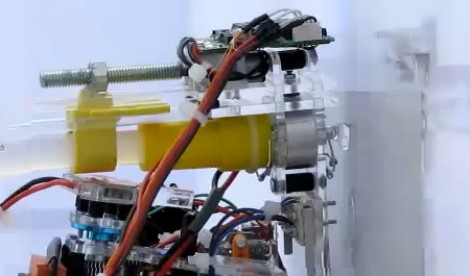
The problem of gripping all surfaces has always plagued the field of climbing robotics. But if you don’t care about damaging the wall, why not just let the robot glue its feet to the surface. That’s exactly how this robot does it, using a couple of climbing feet in conjunction with a hot melt glue gun wielding arm. It seems to be a predecessor of the hot glue 3D printing robot which we saw last week.

Check out the video to get a full overview of the climbing process, but here’s the gist of it. The legs and arm are able to pivot around the central axis of the robot, parallel to the climbing surface. Once one leg is glued in place the robot swivels around it so that the body is directly above that leg. From there it reaches up with the arm to deposit some glue on the wall, then moves it out of the way so the other foot can be pressed against the hot adhesive. When the newly attached foot has cooled sufficiently, the lower foot is reheated to free it from the wall. At this point the whole process repeats.

We’re still fond of vacuum-based climbers like this parachute-equipped robot. But the design of the hot-glue arm on this guy is something that might make it into one of our own projects someday.

Continue reading “Climbing Robot Glues It’s Own Feet To The Wall”