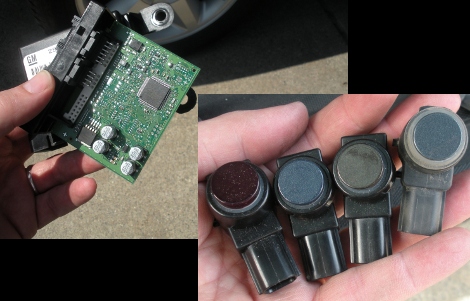
Investigating Parking Assist Sensors

While his wife was out-of-town [James] jumped at the opportunity to do some snooping around with her Chevy Tahoe’s parking assist sensors. We can understand how pulling parts out of someone’s car would make them none too happy. But we find it hilarious that it’s a leased company car he’s tinkering around with. But we’re glad he did, the ten-page write-up he published about the project is a fascinating read.

You can see the control board above which is housed beneath the passenger seat. It uses a Freescale microcontroller to read from the four bumper-mounted ultrasonic sensors. But just looking at what parts are used obviously isn’t enough to satisfy a hacker’s appetite for knowledge. [James] busted out a CAN bus tool to sniff the data packets. These sensors use a custom chip designed by GM, utilizing a single wire communications system. He figures out the communication scheme and builds an mbed based test rig to read them directly.

[via Dangerous Prototypes]

IOU Management For Roommate Chores

[Chris] shares a dorm room with five other people. When living with others its important to stay on top of cleaning and to do so equitably the sextuplet came up with a well-planned whiteboard of chores. The problem lies in getting everyone to do theirs in a timely manner. To help facilitate this, [Chris] came up with a system that lets roommates swap chores, giving each other IOU’s for future duties.

The system uses an Arduino board along with an RTC chip for precise timekeeping. The user interface is made up of a graphic LCD and a keypad with everything mounted inside of a cardboard box. [Chris] shows off his system in the video after the break, spending the majority of time on the debt system. The roommates have a pot of money for group groceries and this system will let you know where everyone stands. But according to his written description this also stores the calendar of chores that need to get done, and will let you trade with one another to fit your personal schedule.

So now the issue is getting everyone to use the system. But we don’t think that’s going to be too tough since all six of them are computer scientists.

Continue reading “IOU Management For Roommate Chores”

Hackaday Links: February 26, 2012

Wii Nunchuk controlled Monotron

Adding a bit of motion control to your music synthesizer turns out to be pretty easy. Here’s an example of a Wii Nunchuk used to control a Monotron. [Thanks John]

Hackers on the Moon and other space related goals

Yep apparently a non-government backed expedition to the moon is in the works. But you’ve got to walk before you can crawl and one of the first parts of the process is to launch a hackerspace-backed satellite network called the Hackerspace Global Grid. Check out this interview with one of the initiative’s founders [Hadez]. [Thanks MS3FGX]

Laser pointers and frosted glass

We were under the impression that a laser show required finely calibrated hardware. But [Jas Strong] proves us wrong by making pretty colors with laser pointers and slowly rotating glass. [Thanks Mike]

MSP430 Twitter Ticker

[Matt] built a Twitter ticker using the TI Launchpad. It works on an LED matrix or OLED display along with a Python script which handles the API.

Android floppy drive hack

[Pedro] shows us how he reads floppy disks with his Android tablet. The hardware includes a docking station to add a USB port to the tablet, as well as a hub and USB floppy drive. On the software side of things an Android port of DOSbox does the rest.

Giving Old Appliances A Second Life With Simple Tweaks

blender-light

Cruising estate sales can be a total crapshoot – sometimes you find a goldmine, other times nothing but junk. [John Ownby] recently found a sleek-looking old blender at such a sale and decided to take it home. The chrome plated base and fluted glass immediately caught his eye, but he didn’t buy the blender so he could make mediocre frozen drinks – he wanted a lamp instead.

The conversion was fairly simple, requiring him to gut the machine of its moving parts including the motor and blades, replacing them with a small incandescent candelabra base. While his modifications themselves are not groundbreaking, taking them a step further would make for some really cool (and functional) retro house fixtures.

Indulge me for a moment, if you will, and imagine swapping out the simple incandescent bulb for some LED strips or even EL wire. Replace the blender’s cap with a small speaker, and you can use several of these together as retro-looking surround satellites.

We can definitely get behind his reuse of the blender, which would have otherwise likely ended up in a landfill. It’s great to see solid, durable appliances given a second life, even in ways which were never intended. Have you rescued anything from the trash heap like [John], or do you have other ideas for your fellow hackers who might come across similar goods? Let us know in the comments.

Overbuilding An ITunes Rating System

Even though iTunes and it’s song rating system has been around for over a decade now, [Steve] still hasn’t gotten around to assigning ratings to his vast library of MP3s. We can’t blame him – who wants to pull up iTunes every four minutes and assign a star rating to each song individually? To solve this interface problem, [Steve] set out to design a hardware song rating interface that fell down the rabbit hole into development hell.

The build started off simply enough – just an Arduino attached to a few buttons that sends data to a Cocoa app which rates the current song. Everything was working wonderfully until [Steve] restarted his mac and the COM ports went to pot. Wanting a ‘plug-and-play’ solution, he did away with the Arduino-based build and started designing a USB device that would display the current iTunes track and provide hardware buttons for rating the current song.

The current build is based around a very capable PIC 18F4550 micro. After looking up the USB HID protocol, [Steve] had some boards fabricated. He’s keeping us waiting on a final build report, but with the amount of work that went into this project, we’re sure it’ll be a winner.

had-script

Hacking Hack A Day With Greasemonkey

Ever since Hack a Day first emerged on the scene in 2004, the site’s design has been pretty consistent. The black background with its green and white text, while a bit dubious looking at work, is fine by me. For others however, the site’s design is a constant eyesore both figuratively and literally. [James Litton] is one of those readers, and he wrote in to share a tip that helps him read up on the latest hacks without killing his eyes.

[James] uses Firefox to browse the web, so he whipped up a small Greasemonkey script that tweaks Hack a Day’s style sheet once it reaches his browser. His script inverts the background while changing a few other items, making for a much more comfortable read. Overall we found the change to be pretty reasonable, but go ahead and judge for yourself – you can see the before and after screen shots in greater detail on his site.

[James] also points out that the script should work just fine in Chrome, for those of you who prefer that browser instead.

So if your eyes are a bit on the sensitive side, feel free to grab his script and customize away – I don’t think we’ll be changing the theme any time soon.

Weekly Roundup 2/25/12


In case you missed them the first time around, Here are out most popular posts from the past week:

In first place is a post about a DIY ski lift that [Darrin] built. Why should you let a strenuous hike back up a snowy hill ruin your day when you can ski down the hill and then ski right back up it again? Way to go [Darrin]! You are our kind of lazy!

Our second-most popular post is a modern twist on the Nixie tube. This device is made from many layers of clear acrylic that have the numbers engraved onto them. The acrylic is edge lit to achieve a Nixie-tube look-alike.

Next up is a post about a clever way to check the accuracy of a watch. [th3badwolf] did this by making a video at one frame per minute and seeing what the second hand did. Under ideal circumstances, the second hand would stay in the same place for the whole video.

Take a look at this one! Did you think that a CNC machine needs to have a very rigid structure to control the cutting bit? This one doesn’t have any. You hold it with your hand!

Finally, we leave you with a repeat from last week. We didn’t post it this week but you guys just kept coming back for more of this post where [Superluminal] and some friends cast their wedding present for an unlucky bride and groom inside of a big sticky sugar cube.