
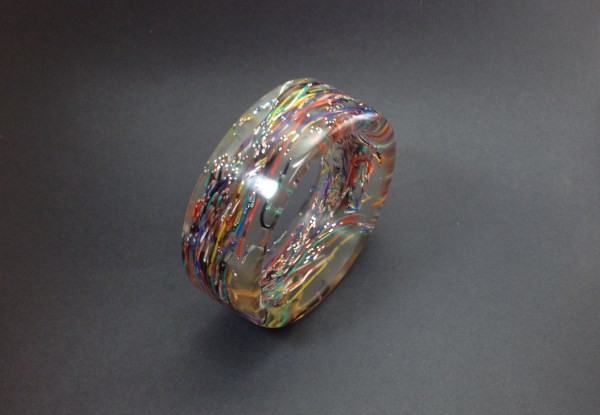
When a job left him with some extra phone wire, [Peter] didn’t toss it in the scrap pile. He broke out the casting resin and made an awesome bracelet (Imgur link). [Peter] is becoming quite an accomplished jeweler! When we last checked in on him, he was making rings out of colored pencils.
Casting the wire in resin was as simple as building a square form, placing the wires, then filling the form with appropriate amounts of epoxy and hardener. Once the epoxy cured, [Peter] drilled out the center with a sharp Forstner bit. A band saw brought the corners of the block closer to a cylinder.
From there it was over to the lathe, where [Peter] used a jam chuck to hold the bracelet in place. Once he shaped the bracelet [Peter] started wet sanding. It took Lots and lots of sanding both inside and out to finish the bracelet. The result is a mirror smooth finish, with bits of insulation bright copper just popping out of the resin.
One might think that the bracelet would be rough with all that copper, but [Peter] mentions on his Reddit Thread that it feels like plastic, though the bits of copper were “very pokey” before sanding. We’d recommend tossing on a clear coating to protect the exposed copper. Worn on a wrist, all that exposed metal would start oxidizing in no time.
This hack gives us lots of ideas for casting wearable circuits. Some WS2812’s and a teensy would make for a pretty flashy setup! Got an idea for a project? Tell us about in the comments, or post it up on Hackaday.io!
Continue reading “[Peter] And The Amazing Technicolor Phone Wire Bracelet”




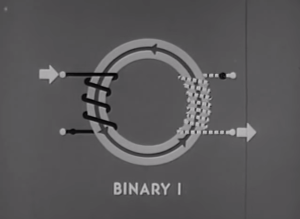 The film covers a lot of theory and does so clearly and concisely. It begins by explaining what a magnetic core is and why it’s used, and then moves on to describe how the cores are used to store bits and the method by which they can transfer information to other cores. Along the way, it provides background on bi-stable devices and provides explanation of magnetization behavior in terms of magnetizing force and flux density.








