This Week In Security: Escaping Linux VMs, Vulnerable Solar, Confusing AI (Again), And Confusing NPM Malware

The Januscape vulnerability allows a user in a guest VM managed by the Linux Kernel Virtual Machine (KVM) to corrupt memory in the host system and break out of isolation.

KVM virtualization is used by major hosting platforms like Amazon AWS, Google GCP, Digital Ocean, and many more. All of the shared hosting platforms count on virtualization to isolate untrusted guest systems from the physical hardware and each other; being able to corrupt memory for all guests or break isolation presents a major threat.

The bug report says the error has been present for 16 years, which is nearly the entire lifetime of the KVM subsystem in Linux. Fixes are available in mainline, and major hosting providers who count on KVM are likely already updating.

Vulnerabilities In Balcony Solar

Micro solar, or “balcony solar”, installs have been gaining traction in Europe as a way to offset rising electrical costs by connecting solar and battery systems to a house or apartment power system.

Vulnerabilities have been found in the popular Hoymiles micro-inverter, which uses a proprietary RF radio protocol to manage the devices. Unfortunately, it looks like this protocol has no encryption or authentication beyond validating the serial number, and the serial number is also available over a wireless probe command.

Armed with a Nordic nRF radio researchers were able to discover nearby inverters in the wild and collect the serial numbers, though of course they stopped short of issuing commands to random users.

The wireless management control allows controlling the device power and output levels, as well as setting a lockout PIN, which the researchers suspect could be used to disable devices and lock the legitimate owners out completely.

There are an estimated 500,000 units in use, and currently the only known mitigation is to unplug the device entirely and disconnect the solar panels, though the team suggests that setting an anti-theft PIN may also help – or at least prevent an unknown PIN being set.

Be sure to check out the link for an in-depth analysis of the protocol and the surprising lack of protection.
Continue reading “This Week In Security: Escaping Linux VMs, Vulnerable Solar, Confusing AI (Again), And Confusing NPM Malware”

Browser-Based Image Inpainting Runs Locally, If One Doesn’t Mind A Big Download

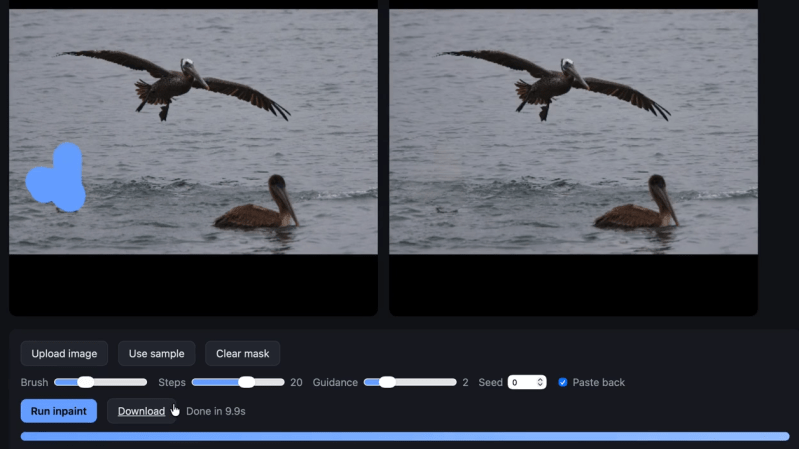
[Simon Willison] ported the Moebuis 0.2B image inpainting model to run locally in a web browser.  The web tool simply requires a user to provide an image, mark a section of it to be removed, and the model will do it’s best to patch up the missing area. The project was handled by Claude Code as an experiment in how things in the AI coding world have evolved, but more on that in a moment.

The existence of this tool shows that it’s possible for this kind of image editing to be done on the client side, running entirely locally with no reliance on remote services or server-side GPU resources. The online demo (GitHub repository here) is available if you want to try it out, but be warned it triggers a 1.27 gigabyte download of the required model on the first run.

What’s also interesting is [Simon]’s write-up, because he used the project as an opportunity to learn what has changed in the realm of AI coding agents. [Simon] is a software developer but in this project he didn’t personally write any of the code. One may think that means he didn’t learn anything other than how to use the tools, but that’s not quite true.

He learned it’s possible to convert a PyTorch-based model to ONXX, that the converted model can run in supported browsers using local WebGPU acceleration, and that the CacheStorage API will work on large files. Last but not least, he learned Claude Opus 4.8 is capable of handling such a project pretty much autonomously, and even created an informative document explaining the underlying architecture.

One may consider AI coding agents to be disasters waiting to happen, but it’s also true that the landscape is changing quickly, and write-ups like [Simon]’s give a helpful peek at those developments.

A Super Cheap Desk Toy Becomes A Hackable Desktop Notifier

The GeekMagic SmallTV is as its name suggests, a tiny, vaguely TV-styled, device with a screen, that’s sold as a desktop notifier. Depending on the firmware running on the device it can display various pieces of information, ranging from the time and weather to the current price of Bitcoin. What makes it interesting is that it supports software updates over WiFi, so [Giovi321] has made a new firmware package for it.

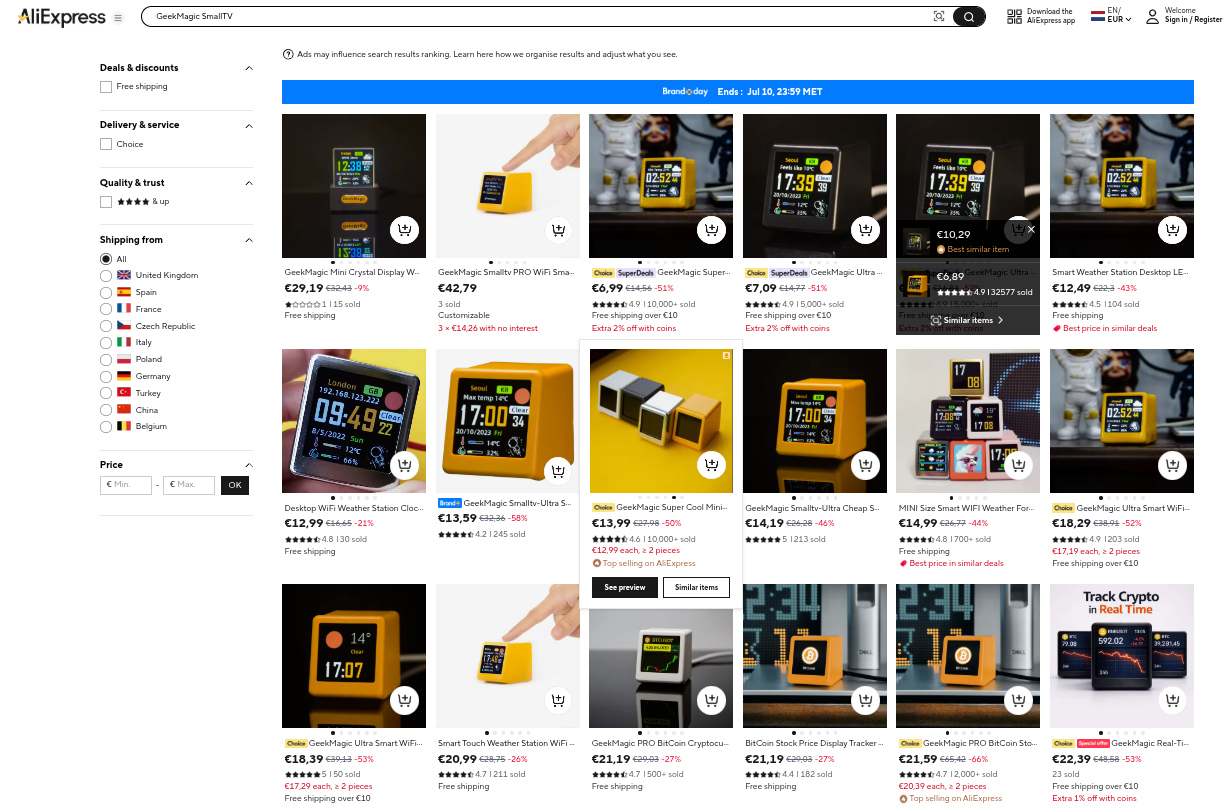
A screenshot of AliExpress showing a range of the devices for sale.
These things are readily available from AliExpress.

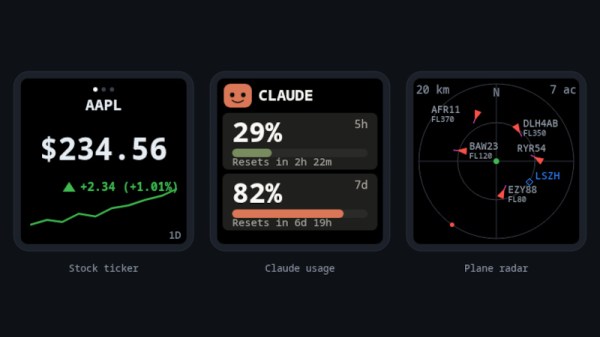
It seems there are several versions of this device, something which appears to be reflected in the prices they sell for on AliExpress. The older version runs on the ESP8266, and there’s also a ESP32-C2 variant in the wild. The firmware supports both flavors, providing stock and crypto tickers, an ADS-B tracker, and a Claude AI token usage gauge.

What gives this potential is that the various functions are clearly split out in the code, and there’s nothing to stop you pointing it at a data source of your choosing. This makes it more than a bit of cheap e-waste novelty, and we hope that others will take up the baton and do interesting things with it.

The ESSP8266 is a chip we don’t see too much of these days, having been surpassed by its ESP32 siblings. Still, someone recently gave it a simple OS.