Hardware hackers love their test equipment. There are entire forums dedicated to talking about multimeters, oscilloscopes, signal generators, and other common bench tools. At times it seems we spend more time talking about our tools than actually using them. For some, off the shelf equipment is never quite good enough. These hackers, makers and engineers design and build their own test equipment. This week’s Hacklet is dedicated to some of the best test equipment projects on Hackaday.io!
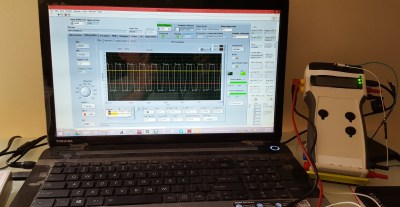 We start with [Roman] and Handheld Electronic Test And Measurement Lab. [Roman] travels a lot, and often needs to bring a lab’s worth of tools with him. After suffering through several ‘random’ searches, he decided to design a simple tool that would cut down his packing, and not get him strip searched. The handheld lab packs a multimeter, low-frequency oscilloscope, data logger, waveform generator, and several other tools into a small package. The tool can be connected to a PC to display data and update settings. The on-board PIC24 handles all the hard work of taking measurements. Some careful analog design gives this tool 10 megohm of input impedance.
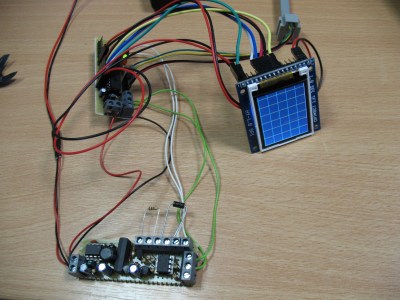 Next up is [Jaromir Sukuba] with 10$ curve tracer. The only way to find out of that a transistor or diode really works as well as the data sheet suggests is to pull out your semiconductor curve tracer. Curve tracers are also perfect for matching transistors for projects like analog synthesizers. [Jaromir] built this quick and dirty tracer over the course of just two evenings. A dsPIC microcontroller runs the show, generating an IV curve by sending pulses through the device under test. Once the curve has been traced, the PIC displays the results on a TFT LCD module. The tracer is a bit limited with a max of 35V at 0.5 amps. Knowing [Jaromir] though, extending the range would only take another evening or two of work.
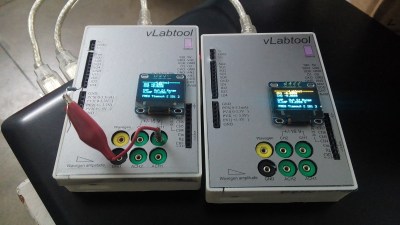 Next we have [Jithin] with A Versatile Labtool. This tool can do just about everything you could want – all in one box. From oscilloscope to frequency counter to multimeter to current source, and much more. Much like [Roman] up above, [Jithin] chose a Microchip PIC24 MCU as processing heart of his design. The Versatile Labtool connects to a PC via USB. If you’re not close to your PC, an ESP8266 module allows the unit to connect over WiFi. A PC isn’t required though. The on-board OLED is always available for quick measurements.
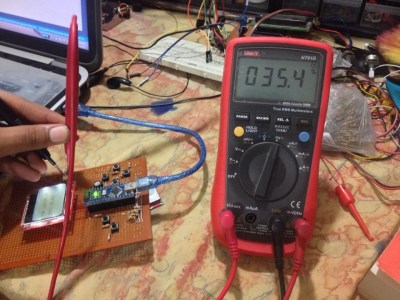 Finally we have [ZaidPirwani] with Engineer’s Multi Tool, his entry in the 2015 Hackaday Prize. [Zaid] started with the popular transistor tester codebase. He ported the code to his own hardware, an Arduino Nano and Nokia LCD. Making the port function required quite a bit more work than [Zaid] expected. He ended up going with a fresh repository and adding a bit of code at a time. Once everything was working, [Zaid] verified that his hardware design operated as expected with a good old-fashioned multimeter. Now that everything is working, [Zaid] is just about out of space on the little ATmega328. Next stop is a Teensy 3.2!
A special thank you goes out to [Jaromir Sukuba] for suggesting test equipment as the theme for this week’s Hacklet. You can find his projects and more on the new test equipment project list! If I missed your project, or if you have a suggestion for a future Hacklet theme, don’t be shy! Drop me a message on Hackaday.io. That’s it for this week’s Hacklet. As always, see you next week. Same hack time, same hack channel, bringing you the best of Hackaday.io!

 Let’s start with the jet powered part. During the video, [Frank] looks down at his board and the water below. Between his sneakers we can see two round openings – which look a lot like jet intakes. At the end of the video, [Frank] flies over the camera. stopping the action shows a split second where four exhaust holes are visible on the bottom of the board. These jets look quite a bit like model aircraft jet engines.
 Standing on a column of uncontrolled thrust would take quite a bit of skill on the part of the pilot. As it turns out, [Frank] is one of the world’s most experienced thrust riders. His previous invention, the


 It’s been said that hackers are enamored with complex networks. In the 60s and 70s, the telephone network was the biggest around, singing a siren song to an entire generation of blue-boxing phone phreaks. I started a bit closer to the house. As a child I was fascinated by the heating system in the basement of our home: a network of pipes with a giant boiler in the middle. It knew when to come on to provide heat, and when to kick on for hot water. I spent hours charting the piping and electrical inputs and outputs, trying to understand how everything worked. My parents still tell stories of how I would ask to inspect the neighbors heating systems. I even pestered the maintenance staff at my nursery school until they finally took me down to see the monstrous steam boiler which kept the building warm.