Facebook To Buy Oculus VR

facebook-ocu


Facebook has agreed to purchase Oculus VR. The press values the deal at about $2 Billion USD in cash and stock. This is great news for Oculus’ investors. The rest of the world has a decidedly different opinion. [Notch], the outspoken creator of Minecraft, was quick to tweet that a possible rift port has now been canceled, as Facebook creeps him out. He followed this up with a blog post.

I did not chip in ten grand to seed a first investment round to build value for a Facebook acquisition.

Here at Hackaday, we’ve been waiting a long time for affordable virtual reality. We’ve followed Oculus since the early days, all the way up through the recent open source hardware release of their latency tester. Our early opinion on the buyout is not very positive. Facebook isn’t exactly known for contributions to open source software or hardware, nor are they held in high regard for standardization in their games API. Only time will tell what this deal really means for the Rift.

The news isn’t all dark though. While Oculus VR has been a major catalyst for virtual reality displays, there are other players. We’ve got our eggs in the castAR basket. [Jeri, Rick] and the rest of the Technical Illusions crew have been producing some great demos while preparing CastAR for manufacture. Sony is also preparing Project Morpheus. The VR ball is rolling. We just hope it keeps on rolling – right into our living rooms.

Stealth Bluetooth Stereo: It’s A Jeep Thing

jeep-bluetooth

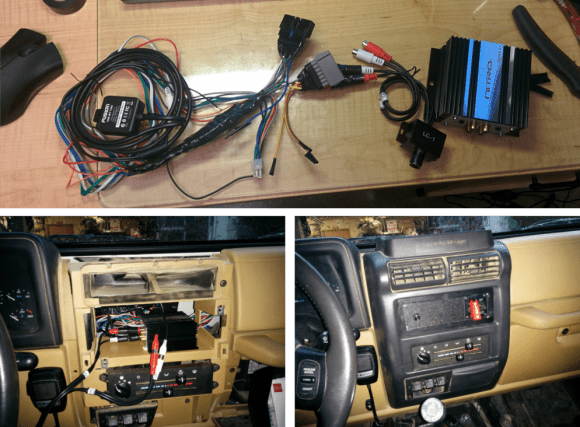
[Feueru] wanted to update the sound system in his 1998 Jeep Wrangler. The problem is that soft top Jeeps are notorious for radio theft. His solution was to build his own stealth bluetooth stereo. The music comes from his Nexus 5 via bluetooth. A Fusion MS-BT 100 waterproof bluetooth receiver picks up the tunes. From there the signal is passed through the one external control, a line level volume knob. A “BMWx-43 300 Watt” amplifier provides the power to drive the Jeep’s speakers. We’re a bit dubious about the 300 Watt rating, as well as the “Only from the mind of a German” catch phrase. Hey, at least the real BMW didn’t have the amplifiers destroyed at the US port due to trademark issues. 

[Feueru] used a standard DIN radio install kit for his Jeep. In place of a headunit, he glued an ABS plastic sheet. The ABS provided a good place to mount his volume control. That volume knob was a bit lonely, so [Feueru] added “Plan B”, his winch controls. The final result looks… well, it looks like a single knob, which is exactly what [Feueru] was going for. Any would-be car radio thief would pass this right by. The only thing missing is an actual FM receiver. Sure, there is a bit of loss when using a bluetooth audio path. However, this is a soft top Jeep with stock speakers, so it’s really not noticeable to [Feueru].

[via reddit]

Magnetic Propeller Balancer Takes Away The Shakes

prop-balancer

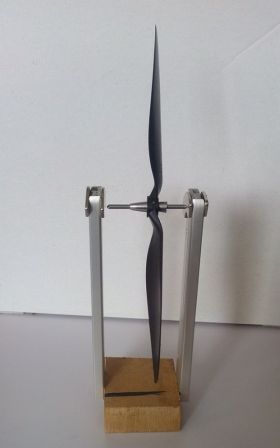
[Danijel0frk’s] friends may call him unbalanced, but his propellers are always spot on. His well-balanced props are thanks to this magnetic balancer he built from scrap PC parts and pilfered office supplies. Propeller balance has always been important for radio controlled models. Flying for hours with a poorly balanced prop can wreak havoc on an air frame and the radio equipment within.  With today’s drones and R/C vehicles carrying cameras, accelerometers, and gyros, propeller balance has become even more important. A vibrating propeller can ruin a picture at best. At worst it can throw gyroscope and accelerometer readings off and cause a crash.

[Danijel0frk’s] balancer is based upon several commercial designs. A steel shaft from a CD-ROM drive is cut and the ends ground to points. A propeller to be balanced is mounted to the shaft. Propellers don’t all have the same hole size so two pen tips are pressed into service as self centering mounts. [Danijel0frk’s] picture shows one tip pointing toward the prop hub while the other points away. The balancer will work better if both tips point inward, ensuring the shaft sits directly in the center of the propeller hub’s hole. Hard drive magnets suspend the prop and shaft from a drive rail and wood frame.  We should note that this type of balancer will only perform a static balance. Dynamic balance would require the propeller to be spinning on a motor with force sensors on the shaft. To perform a static balance, material is added to or removed from the propeller until it balances in any orientation. Click past the break for a good tutorial video on balancing.

Continue reading “Magnetic Propeller Balancer Takes Away The Shakes”

Prophet 600: A Classic Synthesizer Gets Processor Upgrade

proph-600

We love classic synthesizers here at Hackaday. So does [gligli], but he didn’t like the processor limitations of the Prophet 600. That’s why he’s given it a new brain in the form of a Teensy++. The Sequential Circuits Prophet 600 was a big deal when it was released back in 1982/1983. The 600 was the first commercially available synthesizer to include a MIDI interface. The original design of the 600 could be called a hybrid. A Zilog Z80 microprocessor controlled modular analog voice chips. The Z80 was a bit stressed in this configuration though, and a few limitations were evident. An 8 bit processor just wasn’t quite enough for software driven envelopes and a Low Frequency Oscillator (LFO) control. This was further exacerbated by the fact that everything was driven through a 14 bit DAC.

[gligli] discovered most of the limitations in the 600 were due to the processor. By beefing up the processing power he could really unlock the potential within 600. Since he didn’t actually have a Prophet 600, he started with the schematic. [gligli] created a PC based emulator for the digital circuits, learning the whole system as he worked. With that phase complete, [gligli] bought a used Prophet and started hacking. The Teensy++ required a few hardware mods to fill the Z80’s shoes, including cutting off a pin and adding a few jumper wires. We really like the fact that no changes to the Prophet 600 itself are required. Pull out the Teensy++, drop in the Z80, and you’re ready to party like it’s 1982 again.

The new processor interfaces directly with the Z80’s 8 bit bus. Since the AVR on the Teensy has built-in RAM and ROM, it simply ignores the ROM and RAM address spaces of the original system. Interfacing a fast micro with older parts like an 8253 timer and a 68B50 UART does have its pitfalls though. The system bus had to run slow enough to not violate timing requirements of the various peripheral chips. To handle this, [gligli] added a number of wait statements in his firmware. Once the system was working, [gligli] was free to start adding new features. He began by smoothing out the stepped envelope and filter generators, as well as adding new exponential modes. From there he added new keyboard polyphony modes as well as pitch and mod wheel changes. The full lineup of new features are listed in the instruction manual (PDF link). Since this is an open source project, adding a feature is as simple as cracking open your favorite editor and writing it up.

Continue reading “Prophet 600: A Classic Synthesizer Gets Processor Upgrade”

Good Vibrations: Giving The HC-SR04 A Brain Transplant

[Emil] got his hands on a dozen HC-SR04 ultrasonic sensors, but wasn’t too happy with their performance. Rather than give up, he reverse engineered the sensor and built an improved version. Hackers, Makers, and robotics enthusiasts have had easy access to standard sonar platforms since the early 1980’s, when Polaroid began selling their 6500 sonar modules. A number of companies have released sonar boards since then, notably The Parallax Ping))) module. The HC-SR04 appeared on the market a few years back as a low-cost alternative of the Ping.

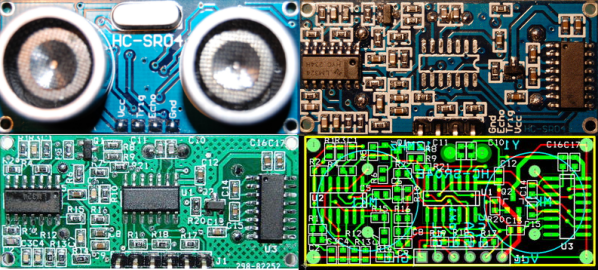
[Emil] found that the HC-SR04 would work reliably on hard surfaces as far as 4 meters away from the sensor. However, he got a lot of bad data back when using soft sided targets, or when no target was present at all.  [Emil] reverse engineered the schematic of the HC-SR04 and found some interesting design decisions. A Max232 RS-232 converter chip is used for its +-12V +-10V charge pumps. The charge pumps are connected to create 24V 20V at the ultrasonic transmitter. A mask programmed microcontroller manages the entire unit, commanding the ultrasonic transmitter to send 40Khz pulses, and listening for returns on the receive side of the system. [Emil] believes the micro is running in polled mode, due to the fact that it sometimes misses pulses. Even worse, the micro runs on an unmarked 27MHz crystal which had quite a bit of drift.

[Emil] solved these problems by creating his own PCB with an ATtiny24 and a 12MHz crystal. He increased the pin count from 4 to 6, allowing the ATtiny to be programmed in circuit, as well as opening the door to I2C and SPI operation. To build the boards up, [Emil] first solders his micro and crystal. He then uses a hot air gun to move all the components from the HC-SR04 board to his own. The new boards are still being tested, but [Emil] has posted his PCB and BOM data. He’s also promised to post his AVR code when it is available.

DIY Mini-Drill Would Make Mad Max Proud

mini-drill

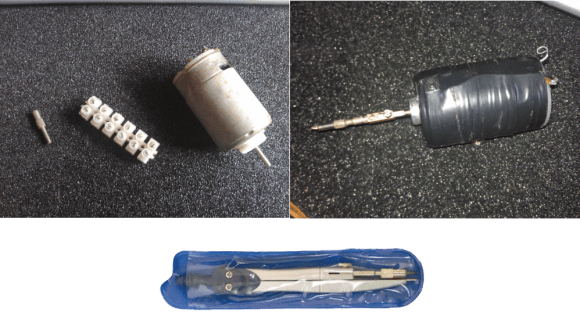
That’s not a prison tattoo gun up there, it’s [Szabolcs] DIY mini drill. Hackaday has been on a bit of a DIY tool kick lately – with improvised saws, grinders, and grinders converted to saws, among other things. We haven’t had any DIY drills yet, though. [Szabolcs] needed a drill for his home-made printed circuit boards. Usually a Dremel or similar rotary tool is pressed into service for drilling PCBs. However, for some reason he didn’t have access to one. [Szabolcs] called upon his inner MacGyver and built a drill from parts he had on hand.

Every drill needs a chuck, or at least a collet holder. This drill’s chuck is sourced from a drafting compass. Long ago in the dark ages before CAD, mechanical drawings were manually drawn up. Companies employed entire drafting departments to draw designs, blueprints, and schematics. These draftsmen used the compass to create accurate circles and arcs. [Szabolcs] re-used the lead holder from the compass as a chuck for his drill. A 540 or 550 brushed sealed endbell can motor, common to the R/C cars spins the drill up. We originally thought [Szabolcs] used an Erector or Meccano set piece as a shaft coupling. The truth is it’s the internals of a Euro style terminal strip. A small tactile button is used to activate the motor. Some electrical tape wrapped around the motor holds the button in place. The tape also makes sure that the user isn’t cut by the sheet metal field ring wrapped around the can. Power for the system can come from just about anywhere, though [Szabolcs] says he uses the 12v rail of an old ATX power supply.

Temperature Controller Gets Open Source Firmware Upgrade

stc1000

Beer lovers rejoice! [Mats] has reverse engineered a temperature controller and written new open source firmware for it. This effectively gives all us homebrewers a low cost, open source software driven controller. The STC-1000 is a cheap (under $20 USD) temperature controller mass-produced in the far east. The controllers do work, but have several limitations. The programming options are somewhat limited to basic set points for heat and cool. The controller also is only programmed for temperature display in Celsius, which is a bit of an annoyance for those of us who think in Fahrenheit. Under the hood, the STC-1000 utilizes a Microchip PIC16F1828 microcontroller. Unfortunately the PIC’s protection bits were set, so the original code would have been extremely difficult to extract. Not a problem, as [Mats] reverse engineered the hardware and wrote his own firmware. A 10k NTC thermister acts as the temperature probe. The probe is read by the PIC’s ADC. These probes are not very linear, so a look up table is used to convert from volts to degrees Celsius or Fahrenheit.

[Mats] new firmware allows for up to 6 profiles. Each profile has up to 10 set points and a time duration to hold each of the set points. Hysteresis and temperature offset values are also programmable via the front panel. PIC software is often written in C using Microchip’s MPLAB tool chain, and programmed with the PICkit 3 In Circuit Serial Programming (ICSP) tool. [Mats] decided to buck the system and wrote his C code using Small Device C Compiler. To keep things simple for homebrewers who may not have Microchip tools, [Mats] used an Arduino Uno for flashing duties. Thankfully the unholy matrimony of a PIC and an AVR has not yet caused a rift in time and space. The firmware is still very much in the beta stage, so if you want to help out, join the discussion on the homebrew talk forum. If you see [Mats] tell him we owe him a Haduino which he can use to almost open his beer.

[Thanks for the tip Parker!]