Woodhouse Controls Your House, Avoids Danger Zone

woodhouse

[Pat] may not be the world’s most dangerous secret agent, but he does have Woodhouse taking care of his home. [Pat] has been upgrading his sonic screwdriver home automation system these past few months. Waking up to a chilly room led him to start hacking a thermostat interface. [Pat] found that his furnace only needed one 24VAC wire to be shorted to a common during a call for heat. [Pat] was lucky in that his thermostat was low voltage. While researching a thermostat hack, we made the painful discovery that our thermostat is 120VAC, so watch for that if you try this one at home.

[Pat] connected his thermostat leads to a relay controlled by a Raspberry Pi. The Pi would read a temperature sensor and set the relay accordingly. That was fine for a quick hack, but opening an SSH window to change the temperature isn’t the most convenient thing in the world. Enter an old Asus Transformer Prime tablet. [Pat] coded up an Android Holo style interface using AJAX along with HTML/CSS/jQuery and PHP. OpenMic+ constantly listens for voice commands, and fires them off to Tasker tasks as needed. He calls the results Woodhouse, and the interface is very slick. The tablet controls and graphs temperature, [Pat’s] media center, and his lights. Woodhouse is even [Pat’s] right hand man when getting ready for those intimate moments. We can’t wait to see what [Pat] comes up with next.

Continue reading “Woodhouse Controls Your House, Avoids Danger Zone”

RFID Jacket Flashes The Crowd At Make Fashion 2014

RFID-DRESS

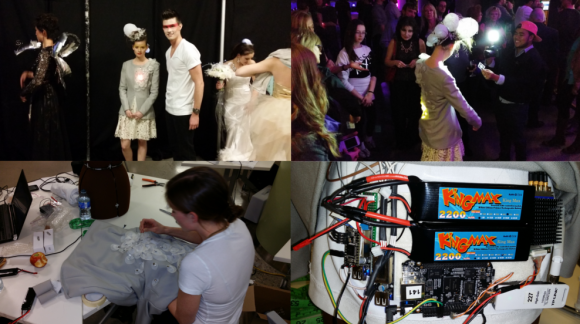
The [RADLab team] has created an eye-opening RFID jacket for Make Fashion 2014. For this project, [Dan Damron, Chris Zaal, and Ben Reed] of RADLab teamed up with designer [Laura Dempsey] to create a jacket which responded both to a dancer on the runway and the audience itself. RADLab stands for Radio Frequency Identification Application Development Lab, so you can probably guess that RFID was their weapon of choice for interaction. We’ve got a bit of RFID experience here at Hackaday, having recently used it at The Gathering in LA. The [RADLab team] didn’t skimp on processing power for this jacket. A BeagleBone Black running Debian controls the show. The BeagleBone receives data from a Thingmagic M6e 4 port UHF RFID Reader. The M6e is connected to 4 directional antennas. The BeagleBone responds differently depending on which RFID card is read, and which antenna reads it. With the data processed, the BeagleBone then issues commands to a teensy 3.0, which controls  WS2811 “Neopixel” addressable RGB LEDs sewn into the jacket.

During the fashion show, the jacket wearer danced with a second model who had RFID tags sewn into his t-shirt. The LED clusters on the front, back and sleeves of the jacket would light up, and change color and flash frequency based upon which tag and antenna got a read. Once the performance was over, the audience was encouraged to pick up tags and interact with the jacket themselves. The software was still very much beta, so the [RADLab team] monitored everything via WiFi and restarted the software when necessary.

Continue reading “RFID Jacket Flashes The Crowd At Make Fashion 2014”

Atomic Powered Robots And Records Played With Optics

mike

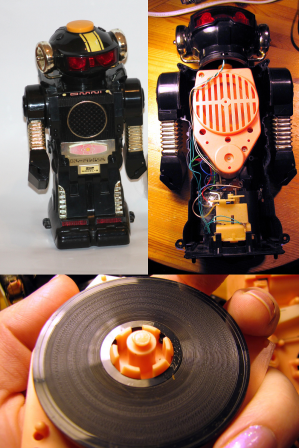
If you were a child of the 80’s or early 90’s you probably remember Magic Mike. He went by many names, but he always said the same thing “I am the atomic powered robot. Please give my best wishes to everybody!” [Oona’s] version of Mike had been malfunctioning for a few years. He’d stopped talking! She decided he needed more input, so she disassembled Mike to reveal the flesh colored plastic box in the center of his chest. This talkbox was used as a sound module in several toys. Before the days of cheap digital playback devices, sounds were recorded in a decidedly analog fashion. [Oona] found that Mike’s voice and sound effects were recorded on a tiny phonograph record in his chest. The phonograph was spun up by an electric motor, but the playback and amplification system was all mechanical, consisting of a needle coupled to a small plastic loudspeaker. The system was very similar to the early phonograph designs.

Mike’s record contained two interwoven spiral tracks. Interwoven tracks is a technique that has been used before, albeit rarely on commercial albums. One track contained Mike’s voice, the other the sound of his laser gun. The track to be played would be chosen at random depending upon where the needle and record stopped after the previous play. The record completely sidetracked [Oona’s] repair work. She decided to try to read the record optically. She started with a high resolution image (image link) of the record, and wrote some Perl code to interpolate a spiral around the grooves. The result was rather noisy, and contained quite a bit of crosstalk. [Oona] tried again with laser illumination using a Lego train set. Unfortunately the Lego train / laser system wasn’t smooth enough to get a good image. In the end she used a bit of Gimp magic and was able to pull better audio from her original image. We never did find out if she put poor Mike back together though.

Continue reading “Atomic Powered Robots And Records Played With Optics”

Design Your Own Processor With Verilog

Intel-sandy

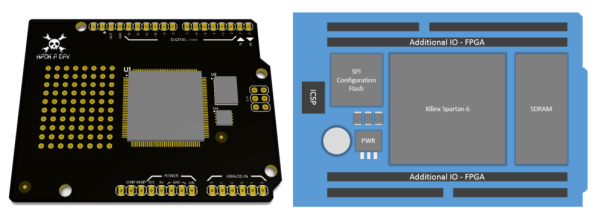
Designing a computer from scratch is one of the holy grails of hardware design. For programmable logic, designing your own processor is a huge accomplishment. That’s exactly what [zhemao] has done. He created EZ8, an 8 bit processor is written in Verilog. EZ8 has a 3 stage pipeline, which makes design very interesting. Instruction set pipelines have been used in processors for many years. They speed up operation by allowing the processor to execute more than one instruction in parallel. The idea is similar to washing, drying and folding laundry. Most people pipeline their laundry. One load is in the washer, another in the dryer, and a third is being folded. Pipelines aren’t a free lunch though – there are hazards. If one instruction requires the result of an instruction which is still being executed in parallel, there’s a problem. In our laundry analogy this would be like having one sock on the folding table while its mate is still in the dryer. The folding operation must wait for the drying operation to complete before the socks can be paired. This is exactly how assemblers handle the situation – they insert NOPs between known hazard instructions.

[zhemao] didn’t just give us a processor and no support though. He also included an assembler written in OCaml, and an emulator written in C. Several test assembly programs are also up on [zhemao’s] github repo  to verify operation. [zhemao] has tested his processor with Altera Cyclone 5 series FPGAs, but it should be possible to port it to other FPGA manufacturers. If you want more information, [zhemao] also has a discussion going on in the ECE subreddit.

[Thanks for the tip LongHornEngineer!]

[Image courtesy of intel]

Raspberry Pi GPU Goes Open Source! $10,000 Bounty For Quake 3

raspberrypi_logo

One of the thorns in the side of the Raspberry Pi crowd has been the closed source GPU. Today that all changes. [Eben Upton] reports that Broadcom is opening the source to the VideoCore® IV 3D graphics subsystem. In Broadcom’s own words:

The VideoCore driver stack, which includes a complete standards-compliant compiler for the OpenGL® ES Shading Language, is provided under a 3-clause BSD license; the source release is accompanied by complete register-level documentation for the graphics engine

Full documentation is available on Broadcom’s support site. To celebrate this, The Raspberry Pi Foundation is offering $10,000 to the first person to run Quake III at a playable frame rate on Raspberry Pi with open source drivers. The competition is worldwide. Full rules available here.

This release doesn’t cover everything, as there are still parts of the Pi’s BCM2835 which are hiding behind the blob files. However, it is a very big step for open source. Congrats to the Raspberry Pi Team, and good luck to all the entrants.

Computers Playing Flappy Bird. Skynet Imminent. Humans Flapping Arms.

flappy-double

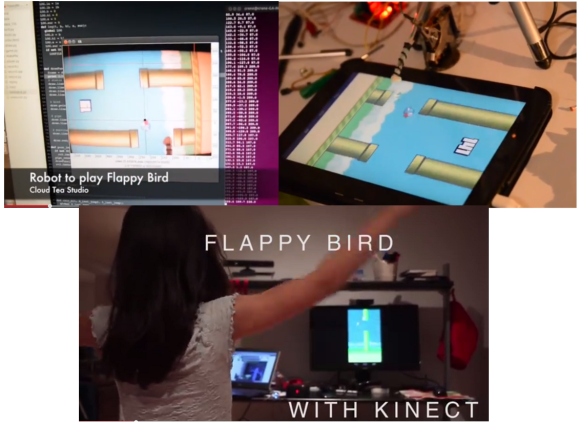
After viral popularity, developer rage quits, and crazy eBay auctions, the world at large is just about done with Flappy Bird. Here at Hackaday, we can’t let it go without showcasing two more hacks. The first is the one that we’ve all been waiting for: a robot that will play the damn game for us. Your eyes don’t deceive you in that title image. The Flappy Bird bot is up to 147 points and going strong. [Shi Xuekun] and [Liu Yang], two hackers from China, have taken full responsibility for this hack. They used OpenCV with a webcam on Ubuntu to determine the position of both the bird and the pipes. Once positions are known, the computer calculates the next move. When it’s time to flap, a signal is sent to an Arduino Mega 2560. The genius of this hack is the actuator. Most servos or motors would have been too slow for this application. [Shi] and [Liu] used the Arduino and a motor driver to activate a hard drive voice coil. The voice coil was fast enough to touch the screen at exactly the right time, but not so powerful as to smash their tablet.

If you would like to make flapping a bit more of a physical affair, [Jérémie] created Flappy Bird with Kinect. He wrote a quick Processing sketch which uses the Microsoft Kinect to look for humans flapping their arms. If flapping is detected, a command is sent to an Android tablet. [Jérémie] initially wanted to use Android Debug Bridge (ADB) to send the touch commands, but found it was too laggy for this sort of hardcore gaming. The workaround is to use a serial connected Arduino as a mouse. The Processing sketch sends a ‘#’ to the Arduino via serial. The Arduino then sends a mouse click to the computer, which is running  hidclient.  Hidclient finally sends Bluetooth mouse clicks to the tablet. Admittedly, this is a bit of a Rube Goldberg approach, but it does add an Arduino to a Flappy Bird hack, which we think is a perfect pairing.

Continue reading “Computers Playing Flappy Bird. Skynet Imminent. Humans Flapping Arms.”

Sparkfun’s AVC 2014: Robots, Copters, And Red Balloons Of Death, Oh My!

SparkFunAVC2014

Registration is open for Sparkfun’s 2014 Autonomous Vehicle Competition (AVC)! Every year the fine folks at Sparkfun invite people to bring their robots, rovers, and drones  to Colorado to see who is the king of the hill – or reservoir as the case may be. We see plenty of robots here at Hackaday, but precious few of them are autonomous. To us that means capable of completing complex tasks without human intervention. Sparkfun has spent the last five years working toward changing that. Each year the robots get more complex and complete increasingly difficult tasks.

The competition is essentially a race through the Boulder reservoir. Time is key, though there are multiple ways to gain bonus points. For aerial vehicles there are two classes: fixed and rotary wing. Planes fall under the fixed wing category. Helicopters, gyrocopters, tricopters, quadcopters, and beyond fall into rotary wing. We’re holding out hope that e-volo shows up with their Octadecacopter. Ground vehicles have a few more class options. Micro/PBR class is for robots with a build cost less than $350 total, or small enough to fit into box that’s 10″x6″x4″. The doping class is unlimited. Sparkfun even mentions costs over $1kUSD+, and weights over 25LBS. Non-Traditional Locomotion class is for walkers, WildCats and the like. Peloton is Sparkfun’s class for robots that don’t fit into the other classes.

Sparkfun is also making a few changes to the course this year. A white chalk line will be drawn through the course, so robots don’t have to rely on GPS alone for navigation. We’re hoping to see at least a few vision systems using that chalk line. Aerial robots will have to contend with three “Red Balloons of Death”. Robots can navigate around the balloons without penalty. The balloons can be bumped or even popped for bonus points, but the robot must do this with its own body. Projectile weapons are not allowed. To say we’re excited about the AVC would be an understatement. As much as we enjoy watching the big players at competitions like the DARPA Robotics Challenge, we love seeing individuals and small teams of hobbyists compete every year at the AVC. Click on past the break for Sparkfun’s AVC 2013 wrap up video.

Continue reading “Sparkfun’s AVC 2014: Robots, Copters, And Red Balloons Of Death, Oh My!”