Hackaday Links Column Banner

Hackaday Links: October 1, 2017

Remember when you first saw a USB port in a standard wall outlet? It was a really great idea at the time, but how’s that 500mA charge holding up now? Fresh from a random press release, here’s a USB 3.0 wall outlet, with USB A and C ports. 5A @ 5V. Future proof for at least several years, I guess.

This is what you call ‘pucker factor’. An Air France A380 traveling from CDG to LAX suffered an uncontained engine failure somewhere over Greenland. Everyone on board is fine, except for the fact they had to spend the night in Goose Bay, Canada. Want the best Twitter/YouTube account of being a passenger? Here you go. Want to know why it landed in Goose Bay? This video is about ETOPS which really doesn’t apply in this instance but it’s a sufficient introduction to diverting airplanes after engine failures.

There are mysterious pylons going up alongside bridges and tunnels in NYC (auto-playing video). No one knows what they are, and the transportation board for New York is hiding behind a cloud of secrecy. We do know there are ‘fiber optics necessary for Homeland Security items’ inside, so place your bets. It’s facial recognition, or at the very least license plate readers. You know, exactly what New York and dozens of other cities have been doing for years.

Did somebody lose a balloon? A Raspberry Pi high-altitude balloon was found on the beach in south-west Denmark.

[Peter] is building an ultralight in his basement. We’ve covered the first part of the build, and we’ve been keeping tabs on him with semi-weekly updates. Now he’s fiberglassed the fuselage and started construction of the wings. Updates of note this week: he’s found a shop with an 8-foot CNC hot wire cutter for the wings. That really cuts down on the build time and it’s actually pretty cheap. One interesting part of this build is a ‘landing gear ejection system’, or a spring thing that allows the landing gear to fall away with the tug of a wire. Why would anyone want a landing gear ejection system? In case he needs to land in a soybean field. A flat bottom means a smoother and more survivable landing. If anyone is still concerned about [Peter]’s safety, this is a put up or shut up situation. Pitch in ten bucks for a parachute if you’re so concerned.

Hoverbike Kalashnikov! What? It’s a guy’s name. No big deal.

Open Hardware Summit is this week in Denver. What will be the highlights of the event? Well, last year, OSHWA announced the creation of an Open Hardware license. This is an all-encompassing license for Open Source Hardware that’s trying to solve some very, very hard problems. Copyright doesn’t work with hardware (except for boat hulls) like it does with software, and this Open Hardware license is the best we’ve got going for us. We’re going to get an update on how well this license is propagating. Also on deck for Summit attendees is a field trip to Sparkfun and Lulzbot. Want to see the world’s second largest 3D printer bot farm? It’ll be awesome.


Enresoning An IPhone 8 Ring

The iPhone 8 was just released last week, and that means some people were standing in line in front of an Apple store for hours waiting to get their hands on the latest and greatest glowing rectangle. [Patrick Adair] had a better idea: he would stand in front of an Apple store for four hours, then do something productive with his new smartphone. With the help of a waterjet, some resin, a lathe, and some very fine grades of sandpaper, he created the Apple Ring.

Setting aside the whole process of actually acquiring an iPhone 8 on launch day, the process of turning an iPhone into a ring is more or less what you would expect. First, the iPhone was cut into ring-shaped pieces on a waterjet cutter. Special care was taken to avoid the battery, and in the end [Patrick] was able to get a nice chunk ‘o phone that included the camera lens.

This ring piece was then embedded in clear resin. For this, [Patrick] used Alumilite epoxy, a pressure pot, and a toaster oven to cure the resin. Once the phone parts were firmly encased for the rest of eternity, the ring blank moved over to the lathe. The center of the ring was bored out, and the process of sanding, polishing and gluing in all the tiny parts that fell out during the process commenced. The end result actually looks pretty great, and even though it’s probably a little too bulky, it is a remarkable demonstration of the craft of turning.

You can check out [Patrick]’s video below, along with a video from the Waterjet Channel showing the deconstruction of a glowing rectangle.

Continue reading “Enresoning An IPhone 8 Ring”

Friday Hack Chat: All About LED Design

There are three great enabling technologies of the last twenty years. The first is lithium batteries that hold a lot of juice. Quadcopters wouldn’t exist without them, and the Tesla Model S wouldn’t either. The second is crazy powerful brushless motors. Here, again, quads wouldn’t exist without them, but we’re also getting smaller, torquier, and more powerful motion platforms.

The third great enabling technology in recent memory is LEDs. Remember when the PlayStation 2 came out, and everyone was amazed by the blue LED? That blue LED won a Nobel Prize. Now, we have LED light bulbs, LEDs in any color of the rainbow, powerful UV LEDs, and bazillion candela flashlights. LEDs are awesome.

For this week’s Hack Chat, we’re going to be talking all about LEDs. Everything from strips to rings, discrete to waterproof, COBs, weird colors, and everything in between. If you’re looking to replace your workshop lighting with LEDs, this is the Hack Chat for you. If you’ve ever wondered about the quality of LEDs, and the price-performance ratio, this is for you. This is all about blinky bling.

Our guest for this week’s Hack Chat will be [Metalnat], founder of the Burbank MakerSpace, a recent resident of the Supplyframe DesignLab where he designed a VR controller, and worked on Crane, a flapping automaton that glided over the playa at this year’s Burning Man. During this Hack Chat, we’ll be talking about LEDs, including installation methods, types of LEDs, suppliers, and LED manufacturing methods.

This is a Hack Chat, so we’re taking questions from the audience. Here’s a spreadsheet we’ll be using to guide the discussion.

Here’s How To Take Part:

join-hack-chatOur Hack Chats are live community events on the Hackaday.io Hack Chat group messaging. This Hack Chat will be going down noon, Pacific time on Friday, September 29th. Sidereal and solar getting you down? Wondering when noon is this month? Not a problem: here’s a handy countdown timer!

Click that speech bubble to the right, and you’ll be taken directly to the Hack Chat group on Hackaday.io.

You don’t have to wait until Friday; join whenever you want and you can see what the community is talking about.

Laser Smoothies At Maker Faire

This year at Maker Faire, laser cutters were all the rage. Dremel announced a 40W laser cutter, but it won’t be available for purchase until this time next year, there is no price yet, and therefore doesn’t deserve further mention. Glowforge was out in full force, but the most interesting aspect of the Glowforge — a compact filter system that sits right underneath the laser — was not to be found. It looks like lasers are the next 3D printer.

Of course, those in the know have already been using laser cutters for years, and there are options for desktop CO2 laser cutters that cost less than a kilobuck. I speak, of course, of the ubiquitous K40 laser, a machine you can get off of eBay or AliExpress for the price of a generic, off-brand 3D printer. There is a downside to the K40, though: the control electronics and software are notoriously terrible. Fix that, though, and you have something really spectacular.

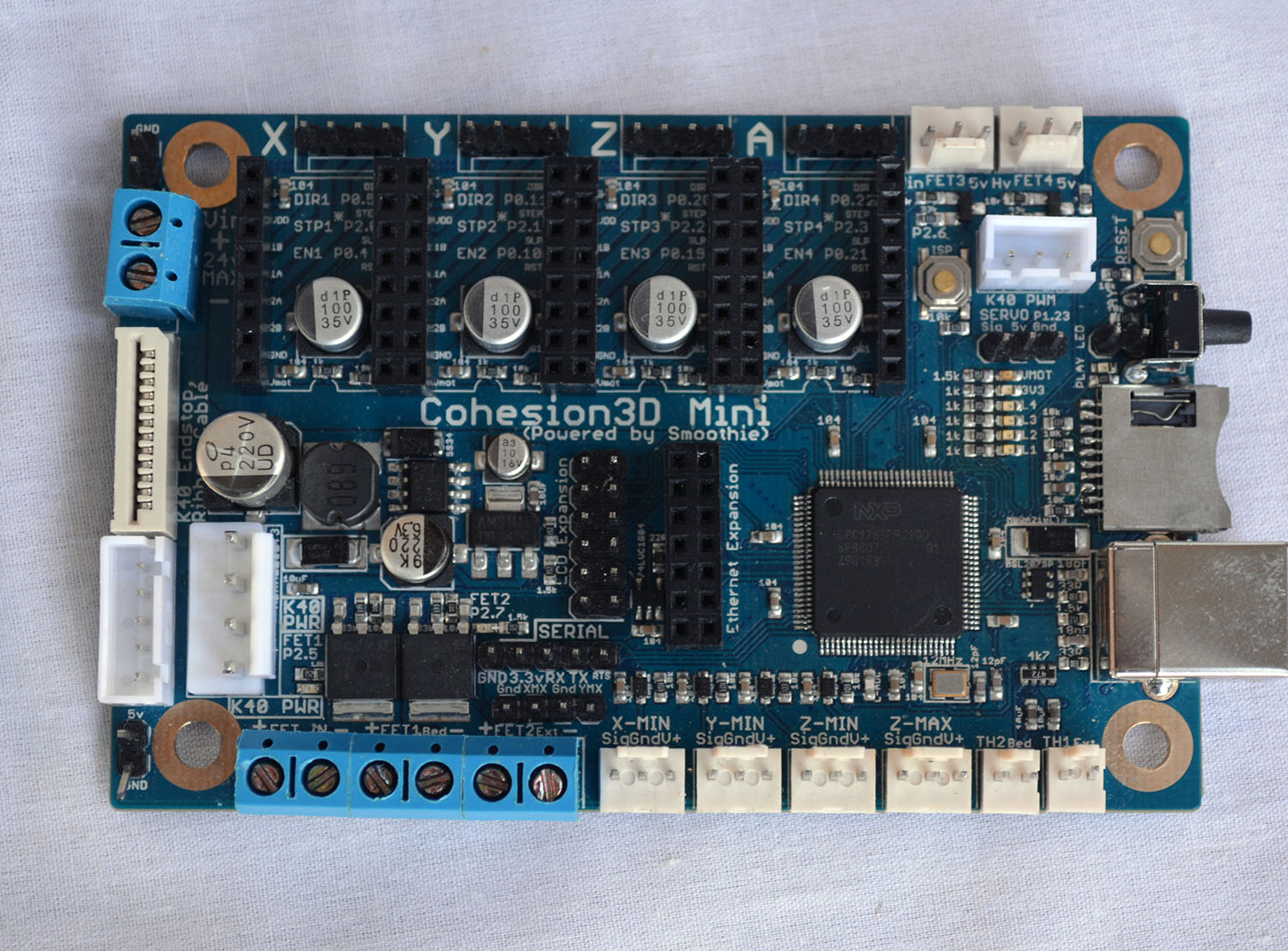
The Cohesion3D Mini

This year at Maker Faire, [Ray Kholodovsky] of Cohesion3D brought out his Smoothie-derived control boards for CNC machines and laser cutters. Of note is his K40 upgrade that turns the eBay special laser cutter into a 32-bit professional machine. This is the cheapest way to start lasing in your workshop.

We saw [Ray] at the Faire last year when he was demoing his Smoothie-derived boards for 3D printers and CNC machines. These are tiny, relatively low-cost boards that use Smoothieware, an Open Source, 32-bit CNC control system that is extremely extensible and very powerful. Basically, if you’re building a normal, ordinary DIY 3D printer, a RAMPS or RAMBO will do. If you’re doing something weird, like a 3D printer with strange kinematics, a 5-axis milling machine, or you’d like awesome engraving on a laser cutter, Smoothie is the way to go.

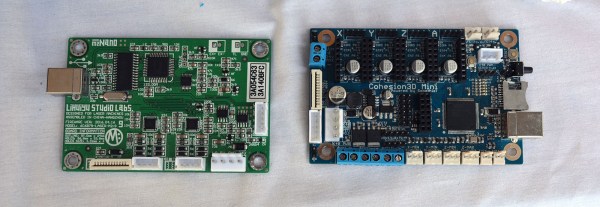
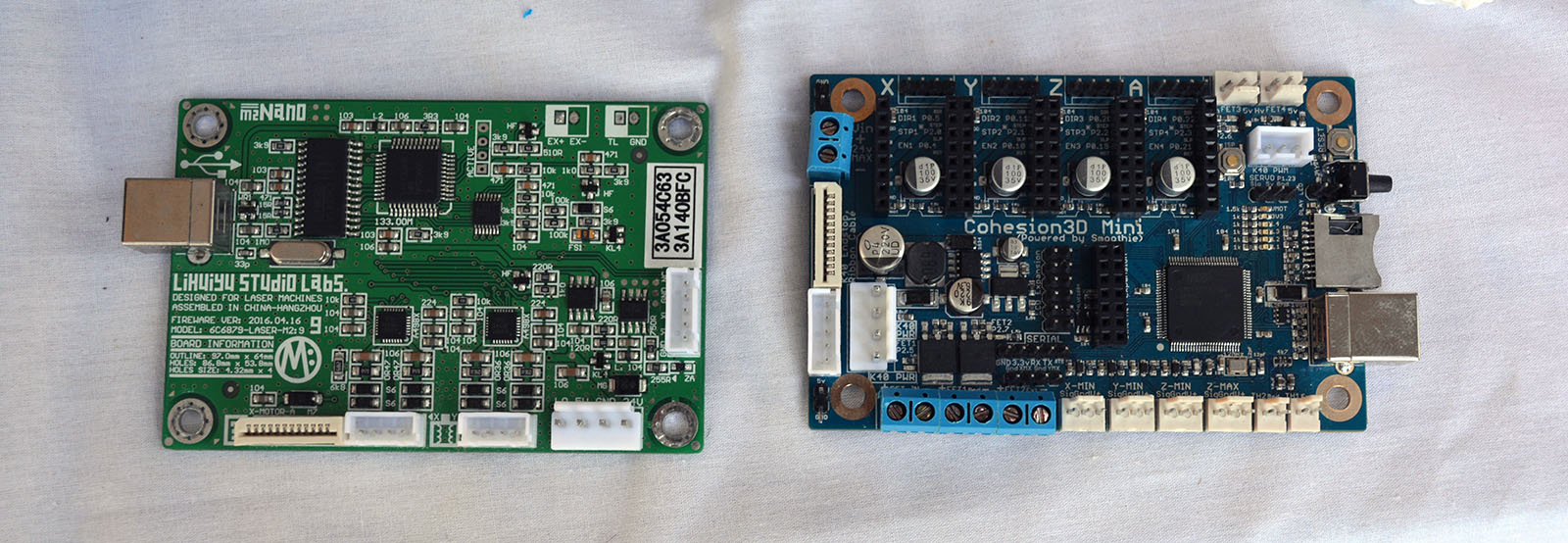
The stock board found in a K40 (left) and the Cohesion3D Mini (right). The Cohesion3D Mini is a drop-in replacement for the stock K40 board.

The Cohesion3D board is a direct, drop-in replacement for the control board found in the K40 laser. Since all of the K40 laser cutters are the same, and they’re really only a power supply and a CNC gantry, this is the one-stop-shop of K40 upgrades. The terrible electronics are gone, you don’t have to use Corel, and for a hundred bucks, you have something resembling a professional laser cutter.

The K40 laser has been around for several years now, but only recently have a few very interesting hacks and mods come out that push this blue light special laser cutter into semi-professional territory for people willing to get their hands dirty. A few months ago [Scorch] published K40 Whisperer, a piece of software that makes the stock electronics tolerable and able to accept normal SVGs and DXFs. The K40 has also been modified for a larger bed, and LaserWeb has been handling the software side of things for about two years now. Things are looking great for the K40 hacking scene, and Hackaday already has a, ‘I just bought a K40, now what?’ series in the works. Things are looking up for cheap laser cutters, and a Smoothie upgrade is just the cherry on top.

Hackaday Links Column Banner

Hackaday Links: September 24, 2017

This is it. After twelve years we finally have a new Star Trek. Star Trek: Discovery (we’re using ST:DSC as the abbreviation) is airing right about when this post goes up. Next week, you’ll have to pay CBS $6USD a month to get your Star Trek fix, and today might be the last time a new episode of Star Trek is aired on broadcast TV ever. Enjoy it now, and hope the theme song doesn’t have lyrics. Also, hope The Orville is a tenth as good as a Galaxy Quest series could be.

What’s the best way to describe Delta Sigma PLLs? The Cat In The Hat (PDF, page 31). [Dr. Tune] found a Seuss reference in a TI app note. Personally, I’m a fan of hand-drawn cartoons, but we’ll take what we can get.

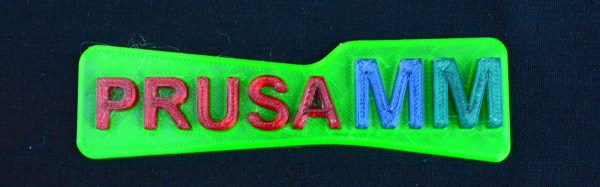
This weekend the Prusa I3 MK3 was announced. A good printer just got better. Now here’s the video.

The Raspberry Pi is a great media storage device, but it’s absolutely insufficient for audiophile tomfoolery. Here’s a neat Pi DAC/amp/DSP thingy. The VoltaStream turns the Raspberry Pi into a WiFi-connected pair of speakers with low-latency audio in and a TOSLINK connector.

SpaceX! There is serious consideration being given to starting an ‘Elon Musk column’ here on Hackaday. There will be SpaceX updates coming this week from the International Astronautical Congress in Adelaide. What will we find out? I don’t know bruh, but I just got back from Burning Man and I realized it was a whole lot like Mars and I was wondering Elon, like, have you ever been to Burning Man because it’s really dusty and a whole lot like Mars and there’s not much water… Please, organizers of the IAC, I implore you: give more idiots microphones. That was hilarious.

How was the World Maker Faire in New York this weekend? In one word, empty. Abnormally so. Maker Faire was not as crowded as last year, and you could actually move around. My agoraphobia didn’t kick in until the afterparties, and lines for the $5 bottles of water were short. Bay Area Faire attendance was down 16% from 2016-2017, and I would bet attendance for the NY Faire would be down a similar amount. Even a 10% decline in attendance would be noteworthy; the weather last year was cold and rainy and this year was beautiful. There are rumors, speculation, and people wondering how long Maker Faire will continue, but except for Intel pulling out of the maker market, no actual information. Millennials are killing the Maker Faire industry?

Hackaday Prize Entry: Infrared Vein Illumination

Phlebotomy is a fun word, and the fine art of finding veins. While the skill of putting needles in arms is honed by nurses and physicians over the course of decades, there are, of course, technological solutions to finding veins. One of the more impressive medical devices that does this uses near-infrared imaging — basically looking under the skin with almost visible light. These devices cost a fortune.

One project in the Hackaday Prize is looking to change that. It’s a near-infrared vein finder. Instead of the thousands of dollars professional unit costs, this one can be built for under one hundred bucks.

As far as this build goes, veins are illuminated via IR light at about 950nm. The backscatter of this light is captured via a Raspberry Pi NoIR camera, with regular old photography film blocking visible light. From there, it’s just a simple matter of image processing and hitting enhance several times until veins appear on a display.

The team behind this project has already developed a mobile version of the device, complete with 3D printed parts. It’s a handy device and a great entry for the Hackaday Prize.

3D Printing At Maker Faire

The current trend of cheap, desktop, consumer 3D printers arguably began at the World Maker Faire in New York several years ago. What began with just a single printer exploded into a mindless proliferation of extrusion boxes, and by 2012, every single booth had to have a 3D printer on display no matter how applicable a CNC machine was to what they were actually selling.

Now we’re in the doldrums of the hype cycle and 3D printers just aren’t cool anymore. This year at the World Maker Faire, 3D printers were relegated to a tiny corner of the faire, right next to the portajohns. It’s the smallest showing of 3D printing I’ve ever seen at the New York Maker Faire.

Of course, this doesn’t mean the state of 3D printing isn’t constantly improving. 3D printers have never been cheaper, more capable, or more popular. This is how technology works, really: it doesn’t get good until it gets boring. Still, there were some impressive displays of the current state of 3D printing at the World Maker Faire this weekend. You can check that out below.

Continue reading “3D Printing At Maker Faire”