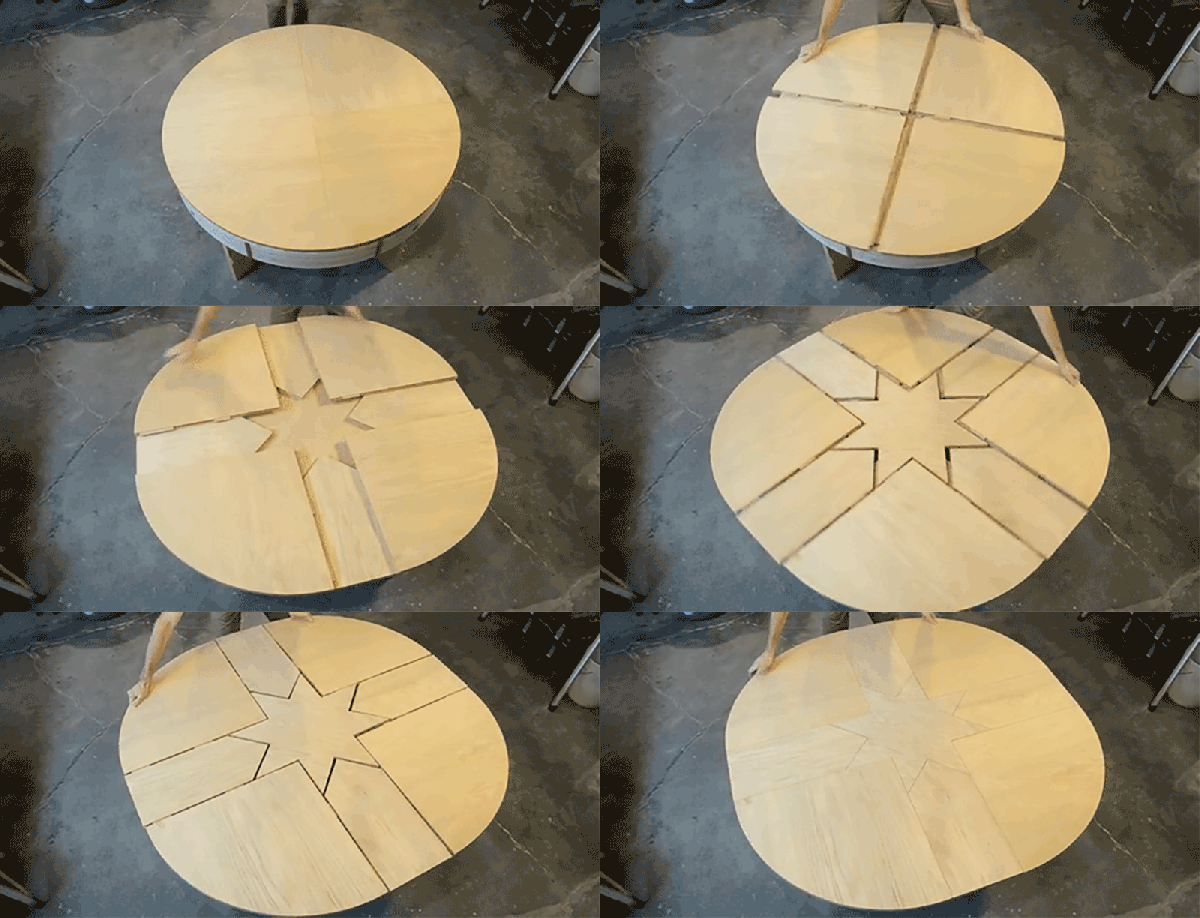
A Better Expanding Table

About a year ago, [Scott] completed what is probably one of the finest builds ever shown on a YouTube channel. It was an expanding wooden table, a build inspired by a fantastically expensive expanding table that was itself inspired by a creation by a mad woodworker in the early 1800s. Although [Scott]’s table is a very well-engineered build, there were a few things he wasn’t happy with. Over the past few months he’s been refining the design and has come up with the final iteration – and plans – for a wooden mechanical expanding table.

Late last year, [Scott] had about 450 hours of design and build time in his table, and by the time he got to the proof of concept stage, he simply ran out of steam. Another year brings renewed enthusiasm, and over the past month or so he’s been working on much-needed improvements to his expanding table that included a skirt for the side of the table, and improvements to the mechanics.

The expanding table is rather thick with three layers of tabletop stacked on top of each other, and those exposed mechanical linkages should be hidden. This means a skirt, and that requires a huge wooden ring. [Scott] built a ring 5 1/2″ deep, about an inch and a half thick, and has the same diameter of the table itself. This means cutting up a lot of plywood, and stacking, gluing, sanding, and routing the entire thing into a perfectly round shape.

The other upgrades were really about the fit and finish of the internal mechanics of the table. Screws were changed out, additional brackets were crafted, and the mounts for the internal ‘star’ was upgraded.

After all that work, is the table done? No, not quite; the skirt could use a veneer, proper legs need to be built, and the entire thing could use a finish. Still, this is the most complete homebuilt expanding table ever conceived, and [Scott] has the plans for his table available for anyone who would want to replicate his work.


Continue reading “A Better Expanding Table”

23 Superconference Talks You Shouldn’t Miss

November marked our inaugural Hackaday Superconference, something we’ve been wanting to do for a very long time. Hackaday already has a massive and vibrant online community, but until now, we haven’t asked people to come together for a hardware conference that spans a full weekend. The Supercon is Hackaday incarnate, and hundreds of very cool people showed up for a few dozen talks, amazing workshops, and a lot more.

Over the past month, we’ve been putting together a compilation of everything that happened at the first Hackaday Superconference. This includes videos of all the talks, relevant asides, and posts for everything that happened over a two-day conference. Even if you couldn’t make it out to our first con, this great material that should be shared by all.

Below is a YouTube playlist of all the talks. If you’re looking for eight hours to kill over the holiday weekend, well, there you have it. After the break is the complete conference indexed by day and speaker, with links to the talk and accompanying Hackaday post.

We’d like to thank everyone who came out to the first Hackaday Supercon, with a huge shout-out to the speakers, workshop organizers, and volunteers. It couldn’t have happened without the full support of the Hackaday community. That’s good, because we’re going to be doing this again next year.

Continue reading “23 Superconference Talks You Shouldn’t Miss”

Nick Sayer: Making 10ⁿ Isn’t The Same As Building One

Building one of something is tremendously easy. If you’re making one of something, you can cover the insides with hot glue, keep everything held together with duct tape, and mess around with it enough that it mostly works most of the time. Building more than one of something is another matter entirely. This is the thought behind DFM, or Design For Manufacturing. [Nick Sayer] is an experienced seller on Tindie and he’s put together enough kits to learn the ins and outs, rights and wrongs of building not one, but an inventory of things. Check out this last talk of the 2015 Hackaday SuperConference, then join us below for a bit more on the subject.

Continue reading “Nick Sayer: Making 10ⁿ Isn’t The Same As Building One”

The Hackaday 2015 Omnibus: A Puzzle So Dense, Even We Don’t Know The Answer

Print is dead, so we put a skull on it. That’s the philosophy behind the 2015 Hackaday Omnibus, the printed collection of the best Hackaday has to offer.

We have a few ideas of where we would like to take the print edition of Hackaday. Mad magazine-style fold-ins are on the list, specifically a fold-in style schematic that does two completely different things. Remember when records were included as a magazine insert? Those are called flexi-discs, and there’s exactly one company that still does it. All of these and more are plans for the future, and for the 2015 Hackaday Omnibus, we chose to include something we’re all very familiar with: a puzzle. This is no ordinary puzzle – even we don’t know what the solution is.

EOT ACK BS
The first clue on the front cover of the 2015 Omnibus

Continue reading “The Hackaday 2015 Omnibus: A Puzzle So Dense, Even We Don’t Know The Answer”

The ESP32 Beta Units Arrive

A little more than a year ago, the ESP8266 WiFi module showed up uneventfully in Seeed Studio’s store. Since then, the documentation has been translated to English, a proper development environment for this chip was created, and everybody is using this cheap but powerful chip for the latest Internet of Things things.

The company behind the ESP8266, Espressif, is not one to rest on their laurels, and for several months they’ve been working on the next generation of powerful WiFi-enabled tiny, cheap systems. They have their silicon, and already 200 lucky people have their hands on the very first test units of the ESP32, the next generation of Espressif’s WiFi chips. The teardowns have begun, and [LadyAda] streamed her initial experiments with the chip to the Intertubes (available below). [Martin] is also one of the guys who received these early beta chips, and he was kind enough to post his thoughts on Espressif’s newest chip.

A little bit of information on the ESP32 has dribbled out, and [LadyAda] and [Martin]’s demo unit confirm all we’ve suspected. There are two Tensilica L108 processors running at up to 160MHz, a lot of peripherals including ADCs, DACs, I2C, SPI, I2S, and PWM, more RAM, AES and SSL for security, and Bluetooth Low Energy. WiFi has also been upgraded, and the ESP32 will support speeds up to 150 Mbps.

Continue reading “The ESP32 Beta Units Arrive”

The Scientific Implausibility Of Starkiller Base

This post contains spoilers for Star Wars: The Force Awakens. These spoilers won’t affect you if you haven’t seen the movie; they’re equivalent to saying, “in A New Hope there’s a moon sized battle station with a superlaser” and “someone gets a hand amputated with a lightsaber in a Star Wars movie”


A lot has happened in the Star Wars universe since the battle of Endor. The Empire is in ruins, and Yavin 5 and the forest moon of Endor both have new planetary ring systems. The Rebellion has given way to a new Galactic Republic, but there is a spectre of evil looming in the unknown areas of the galaxy: the First Order, a malevolent force that has built a planet-sized superweapon capable of destroying entire planetary systems from across the galaxy. The Starkiller gets its energy from harvesting entire suns, moving from one solar system to another to feed this massive weapon of terror.

We’ve had nearly forty years to argue the plausibility of the Death Star, lightsabers, parsecs as a unit of time, and hyperdrives. It’s time to pass the hallowed tradition of arguing over fictional spacecraft to a new generation. Starkiller Base is a cool idea, but does the science behind it hold up? No. It’s completely implausible. It makes for a great story, but it’s completely implausible.

Continue reading “The Scientific Implausibility Of Starkiller Base”

Here’s The Reason The FAA’s Drone Registration System Doesn’t Make Sense

Last week, the US Department of Transportation and FAA released their rules governing drones, model aircraft, unmanned aerial systems, and quadcopters – a rose by any other name will be regulated as such. Now that the online registration system is up and running.

The requirements for registering yourself under the FAA’s UAS registration system are simple: if you fly a model aircraft, drone, control line model, or unmanned aerial system weighing more than 250g (0.55 lb), you are compelled under threat of civil and criminal penalties to register.

This is, by far, one of the simplest rules ever promulgated by the FAA, and looking at the full text shows how complicated this rule could have been. Representatives from the Academy of Model Aircraft, the Air Line Pilots Association, the Consumer Electronics Association weighed in on what types of aircraft should be registered, how they should be registered, and even how registration should be displayed.

Considerable attention was given to the weight limit; bird strikes are an issue in aviation, and unlike drones, bird strikes have actually brought down airliners. The FAA’s own wildlife strike report says, “species with body masses < 1 kilogram (2.2 lbs) are excluded from database,”. The Academy of Model Aircraft pushed to have the minimum weight requiring registration at two pounds, citing their Park Flyer program to define what a ‘toy’ is.

Rules considering the payload carrying ability of an unmanned aerial system were considered, the inherent difference between fixed wing and rotors or quadcopters was considered, and even the ability to drop toy bombs was used in the decision-making process that would eventually put all remotely piloted craft weighing over 250g under the FAA’s jurisdiction. We must at least give the FAA credit for doing what they said they would do: regulate drones in a way that anyone standing in line at a toy store could understand. While the FAA may have crafted one of the simplest rules in the history of the administration, this rule might not actually be legal.

Continue reading “Here’s The Reason The FAA’s Drone Registration System Doesn’t Make Sense”