Giving The C64 A WiFi Modem

If there’s any indication of the Commodore 64’s longevity, it’s the number of peripherals and add-ons that are still being designed and built. Right now, you can add an SD card to a C64, a technology that was introduced sixteen years after the release of the Commodore 64. Thanks to [Leif Bloomquist], you can also add WiFi to the most cherished of the home computers.

[Leif]’s WiFi modem for the C64 is made of two major components. The first is a Microview OLED display that allows the user to add SSIDs, passwords, and configure the network over USB. The second large module is the a Roving Networks ‘WiFly’ adapter. It’s a WiFi adapter that uses the familiar Xbee pinout, making this not just a WiFi adapter for the C64, but an adapter for just about every wireless networking protocol out there.

[Leif] introduced this WiFi modem for the C64 at the World of Commodore earlier this month in Toronto. There, it garnered a lot of attention from the Commodore aficionados and one was able to do a video review of the hardware. You can check out [Alterus] loading up a BBS over Wifi in the video below.

Continue reading “Giving The C64 A WiFi Modem”

Hackaday Links: December 20, 2015

If you don’t have a Raspberry Pi Zero right now, you’re not getting one for Christmas. Who would have thought a $5 Linux computer would have been popular, huh? If you’re looking for a new microcontroller platform you can actually buy, the Arduino / Genuino 101 is available in stores. This was released a few months ago, but it still looks pretty cool: DSP, BTLE, and a six-axis sensor.

If you don’t know [David], the Swede, you should. He’s the guy that launched a glider from a high altitude balloon and is one of the biggest advocates of tricopters. Now he bought an airplane wing for his front yard. It was an old Swedish air force transport aircraft being broken up for scrap. Simply awesome.

Chocolate chips. Now that the most obvious pun is out of the way, here’s how you make DIP8 cookie cutters.

[Barb] is over at the Crash Space hackerspace in LA, and she has a YouTube channel that goes over all her creations. This week, it’s a layered wood pendant constructed out of many layers of veneer. Take note of the 3M 77 spray glue used for the lamination and the super glue used as a clear, hard finish.

Star Wars was released and we have a few people digging through the repertoire to see what [John Williams] lifted for the new movie. Here’s musical Tesla coils playing the theme for the Force.

Flickr gives you a full gigabyte of storage, but only if you upload JPEGs, GIFs, and PNGs. That doesn’t prevent you from using Flickr as your own cloud storage.

We know two things about [Hans Fouche]: he lives in South Africa and he has a gigantic 3D printer. His latest creation is an acoustic guitar. It may not sound great, but that’s the quality of the recording. It may not play great, but he can fix that with some acetone vapor. It would be very interesting to see 3D printing used in a more traditional lutherie context; this printer could easily print molds and possibly even something to bend plywood tops.

Starting in 1990, [deater] would make a yearly Christmas-themed demo on his DOS box. You can really see the progression of technology starting with ANSI art trees written in BASIC, to an EGA graphical demo written with QBASIC to the last demo in 96 made with VGA, and SoundBlaster effects written in Turbo Pascal and asm.

Printing Objects Directly From Fallout 4

Fallout 4 was released about a month ago, and although we don’t have a ‘took an arrow to the knee’ meme like Bethesda’s last game, there are ample opportunities for cosplay and printing out deathclaws and mirelurks on a 3D printer. How do you turn files hidden away in a game’s folders into a real, printed object? It’s actually pretty easy and [Angus] is here to tell you how.

The files for Fallout enemies and items can be readily accessed with the Bethesda Archive Extractor, although this won’t give you files that a 3D printer can understand. You’ll get a .NIF file, and NifSkope can convert the files found in the Fallout archives to an .OBJ file any 3D modeling program can understand. The next step from there is taking the .OBJ file into Meshmixer and fixing everything with Netfabb. After that, it’s off to the printer.

[Angus] printed his model of a Deathclaw in ABS in multiple parts, gluing them together with a little bit of acetone. This didn’t go exactly as planned; there were some contaminants in the ABS that turned into a white film on the black ABS. This was ultimately fixed with XTC-3D, the 3D print coating everyone is experimenting with.

The finished product is a solid yellow but completely smooth 3D model of one of the toughest enemies in Fallout 4. The only thing left to do is paint the model. The best way to proceed at this point is probably doing what model builders have been doing for decades – an airbrush, and hundreds of tiny bottles of paint. [Angus] is opening up his YouTube comments for suggestions, and if you have a better idea he’s looking for some help.
Continue reading “Printing Objects Directly From Fallout 4”

Antti Lukats: The Past, Present, And Future Of Programmable Logic

[Antti] has gained a bit of a reputation over on Hackaday.io – he has a tremendous number of FPGA projects on hackaday.io, and they’re all open source. If you’re looking for street cred with FPGAs, [Antti] has it. His Hands-on experience with FPGAs and CPLDs stretches back to the very first chips in the 70s. We’re so happy that he’s working to share this depth of knowledge, and that includes this talk he gave a few weeks ago at the Hackaday SuperConference. Take a look and then join us after the break for an overview of the FPGA terrain, then and now.

Continue reading “Antti Lukats: The Past, Present, And Future Of Programmable Logic”

A Tiny Servo Motor Controller

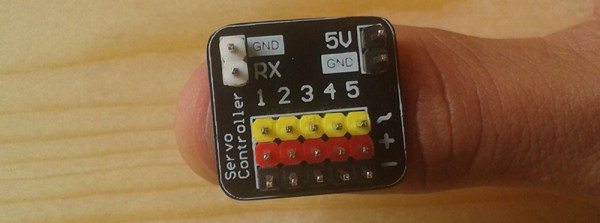
If you’re building a moving thing with a microcontroller, you’ll probably want to throw a servo controller in the mix. Driving a servo or two with a microcontroller takes away valuable cycles that just babysit the servo, making sure all the PWM signals are in sync. The thing is, most servo controllers are a massive overkill, and you don’t need that much to control a few servos over a UART. The proof of this is an attiny13 servo controller over on hackaday.io.

[arief] developed his tiny servo controller around one of the tiniest microcontrollers – the ATtiny13. This chip has just 1kB of Flash and 64 Bytes of RAM, but that’s enough to keep a few servos going and listen in to a UART for commands to drive the servo.

The construction of this servo controller board is simple enough – just a single sided board, microcontroller, and a few headers, caps, and resistors. Commands are sent to the ATtiny through a half duplex UART we covered before, with servos responding to simple serial commands.

If you’re building a robot army, this is the board to make. You’re going to need a high-powered controller to take over the world, but there’s no need to bog down that controller by babysitting a few servos.

The Most Brilliant Use Of Crowdfunding Yet: Medical Research

Since the rise of Kickstarter and Indiegogo, the world has been blessed with $100 resin-based 3D printers, Video game consoles built on Android, quadcopters that follow you around, and thousands of other projects that either haven’t lived up to expectations or simply disappeared into the ether. The idea of crowdfunding is a very powerful one: it’s the ability for thousands of people to chip in a few bucks for something they think is valuable. It’s a direct democracy for scientific funding. It’s the potential for people to pool their money, give it to someone capable, and create something really great. The reality of crowdfunding isn’t producing the best humanity has to offer. Right now, the top five crowdfunding campaigns ever are two video games, a beer cooler, a wristwatch with an e-ink screen, and something to do with Bitcoin. You will never go broke underestimating people.

[Dr. Todd Rider] wants to change this. He might have developed a way to cure nearly all viral diseases in humans, but he can’t find the funding for the research to back up his claims. He’s turned to IndieGoGo with an audacious plan: get normal people, and not NIH grants, to pay for the research.

The research [Dr. Rider] has developed is called the DRACO, the Double-stranded RNA Activated Caspase Oligomerizer. It works by relying on the singular difference between healthy cells and infected cells. Infected cells contain long chains viral double-stranded RNA. The DRACOs attach themselves to these long strands of RNA and cause those cells to commit suicide. The research behind the DRACO was published in 2011, and since then [Dr. Rider] has already received funding from more traditional sources, but right now the project is stuck in the ‘funding valley of death’. It’s easy to get funding for early research, but to get the millions of dollars for clinical trials it takes real results – showing efficacy, and proving to pharmaceutical companies or VCs that the drug will make money.

So far, results are promising, but far from the cure for HIV and the common cold the DRACO promises to be. [Dr. Rider] has performed a few tests on cell cultures and mice, and the DRACOs have been effective in combating everything from the common cold, to the flu to dengue hemorrhagic fever.

The IndieGoGo campaign is flexible funding, meaning all the money raised will go towards research even if the funding goal is not met. Right now, just over $50,000 has been raised of a $100,000 goal. That $100k goal is just the first step; [Dr. Rider] thinks he’ll need about $2 Million to test DRACOs against more viruses and hopefully show enough progress to get additional traditional funding. That $2 Million is a little less than what Solar Roadways raised, meaning no matter what [Dr. Rider] will make one important medical discovery: people are very, very, very dumb.

Continue reading “The Most Brilliant Use Of Crowdfunding Yet: Medical Research”

Mains Powered 3D Printer Heated Beds

Converting mains voltage down to 12 or 24VDC to drive a heating element makes no sense. To get 120 watts at 12 volts requires thick wires that can handle 10 amps, whereas at 120V, tiny 1A wires will do. If you’ve ever felt the MOSFET that switches your heated bed on and off, you know it’s working hard to pass that much current. [Makertum] is of the opinion this is a dumb idea. He’s creating a 110 / 230 V, mains-powered heated bed.

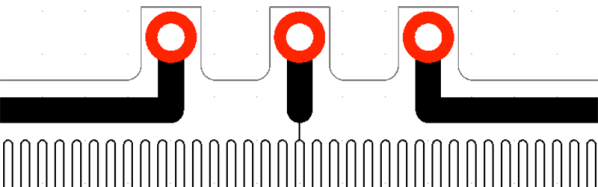
Creating a PCB heat bed isn’t an art – it’s a science. There are equations and variables to calculate, possibly some empirical measurements by measuring the resistance of a trace, but Ohm’s Law is a law for a reason. If you do things right, you can make a PCB heat bed perfectly suited for the task. You can even design in safety features like overcurrent protection and fuses. It can’t be that hard. After all, your house is full of devices that are plugged into the wall.

However, there’s a reason we use 12V and 24V heated beds – they give us, at the very least, the illusion of safety. Therefore, [Makertum] is looking for a few comments from specialists and people who know what they’re doing.

Although a mains powered heated bed sounds scary for a hobbyist-built 3D printer, there are a number of positives to the design. It would heat up faster, thin down a few parts, and significantly reduce the overall cost of the printer by not requiring another 100 Watts delivered from a 12V power supply. It’s a great idea if it doesn’t burn down the house. Anyone want to help?