An Intel Atom CPU In The Raspi Form Factor

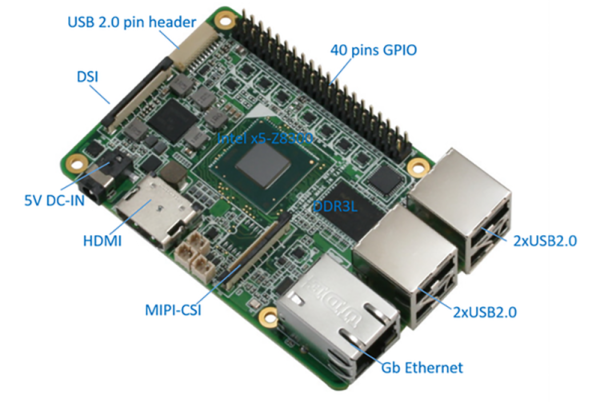
For years now, people have been trying to stuff an Intel processor on a credit card sized board. An x86 board that can fit in your pocket is an intriguing device – after all, that’s what Gumstix, the forerunner of the Raspberry Pi, were. Efforts to put x86 on a dev board have included the Minnowboard, the Intel Galileo and Edison, and even the Intel Compute Stick. These have not seen the uptake you would expect from a small x86-powered board, but that tide may soon turn. The UP board is exactly what you would expect from a Raspberry Pi-inspired board with a real Intel processor.

The feature set for the UP board is impressive for a credit card sized board; it’s powered by a quad-core Intel Atom x5-Z8300 CPU running at 1.84 GHz. The board comes equipped with 1GB of RAM, 16GB of eMMC Flash, Gigabit Ethernet, five USB 2.0 ports (one on a pin header) and one USB 3.0 port. Up also includes a real-time clock, HDMI, the same 40-pin GPIO pin connector found in the Raspberry Pi Model B Plus, and DSI and CSI connectors for the Raspberry Pi camera and touch screen.

To be fair to all the previous attempts at making a board built around an x86 chip that borrows heavily from the Raspberry Pi, there haven’t been many chips out there that have been suitable for credit card-sized applications. Only in the last year or so has Intel released chips suitable for an x86 single board computer, and the growing market of Windows 10 tablets bears this out. While it remains to be seen if the UP board will be a success, more than a few people will pick one of these up for a miniature Skype box.

Hackaday Links: October 18, 2015

We have our featured speakers lined up for the Hackaday Supercon, one of which is [Fran Blanche]. We’ve seen a lot of her work, from playing with pocket watches to not having the funding to build an Apollo Guidance Computer DSKY. In her spare time, she builds guitar pedals, and there’s a biopic of her in She Shreds magazine.

Halloween is coming, and that means dressing children up as pirates, fairies, characters from the latest Marvel and Disney movies, and electrolytic capacitors.

There’s a new movie on [Steve Jobs]. It’s called the Jobs S. It’s a major upgrade of the previous release, featuring a faster processor and more retinas. One more thing. Someone is trying to cash in on [Woz]’s work. This time it’s an auction for a complete Apple I that’s expected to go for $770,000 USD.

Hackaday community member [John McLear] is giving away the factory seconds of his original NFC ring (think jewelry). These still work but failed QA for small reasons and will be fun to hack around on. You pay shipping which starts at £60 for 50 rings. We’ve grabbed enough of them to include in the goody bags for the Hackaday Superconference. If you have an event coming up, getting everyone hacking on NFC is an interesting activity. If you don’t want 50+, [John] is also in the middle of a Kickstarter for an improved version.

Your 3D printed parts will rarely come out perfectly. There will always be some strings or scars from removing them from the bed. There’s a solution to these problems: use a hot air gun.

Everyone has a plumbus in their home, but how do they do it? First, they take the dinglebop, and smooth it out with a bunch of schleem. The schleem is then repurposed for later batches.

FPGAs For The Raspberry Pi

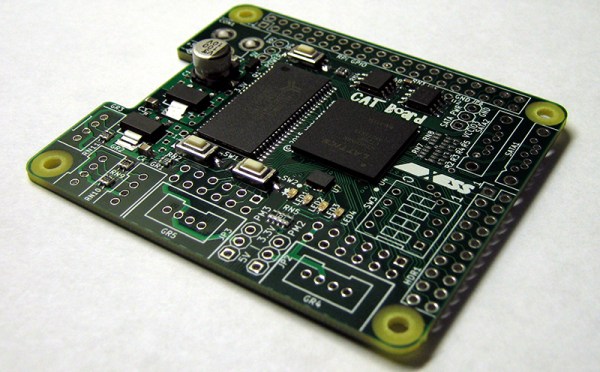
FPGA development has advanced dramatically in the last year, and this is entirely due to an open-source toolchain for Lattice’s iCE40 FPGA. Last spring, the bitstream for this FPGA was reverse engineered and a toolchain made available for anything that can run Linux, including a Raspberry Pi. [Dave] from Xess thought it was high time for a Raspberry Pi FPGA board. With the help of this open-source toolchain, he can program this FPGA board right on the Raspberry Pi.

The inspiration for [Dave]’s board came from the XuLA and StickIt! boards that give the Raspberry Pi an FPGA hat. These boards had a problem; the Xilinx bitstreams had to be compiled on a ‘real’ PC and brought over to the Raspberry Pi world. The new project – the CAT Board – brings an entire FPGA dev kit over to the Raspberry Pi.

The hardware for the CAT Board is a Lattice iCE-HX8K, 32 MBytes of SDRAM, a serial configuration flash, LEDs, buttons, DIP switches, grove connectors, and SATA connectors (although [Dave] is just using these for differential signals; he doesn’t know if he can get SATA hard drives to work with this board).

Despite some problems with his board house, [Dave] eventually got his FPGA working, or at least the bitstream configuration part, and he can blink a pair of LEDs with a Raspberry Pi and programmable logic. The Hello World for this project is done, and now the only limit is how many gates are on this FPGA.

Continue reading “FPGAs For The Raspberry Pi”

Converting A 3D Printer From 3mm To 1.75mm

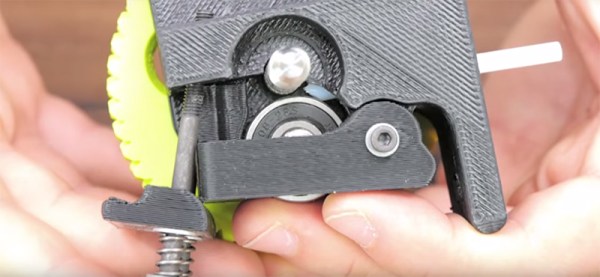
A few weeks ago, I published a post discussing the filament diameters common in 3d printing. For no reason whatsoever, consumer 3D printers have settled on two different sizes of filament. Yes, there are differences, but those differences are just a function of engineering tradeoffs and historical choices. [Thomas], YouTube’s 3D printing guru, took this post as a challenge: what does it take to convert a printer to accept different sizes of filament? Not much, actually.

The printer [Thomas] is changing out to accept 1.75mm is the Lulzbot Mini, one of the most popular printers that would ever need this modification. The only required materials is a new hot end suitable for 1.75mm filament, a 4mm drill, and a few wrenches and allen keys. It would be a smart idea to get a hot end that uses the same thermistor as the old one, but that’s not a deal-breaker as the problem can be fixed in the firmware.

Disassembly was easy enough, and after mounting the PTFE tubing, cutting the old wires, soldering in the new hot end, thermistor, and fan, [Thomas] had everything set up and ready to go.

It should be noted that changing a 3mm hot end to 1.75mm doesn’t really do anything. Just about every filament is available in both sizes, although it may not be convenient to buy 3mm filament locally. It would be a good idea to change out the hot end so can standardize your workshop or hackerspace on a single diameter of filament.

Continue reading “Converting A 3D Printer From 3mm To 1.75mm”

You Might Want To Buy A Quadcopter Now

NBC News has reported the US Government may implement regulations in the coming days that would require anyone who buys an unmanned aircraft system to register that device with the US Department of Transportation.

The most simplistic interpretation of this news is that anyone with a DJI Phantom or a model aircraft made out of Dollar Tree foam board would be required to license their toys. This may not be the case; the FAA – an agency of the US DoT – differentiates between unmanned aircraft systems and model aircraft.

This will most likely be the key thing to watch out for in any coming regulation. The FAA defines model aircraft as, “an unmanned aircraft that is capable of sustained flight in the atmosphere; flown within visual line of sight of the person operating the aircraft; and flown for hobby or recreational purposes.” Additionally, the FAA may not make any regulations for model aircraft. While this means planes and quads flown without FPV equipment may be left out of this regulation, anything flown ‘through a camera’ would be subject to regulation.

Intel And Arduino Introduce Curie-Based Educational Board

This week, Intel and Arduino are releasing their first product pushed directly on the education market, the Arduino/Genuino 101 board powered by the Intel Curie module.

The Intel Curie Module
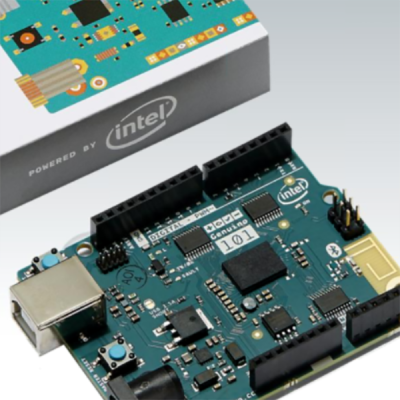
genuino101The Arduino/Genuino 101 is the first development platform for the Intel Curie modules which are a recent development from Intel’s Maker and Innovator group. The button-sized Curie is a single package encapsulating microcontroller, Bluetooth, a 6-DOF IMU, and battery charging circuitry; the requisite hardware for anything marketed as a ‘wearable’. The Curie’s brain is a 32-bit Intel Quark microcontroller with 384kB of Flash 80kB SRAM, giving it about the same storage and RAM as a low-end ARM Cortex microcontroller.

Called a module, it needs a carrier board to interface with this hardware. This is where the Arduino/Genuino 101 comes in. This board – the third such collaboration between Intel and Arduino – provides the same form factor and pinout found in the most popular Arduino offering. While the Curie-based Arduino/Genuino 101 is not replacing the extraordinarily popular Arduino Uno and Leonardo, it is going after the same market – educators and makers – at a similar price, $30 USD or €27. For the same price as an Arduino Uno, the Arduino/Genuino 101 offers Bluetooth, an IMU, and strangely the same USB standard-B receptacle.

Intel has further plans in store for the Curie module; In 2016, Intel, [Mark Burnett] of reality television fame, and United Artists Media group will produce America’s Greatest Makers, a reality show featuring makers developing wearable electronics on TV. No, it’s not Junkyard Wars, but until the MacGyver reboot airs, it’s the closest we’re going to get to people building stuff on TV.

Intel’s Prior Arduino Offerings

In 2013, Intel and Arduino introduced the Galileo board, a dev board packed with I/Os, Ethernet, PCIe, and an Intel instruction set. This was a massive move away from all ARM, AVR, or PIC dev boards made in recent years, and marked Intel’s first foray into the world of education, making, and an Internet of Things. In 2014, Intel and Arduino released the Edison, a tiny, tiny board designed for the embedded market and entrepreneurs.
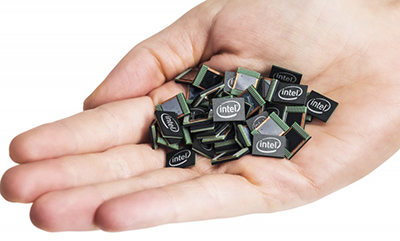
Intel CurieThe Arduino 101 and Genuino 101 – different names for the same thing and the first great expression of arduino.cc’s troubles with trademarks and the Arduino vs Arduino war – are targeted specifically at the ‘maker’ market, however ephemeral and hard to define that is. The form of the Arduino 101 follows directly in the footsteps of the Arduino Uno and Leonardo; The 101 has the same footprint, the same pinout, a single USB port as the Leonardo.

Being the ‘maker market Arduino’, this board is designed to bring technology to the classroom. In a conference earlier this week, [Massimo] framed the Arduino 101 as the educational intersection between technology, coding, art, and design. Students who would not otherwise learn microcontroller development will learn to program an Arduino for art and design projects. The Arduino/Genuino 101 is the board that puts the STEAM in STEM education.

Where the Curie is Going

Intel has big plans for the Curie module, with a few products in the works already. The Intel Edison has made its way into consumer electronics and wearables, including an electronic ski coach that will tell you when to pizza and when to french fry. The Curie will be available independently of the Arduino/Genuino 101, with both products being released in early 2016.

73 Computer Scientists Created A Neural Net And You Won’t Believe What Happened Next

The Internet is a strange place. The promise of cyberspace in the 1990s was nothing short of humanity’s next greatest achievement. For the first time in history, anyone could talk to anyone else in a vast, electronic communion of enlightened thought, and reasoned discourse. The Internet was intended to be the modern Library of Alexandria. It was beautiful, and it was the future. The Internet was the greatest invention of all time.

Somewhere, someone realized people have the capacity to be idiots. Turns out nobody wants to learn anything when you can gawk at the latest floundering of your most hated celebrity. Nobody wants to have a conversation, because your confirmation bias is inherently flawed and mine is much better. Politics, religion, evolution, weed, guns, abortions, Bernie Sanders and Kim Kardashian. Video games.

A funny thing happened since then. People started to complain they were being pandered to. They started to blame media bias and clickbait. People started to discover that headlines were designed to get clicks. You’ve read Moneyball, and know how the use of statistics changed baseball, right? Buzzfeed has done the same thing with journalism, and it’s working for their one goal of getting you to click that link.

Now, finally, the Buzzfeed editors may be out of a job. [Lars Eidnes] programmed a computer to generate clickbait. It’s all done using recurrent neural networks gathering millions of headlines from the likes of Buzzfeed and the Gawker network. These headlines are processed, and once every twenty minutes a new story is posted on Click-O-Tron, the only news website you won’t believe. There’s even voting, like reddit, so you know the results are populist dross.

I propose an experiment. Check out the comments below. If the majority of the comments are not about how Markov chains would be better suited in this case, clickbait works. Prove me wrong.