The Inaccurate Predictions Of Back To The Future

Sometime this evening, after we haven’t rehydrated a pizza for dinner, all of the events portrayed in Back To The Future will have happened in the past. This is it. This is the day all your dreams die.

So, what’s so special about the technology in Back To The Future that we don’t have now? Hoverboards, obviously, but a lot of people have been doing their part to make sure we have something like a hoverboard on this important day. Last week, the record for the longest hoverboard flight was broken by a Canadian company making large multirotor platforms. While it’s called a hoverboard, it’s really not in the spirit of the device that would recreate the skateboard chase scene in front of Hill Valley’s courthouse. For that, you’ll need something that doesn’t use propellers, at least.

There’s a better way to construct a hoverboard than by strapping a few blenders to your feet. Last summer, Lexus built one with superconducting materials and magnets. Yes, it’s effectively the same demonstration you’ve always seen with superconducting materials, only this time it’s dressed up with pro skaters. There are tens of thousands of dollars worth of magnets in the Lexus hoverboard, making this entirely impractical for anyone who wants to build their own.

next-yearThere is another option if you want a hoverboard. This day, last year, Hendo Hoverboards launched a Kickstarter with the best media blitz we’ve ever seen. They built a hoverboard that is basically a quadcopter, but instead of propellers, they use magnets. These magnets produce eddy currents in the metallic, non-ferrous ‘hover surface’. The grand prize for this Kickstarter? Today, October 21, 2015, you’ll be invited to a VIP event where you will not only get to ride a hoverboard, you’ll get one to take home. Price: $10,000.

News Drones
News drones. People still read newspapers.

This company isn’t in the market of building hoverboards; they have a much, much more grandiose idea: the founder wants to use hoverboards as a stepping stone to an active earthquake mitigation strategy for buildings. Yes, buildings can hover inches above their foundation, just in case an earthquake strikes. You say the power might go out during an earthquake, causing the building to fall inches to the ground? I never said it was a good idea.

Lucky for us, the Hendo hoverboard did prove to be a proof of concept that a ‘spinning magnet’ hoverboard is capable of supporting the weight of a rider. We know a few people have been working on this technology before the Hendo hoverboard was announced, and replicating the Hendo hoverboard build shouldn’t cost more than about $1000 USD. We’re eventually going to have to do this, and we’re going to replicate the Pitbull hoverboard, bojo, because we want powah.

So, what else of Back to the Future Part II hasn’t become a reality? News drones. People don’t read newspapers anymore. Self-driving cars are more realistic than hovercar conversions. Pepsi Perfect exists, but only at a Comic Con. Nike Air Mags exist, but not with power laces. The world of Hill Valley still has fax machines, and I really want to rehydrate a pizza.

cubbiesIt’s alright, most of the technology of Back to the Future was just a joke; ‘Queen Diana’ would have never happened, and what exactly was the point of Gray’s Sports Almanac if you can look everything up on the Internet?

There was one possibly accurate prediction in Back to the Future: The Chicago Cubs may win the 2015 World Series. Let me repeat that, for effect. The most accurate prediction of the future given to us in Back to the Future was that the Chicago Cubs win the World Series. That’s how inaccurate Back To The Future was.

BBC’s Micro:bit Gets Python

The BBC has developed a computer to be used by thousands of students across the UK. While not very powerful in terms of hardware, it comes with an interpreted language that will get students writing their own code and will launch the careers of an entire generation of web developers. This is, of course, the BBC Micro, a computer introduced in 1981, but is still deeply revered by millions of former students.

Microcontrollers are everywhere now, and the BBC is looking to replicate their success with the micro:bit. Unlike the BBC Micro, this isn’t a proper computer with a keyboard and a monitor. Instead, it’s a microcontroller development platform based on an ARM chip. Now, the micro:bit is getting Python, the BASIC of today, and will assuredly be even more useful in UK classrooms.

The initial development for Python on the micro:bit started down the road of using Microsoft’s TouchDevelop as a browser-based IDE that would send C++ code to an mBed cloud compilation service. A hex file would be generated, this would be downloaded to the local file system, and finally the student would simply drag the hex file over to the micro:bit since it appeared on the desktop as a USB storage device. This was a terrible idea, because MicroPython exists. The current way of running Python on the micro:bit is as simple as plugging it in to a USB port, opening a terminal, and writing some code. It’s the closest you’re ever going to get to a computer with BASIC in ROM, and it’s the best device for millions of 11-year-olds to learn how to code.

Thanks [dassheep] for the tip.

Ultrasonic Power Transfer: UBeam’s Curious Engineering

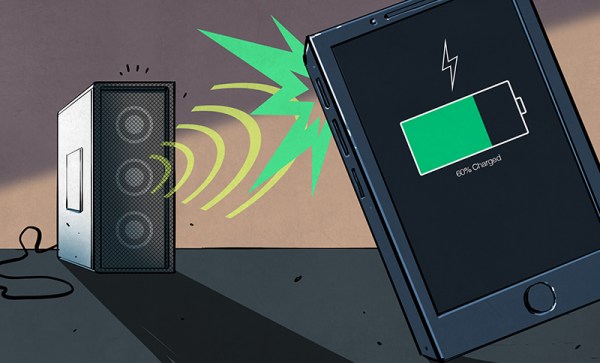
The future is wireless power, or so say a thousand press releases in my spam folder, and with very few exceptions every single system of wireless power delivery has fallen flat on its face. Except for a few niche cases – RFID tags, Wacom tablets and the S Pen, and the Qi inductive power mats for cell phones – the future of wireless power hardly looks bright, and in some cases seems downright dangerous. No one seems to grasp that wireless power transfer is much more inefficient than using a wire, and the inverse square law only makes everything worse.

Now there’s a new wireless power technology that’s a strange mix of running in stealth mode and sending press releases to every tech outlet on the planet. It’s called uBeam. This company says it will deliver wireless power to the world, but it’s not doing it with giant Tesla-inspired towers of power, radios beamed directly at devices, induction, magnetic resonance, or even light. uBeam transmits power via sound, specifically high intensity ultrasound. uBeam has never demonstrated a prototype, has never released any technical specs, and even some high-profile investors that include [Mark Cuban] have not seen the uBeam working. Despite running in a ‘stealth mode’, it has garnered a lot of press, and has been featured on TechCrunch dozens of times. This may just be a consequence of CrunchFunds’s investment in uBeam, but there’s still more Google News results for a technology that hasn’t even been demonstrated than a reasonable person would expect.

In what is perhaps the greatest breakdown ever posted on the EEVForums, [georgesmith] goes over what uBeam is, how the technology doesn’t make sense, and how far you can take a business before engineers start to say, ‘put up or shut up.’ [georgesmith]’s research goes over just some of what makes uBeam impractical, but digging even further reveals how insane uBeam actually is.

Continue reading “Ultrasonic Power Transfer: UBeam’s Curious Engineering”

The First 5nm Chip

For almost forty years, integrated circuits have become smaller and smaller. These chips started out with massive transistors in the early 1970s. They shrank to less than 1μm by 1990, and shrank yet again to less than 100nm by the turn of the last century. Now, Imec and Cadence are experimenting with 5nm technology – the smallest technology available for any mass-produced integrated circuit.

The history of microelectronic fabrication over the last decade is a story of failure. Something happened in 2005, and although chips could be designed at ever-smaller technologies, the transition to these smaller manufacturing processes didn’t go as smoothly as in the 70s, 80s, and 90s. Just a few years ago, Intel said 10nm chips would ship by 2015. These chips are nowhere to be found, and even 14nm technology is still catching up to the yields found in 22nm technology. In 2009, Nvidia said their flagship graphics card would be built with a 11nm process. The current Nvidia flagship desktop graphics card is built with 28nm technology. Moore’s law isn’t 18 months anymore.

While Imec and Cadence have completed the tapeout on a 5nm device, it’s just a test chip. Before starting manufacturing on a single process node, Intel and others will tapeout a simple test chip to verify their latest process. This 5nm tapeout will not become a manufactured chip, but it does mean we’ll see more talk about the 5nm process in the future.

Mostly Non-Volatile Memory With Supercapacitors

Back in the days of old, computers used EPROMs to store their most vital data – usually character maps and a BASIC interpreter. The nature of these EPROMs meant you could write to them easily enough, but erasing them meant putting them under an ultraviolet light. Times have changed and now we have EEPROMs, which can be erased electronically, and Flash, the latest and greatest technology that would by any other name be called an EEPROM. [Nicholas] wanted an alternative to these 27xx-series EPROMs, and found his answer in supercapacitors.

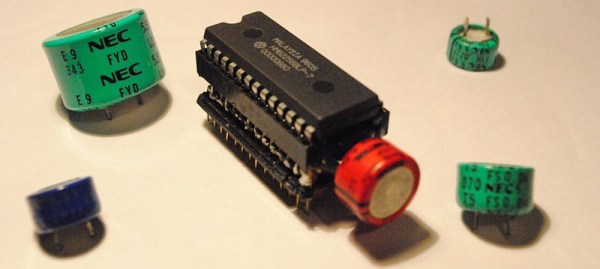
[Nick]’s creation is a mostly non-volatile memory built around an old 62256 32k SRAM. SRAM is completely unlike EPROMs or Flash, in that it requires power to keep all its bits in memory. Capacitor technology has improved dramatically since the 1980s, and by using a supercap and one of these RAM chips, [Nick] has created a substitute for a 27-series EPROM that keeps all its memory alive for days at a time.

The circuit requires a small bit of electronics tucked between the EPROM socket and the SRAM chip; just enough to turn the 12 Volts coming from the EPROM programming pin to the 5 Volts expected from the SRAM’s Write Enable pin. This is accomplished by a few LEDs in series, and a 0.1F 5.5V supercap which keeps the SRAM alive when the power is off.

As for why anyone would want to do this when modern technologies like Flash can be found, we can think of two reasons. For strange EPROM sizes, old SRAMs abound, but a suitable Flash chip in the right package (and the right voltage) might be very hard to find. Also, EEPROMs have a write lifetime; SRAMs can be written to an infinite number of times. It’s not the best solution in every case, but it is certainly interesting, and could be useful for more than a few vintage computing enthusiasts.

This project makes us think of another where an LED may have been supplying keep-alive power to some volatile memory.

Breaking: Drone Registration Will Be Required Says US DoT

Today, the US Department of Transportation announced that unmanned aerial systems (UAS) will require registration in the future.

The announcement is not that UAS, quadcopters, or drones would be required to be registered immediately. This announcement is merely that a task force of representatives from the UAS industry, drone manufacturers, and manned aviation industries would provide recommendations to the Department of Transportation for what types of aircraft would require registration. The task force is expected to develop these recommendations and deliver a report by November 20.

A Short History of FAA Model Aircraft Regulation

Introduced in 1981, AC 91-57 was the model aircraft operating standards for more than 30 years. This standard suggested that model pilots not fly higher than 400 feet, and to notify a flight service station or control tower when flying within three miles of an airport.

The FAA Modernization And Reform Act Of 2012 (PDF) required the FAA to create a set of rules for unmanned aerial systems, however the FAA is expressly forbidden from, ‘promulgating any rule or regulation regarding model aircraft.’ The key term being, ‘model aircraft’. This term was defined by the FAA as being, “an unmanned aircraft that is capable of sustained flight in the atmosphere; flown within visual line of sight of the person operating the aircraft; and flown for hobby or recreational purposes.” Anything outside of this definition was an unmanned aerial system, and subject to FAA regulations.

While this definition of model aircraft would have been fine for the 1980s, technology has advanced since then. FPV flying, or putting a camera and video transmitter on a quadcopter, is an extraordinarily popular hobby now, and because it is not ‘line of sight’, it is outside the definition of ‘model aircraft’.

This interpretation has not seen a great deal of countenance from the model aircraft community; FPV flying is seen as a legitimate hobby and even a sport. The entire domain of model aircraft aviation is expanding, and the hobby has never been as popular as it is now.

The Safety of Model Aviation

The issue of drone regulation focuses nearly entirely on the safety of airways in the United States; model aviators flying within five miles of an airport must ask the airport or control tower for permission to fly. To that end, the FAA created the B4UFLY app that takes the trouble out of reading sectional charts and checking up on the latest NOTAMs and TFRs.

However, the FAA is increasingly concerned with drones, multicopters, and model aircraft. In a report issued last summer, the FAA cited a marked increase in the number of ‘close calls’ between manned aircraft and model aircraft. The Academy of Model Aeronautics went over this data and found a different story: only 3.5% of sightings were ‘close calls’ or ‘near misses’. The FAA data is questionable – the reports cited include a drone flying at 51,000 feet over Washington DC. Not only is this higher than any civilian passenger aircraft capable of flying, the ability for any civilian remote-controlled aircraft to operate at this altitude is questionable at best.

Nevertheless, the requirement for registration has been greatly influenced by the perceived concerns of regulators for mid-air collisions.

What exactly will require registration?

The group of industry representatives responsible for delivering the recommendations to the Department of Transportation will take into account what aircraft should be exempt from registration due to a low safety risk. Most likely, small toy quadcopters will be exempt from registration; it’s difficult to fly a small Cheerson quadcopter outside anyway. Whether this will affect larger quadcopters and drones such as the DJI Phantom, or 250 class FPV racing quadcopters remains to be seen.

How To Control Siri Through Headphone Wires

Last week saw the revelation that you can control Siri and Google Now from a distance, using high power transmitters and software defined radios. Is this a risk? No, it’s security theatre, the fine art of performing an impractical technical achievement while disclosing these technical vulnerabilities to the media to pad a CV. Like most security vulnerabilities it is very, very cool and enough details have surfaced that this build can be replicated.

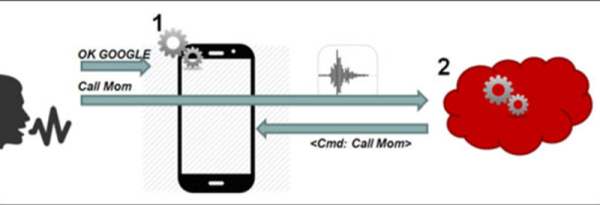
The original research paper, published by researchers [Chaouki Kasmi] and [Jose Lopes Esteves] attacks the latest and greatest thing to come to smartphones, voice commands. iPhones and Androids and Windows Phones come with Siri and Google Now and Cortana, and all of these voice services can place phone calls, post something to social media, or launch an application. The trick to this hack is sending audio to the microphone without being heard.

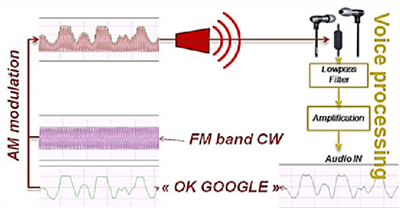
googleThe ubiquitous Apple earbuds have a single wire for a microphone input, and this is the attack vector used by the researchers. With a 50 Watt VHF power amplifier (available for under $100, if you know where to look), a software defined radio with Tx capability ($300), and a highly directional antenna (free clothes hangers with your dry cleaning), a specially crafted radio message can be transmitted to the headphone wire, picked up through the audio in of the phone, and understood by Siri, Cortana, or Google Now.



There is of course a difference between a security vulnerability and a practical and safe security vulnerability. Yes, for under $400 and the right know-how, anyone could perform this technological feat on any cell phone. This feat comes at the cost of discovery; because of the way the earbud cable is arranged, the most efficient frequency varies between 80 and 108 MHz. This means a successful attack would sweep through the band at various frequencies; not exactly precision work. The power required for this attack is also intense – about 25-30 V/m, about the limit for human safety. But in the world of security theatre, someone with a backpack, carrying around a long Yagi antenna, pointing it at people, and having FM radios cut out is expected.

Of course, the countermeasures to this attack are simple: don’t use Siri or Google Now. Leaving Siri enabled on a lock screen is a security risk, and most Androids disable Google Now on the lock screen by default. Of course, any decent set of headphones would have shielding in the cable, making inducing a current in the microphone wire even harder. The researchers are at the limits of what is acceptable for human safety with the stock Apple earbuds. Anything more would be seriously, seriously dumb.