The Open, Hackable Electronic Conference Badge

Electronic conference badges have been around for at least a decade now, and they all have the same faults. They’re really only meant to be used for a few days, conference organizers and attendees expect the badge to be cheap, and because of the nature of a conference badge, the code just works, and documentation is sparse.  Surely there’s a better way.

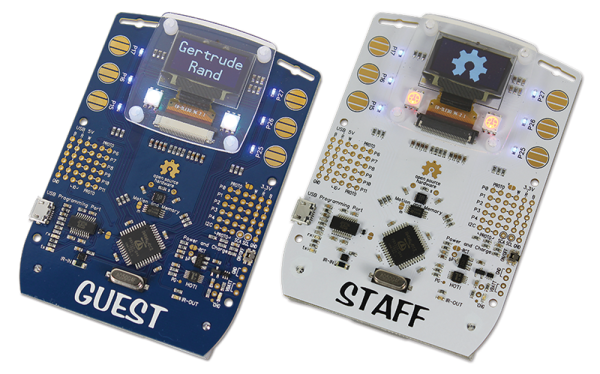
Enter the Hackable Electronic Badge. Ever since Parallax started building electronic conference badges for DEF CON, they’ve gotten a lot of requests to build badges for other conventions. Producing tens of thousands of badges makes Parallax the go-to people for your conference badge needs, but the requests for badges are always constrained by schedules that are too short, price expectations that are too low, and volumes that are unknown.

There’s a market out there for electronic conference badges, and this is Parallax’s solution to a recurring problem. They’re building a badge for all conferences, and a platform that can be (relatively) easily modified while still retaining all its core functionality.

Continue reading “The Open, Hackable Electronic Conference Badge”
Hackaday Prize Semifinalist: An Open Smartphone

One of the biggest trends in DIY electronics, both now and fifty years ago, is creating at home what is usually made in a factory. Fifty years ago, this meant radios and amplifiers. Today, this means smartphones. It used to be the case that you could pull out a Heathkit catalog and find kits for every electronic gadget imaginable. There are no kits for DIY smartphones.

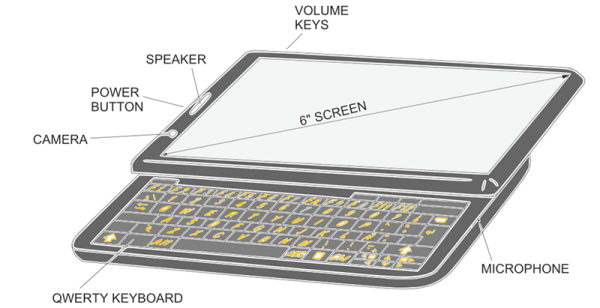
For [Gerard]’s entry for The Hackaday Prize, he’s tapping into the spirit of the decades-old DIY movement and building his own cell phone. He’s calling it the libresmartphone, and it’s able to make calls and send emails, just like any other portable, pocketable computer.

The libresmartphone is built around a Raspberry Pi, with a large battery, HDMI display with touchscreen, and a GSM and GPS module rounding out the build. He’s also rolling his own software to make calls, read SMS, and take a peek into some of the phone’s hardware, like the charge state of the battery.

[Gerard]’s libresmartphone is one of the purest examples of modern DIY electronics you’ll find; it’s not about building something from a kit, but instead building something that’s needed out of the parts he has on hand. That’s the purest example of the DIY movement, and a great entry to this year’s Hackaday Prize.

The 2015 Hackaday Prize is sponsored by:

Hackaday Links Column Banner

Hackaday Links: September 13, 2015

One more go at new enclosures for the Amiga 1200. Yes, it’s a Kickstarter campaign, and we mentioned a similar the same campaign last month. The previous campaign received a little more than half of the desired funding in a 30-day campaign. The new campaign received half its funding in a week. The only difference? Now you can put a Raspberry Pi in a newly manufactured A1200 case. And they say Raspberry Pi consumerism isn’t a thing…

Cheap SLA printing service. [Ian] and Dangerous Prototypes have made a name for themselves with dirt cheap, acceptable quality PCBs. Now they’re going for custom prints on a resin machine. It’s $0.95 per gram (density is 1.3g/cc). That’s cheap.

[James Willis] built a floppy drive orchestra. There are 16 drives in this orchestra, all controlled by an FPGA. Here’s the writeup.

Here’s a video overview of a real, huge, rideable hexapod robot. ‘Wow’ is just about the only thing we got for this.

Western Digital introduced a hard drive made specifically for the Raspberry Pi. It’s a hard drive with a USB interface, and a USB cable that connects to the Pi, the drive, and a power adapter. In other news, externally powered USB hard drives exist. You can buy a 2TB drive for the price of the 1TB PiDrive. What was that thing about Raspi consumerism?

Next week is the Open Hardware Summit in Philadelphia. We’ll be there (or rather, I will). We’ll have a post on the OHS badge up on Monday. Would anyone like to go see the lady made out of soap? It’s right around the corner from the venue.

Hackaday Prize Semifinalist: Superhero Powers

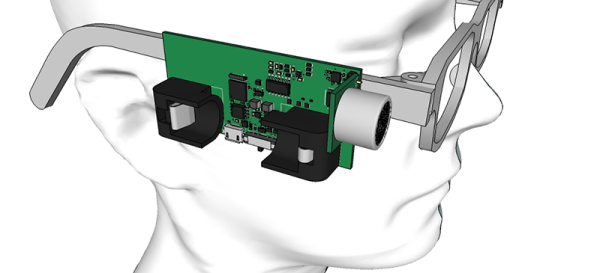
The inspiration for [K.C. Lee]’s project for The Hackaday Prize didn’t come from seeing a grave injustice or inhuman suffering. He was watching Daredevil on Netflix. A show about a blind guy who fights crime in his spare time. People don’t have superhuman senses, and radioactive material falling off a truck in New York City leads to Ninja Turtles, not superheros. Still, a crude form of echolocation is well within the reach of the a capable hacker and would be very useful for those who are legally blind.

[K.C.]’s idea for human echolocation is a small wearable with ultrasonic sensors, 6DOF IMUs, and audio and haptic feedback. With a bit of math and a lot of practice, it’s possible to walk down a hallway, avoid obstacles, and find your way around without sight.

Human echolocation is a real thing, and it’s great to see a device that makes this minor human superpower a little more accessible. [K.C.] says there are 40 million people world wide that could use a device like this, and for an idea that was inspired by a superhero on TV, it’s one of the more interesting inspirations for an entry to The Hackaday Prize.


The 2015 Hackaday Prize is sponsored by:

The Most Self-Replicating RepRap Yet

The goal of the RepRap project was always a machine that could replicate itself. The project began with the RepRap Darwin, a machine with a frame made nearly entirely of threaded rods, and progressed to the Mendel, with a slightly higher proportion of printed parts. Around 2011, the goal of self-replication fell by the wayside after some money was thrown around. The goal now, it seems, is to create the 3D printer with the best profit margins. That doesn’t mean there still isn’t a small contingent of RepRappers out there trying to improve the status quo and create a printer that can truly self-replicate. [Revar] is one of those tinkerers, and he has just released the RepRap Snappy, a snap-together 3D printer built nearly entirely out of 3D printed parts.

Other 3D printers designed around the idea of self-replication, like the RepRap Morgan and the Simpson family of printers, use strange kinematics. The reason for this is that Cartesian bots can’t print up to the limits of their frame, yet self-replication requires all parts be replicated at the same scale.

[Revar] is setting a new tack in the problem of printer self-replication and is joining parts together with snap fit connectors. The entire frame of the Snappy printer is built out of small parts that interlock to form larger units.

Another of the tricks up [Revar]’s scheme is reducing the number of ‘vitamins’ or parts that cannot be 3D printed. This includes belts, motors, screws, and electronics. You can’t really print machine screws yet, but [Revar] did manage to eliminate some belts and bearings. He’s using a rack and pinion system, all made with printed parts. It’s a technique that hasn’t been seen before, but it does seem to work rather well.

[Revar] has made all the files for the printed parts available in his repository. If you have enough filament, these files are enough to print 73% of the RepRap Snappy.

Thanks [Matt] for sending this one in. Video below.

Continue reading “The Most Self-Replicating RepRap Yet”

Hackaday Prize Semifinalist: Better DIY Aquaculture

The theme of this year’s Hackaday Prize is ‘build something that matters’. For a lot of the teams entering a project, that means solving world hunger, specifically though agriculture. Grains are great, but proteins generally taste better and [Michael Ratcliffe] is focusing his project on aquaculture, or farming fish and other aquatic life.

The problem [Michael] decided to tackle is feeding fish at regular intervals according to water temperature, the age of the fish, and how much food is already floating in the tank. This is actually a difficult problem to solve; fish grow better when they’re fed more than once a day. Currently, most aquaculture setups feed fish once a day simply because it’s so time-consuming.

[Michael] is using Pis, Arduinos, USB cameras, and a lot of experience in automation and control systems to feed fish in the most efficient way. The possibilities of the project are interesting; the best research says a more efficient feeding schedule can translate into a 20% increase in production, which is a lot of extra food for the world.

You can check out [Michael]’s introductory video below.

The 2015 Hackaday Prize is sponsored by:

Continue reading “Hackaday Prize Semifinalist: Better DIY Aquaculture”

Hackaday Prize Semifinalist: A Device For Autism And Pomodoros

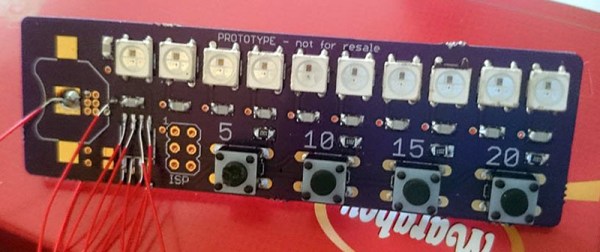
[jens.andree] found that many people on the autism spectrum have problems perceiving time. This makes the simplest tasks at home or at school harder. To help solve this problem, he’s created the Timstock Slim for this year’s Hackaday Prize. It’s a timer with four buttons to count down 5, 10, 15, or 20 minutes, with a neat LED bar graph showing the remaining time.

The Timstock Slim is an extremely simple device – it’s just an ATTiny84, a few shift registers, some LEDs, resistors, buttons, and a coin cell battery clip. It also does exactly what it says on the tin; it counts out a few minutes at a time, while providing visual feedback in the form of a bunch of LEDs.

Interestingly, this device may be useful to more than just those with autism; the pomodoro technique of time management uses a similar device – a kitchen timer – to keep its adherents on track. With no modifications at all, [jens’] Timstock could be used for a slightly modified pomodoro technique, geared towards 5, 10, 15, or 20 minute increments.

The 2015 Hackaday Prize is sponsored by: