Sinterit Pulls SLS 3D Printer Entry Level Price Down To Just $8k

Almost exactly two years ago, news of a great revolution in 3D printing carried itself through blogs and tech columns. Patents were expiring, and soon the ‘squirting filament’ printers would be overtaken by a vastly better method: selective laser sintering. In the last two years, the market has been markedly silent on the possibilities of SLS technology, until now, at least. Today, Sinterit is launching their first printer. It’s an SLS printer that builds objects by fusing nylon powder with a laser, producing things with much better quality than filament-based printers.

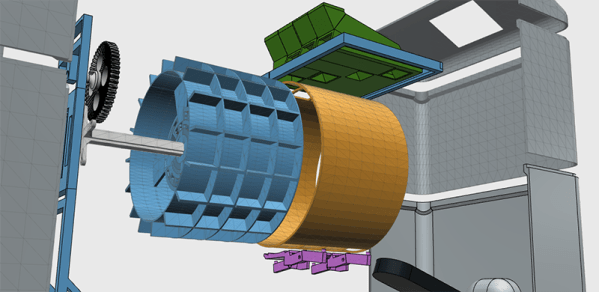
The Sinterit Lisa is a true laser sintering printer, able to create objects by blasting nylon powder with a 5W laser diode. Inside this box that’s about the same size as a laser printer is a CoreXY mechanism to move the laser diode around, heated pistons, cylinders, feed bed and print bed for keeping the print volume at the right temperature and the top layer perfectly flat. The layer thickness of the printer goes down to 0.06 mm, and the maximum print size is 13 x 17 x 13 cm. Material choice is, for now, limited to black PA12 nylon but other materials are being tested.

Continue reading “Sinterit Pulls SLS 3D Printer Entry Level Price Down To Just $8k”
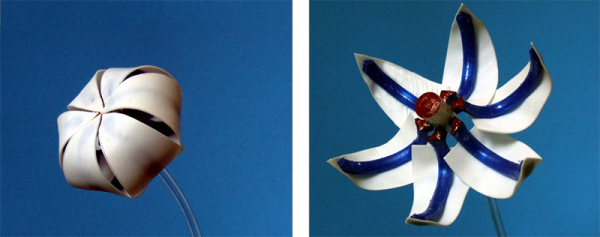
3D Printed Kinetic Art

Artificial muscles and soft robotics don’t get the respect they deserve, but [mikey77] is doing some very interesting work with artificial muscles that can be made on just about any 3D printer.

Like other artificial muscles and soft robotic actuators we’ve seen – like this walking sea slug and this eerie tentacle – [mikey77]’s muscles are powered by air. Instead of the usual casting method, he’s printing these muscles from Ninjaflex, a flexible plastic that is compatible with most 3D printers.

As they come off the printer, these 3D printed pneumatic muscles leak, and that means [mikey77] has to seal them. For that, he created a sealant out of Loctite fabric glue thinned with MEK. The addition of MEK dissolves the outer layer of Ninjaflex, allowing the glue to bond very, very well to the printed muscle.

So far, [mikey77] has created a pneumatic flower that blooms when air is added. He’s also created a muscle that can lift more than four pounds of weight with the help of a 3D printed skeleton. It’s a great way to experiment with flexible robots and pneumatic muscles, and we can’t wait to see what weird creatures can be created with these actuators.

Thanks [Lloyd] for sending this one in.

Hackaday Prize Semifinalist: Big Data And Big Agriculture

For their entry to the Hackaday Prize, the team behind SentriFarm is solving a big problem for farmers in Australia. Down there, farms are big, and each paddock must be checked daily. This means hours of driving every day. Surely a bunch of sensors and some radio links would help, right?

This is the idea behind SentriFarm: a ground station that reads air temperature, atmospheric pressure, wind speed and direction, rain, light, UV and smoke, and relays that back to a central node. Yes, it’s basically a wireless weather station, but the sheer distance these sensors must transmit adds some interesting complexity.

The SentriFarm team is hoping to get about 10km out of their radio system, and they’re using a long-range, low power radio module to do it. This data is received by the ubiquitous radio towers found on Australian farms and sent to a database on the farm’s network. This data can be combined with data from the local weather service to get an accurate picture of exactly what’s happening in each paddock.

You can check out the SentriFarm project video below.

The 2015 Hackaday Prize is sponsored by:

Continue reading “Hackaday Prize Semifinalist: Big Data And Big Agriculture”

Exponential Growth In Linear Time: The End Of Moore’s Law

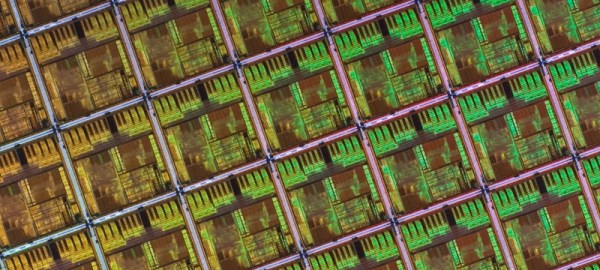
Moore’s Law states the number of transistors on an integrated circuit will double about every two years. This law, coined by Intel and Fairchild founder [Gordon Moore] has been a truism since it’s introduction in 1965. Since the introduction of the Intel 4004 in 1971, to the Pentiums of 1993, and the Skylake processors introduced last month, the law has mostly held true.

The law, however, promises exponential growth in linear time. This is a promise that is ultimately unsustainable. This is not an article that considers the future roadblocks that will end [Moore]’s observation, but an article that says the expectations of Moore’s Law have already ended. It ended quietly, sometime around 2005, and we will never again see the time when transistor density, or faster processors, more capable graphics cards, and higher density memories will double in capability biannually.

Continue reading “Exponential Growth In Linear Time: The End Of Moore’s Law”

Hackaday Prize Semifinalist: Smart Medication Dispenser

The biggest problems with pharmaceuticals isn’t patents, industry reps, or the fact that advertisement to consumers is allowed; this only happens in the United States. No, the biggest problem with pills and medications is compliance, or making sure the people who are prescribed medication take their medication. For his Hackaday Prize entry, [Joe] is working on a solution. It’s a smart desktop medicine organizer, and you can think of it as a pill box with smarts.

The list of features of [Joe]’s organizer include automatic pill organization – each prescription is accessed independently of all the others. When it’s time to take a pill, the smart medication dispenser plops out a pill. You can check out the demo video [Joe] put together using M&M candies.

There are a few more features for the Smart Desktop Medicine Organizer, including connecting to pharmacy APIs to order refills, checking for drug interactions, and setting timers (or not) for different medications; meds that should be taken every day will be dispensed every day, but drugs taken as needed up to a maximum limit will be dispensed as needed.

It’s a very cool project, and you can check out [Joe]’s video for the project below.

The 2015 Hackaday Prize is sponsored by:

Continue reading “Hackaday Prize Semifinalist: Smart Medication Dispenser”

The IPad Controlled Camera Slider

[Daniel] and [Tobias] dabble in videography and while they would love a camera slider controlled by their favorite iDevice, commercial motorized camera sliders are expensive, and there’s no great open source alternative out there. They decided to build one for themselves that can be controlled either from a PS3 controller or from its own iPad app with the help of an ESP8266 WiFi module.

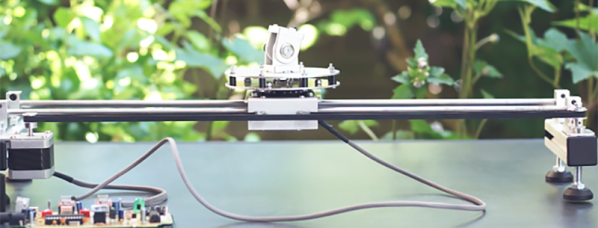
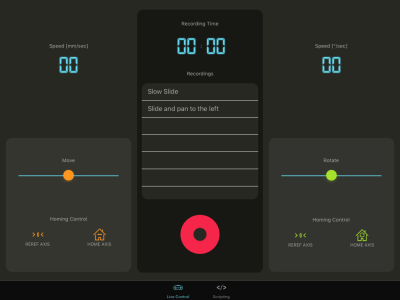
app_live_controlThe camera slider is a two-axis ordeal, with one axis sliding the camera along two solid rails, and the other panning the camera. The circuit board was milled by the guys and includes an ATMega328 controlling two Pololu stepper drivers. An ESP8266 is thrown into the mix, and is easily implemented on the device; it’s just an MAX232 chip listening to the Tx and Rx lines of the WiFi module and translating that to something the ATMega can understand.
By far the most impressive part of this project is the iPad app. This app can be controlled ‘live’ and the movements can be recorded for later playback. Alternatively, the app has a simple scripting function that performs various actions such as movement and rotation over time. The second mode is great for time lapse shots. Because this camera slider uses websockets for the connection, the guys should also be able to write a web client for the slider, just in case they wanted the ultimate webcam.

You can check out [Daniel] and [Tobias]’ demo reel for their camera slider below.

Continue reading “The IPad Controlled Camera Slider”

Finally, An Official Display For The Raspberry Pi

Yes, finally, and after years of work and countless people complaining on forums, there is a proper, official display for the Raspberry Pi.

It’s a 7-inch display, 800 x 480 pixel resolution, 24-bit color, and has 10-point multitouch. Drivers for the display are already available with a simple call of sudo apt-get update, and the display itself is available at Newark, the Pi Store (sold out) and Element14. There’s even a case available, and a stand ready to be sent off to a 3D printer.

As for why it took so long for the Raspberry Pi foundation to introduce an official display for the Pi, the answer should not be surprising for any engineer. It’s EMC, or electromagnetic compliance. The DPI (Display Parallel Interface) for the Pi, presented on the expansion header and used by the GertVGA adapter allows any Pi to drive two displays at 1920 x 1024, 60FPS. This DPI interface is an electrical nightmare that spews RF interference everywhere it goes.

raspberry-pi-touchscreen-thumbThe new display could have used the DSI (Display Serial Interface) adapter, or the small connector on the Pi that is not the camera connector. DSI displays are purpose-built for specific devices, though, and aren’t something that would or should be used in a device that will be manufactured for years to come. The best solution, and the design the Raspberry Pi foundation chose to go with, is a DPI display and an adapter that converts the Pi’s DSI output to something the display can understand.



The solution the Pi foundation eventually settled on is an adapter board that converts the DSI bus to DPI signalling. This of course requires an extra PCB, and the Foundation provided mounting holes so a Pi can connect directly to it.

While this is the first display to make use of the DSI interface, it will assuredly not be the last. The Pi Foundation has given us a way to use the DSI connector to drive cheap DPI displays. While the 800×480 resolution of the official display may be a bit small, there will undoubtedly be a few hardcore tinkerers out there that will take this adapter board and repurpose it for larger displays.

[Alex Eames] got his hands on the Pi Display a few weeks ago, you can check out his introductory video below.

Continue reading “Finally, An Official Display For The Raspberry Pi”