Hackaday Prize Entry: The Internet Of Plants

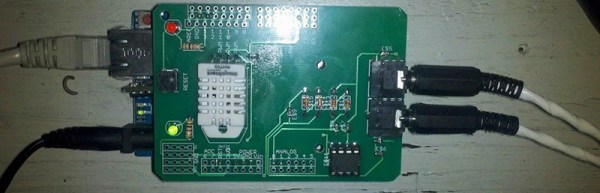
The theme of this year’s Hackaday Prize is ‘build something that matters.’ Acrobotic Industries is in beautiful Southern California, where it won’t rain an appreciable amount until the mudslides come. For a little bit of help during this unprecedented drought, they’ve created Clouden, a system of irrigation that only waters yards and parks when the plants need it. This is apparently a novel concept for Southern California, and is most certainly something that matters.

The Clouden system has two parts. The first is a node with an array of soil water sensors and a Particle WiFi module. This node connects to the controller which alters watering schedules in response to actual conditions and predicted rainfall from the WeatherUnderground API.

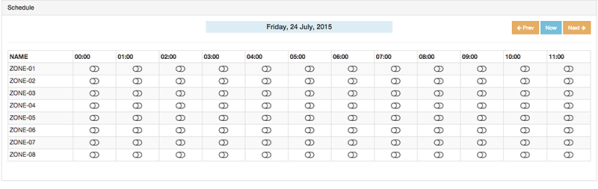
There’s more to just listening to sensors – the Clouden controller also has the hardware to control 24VAC water valves and a web interface for scheduling irrigation times. With this many sensors – and the ability to not water when there’s a ban in place – it’s a great watering system, and something Southern California desperately needs.


The 2015 Hackaday Prize is sponsored by:

Hackaday Links Column Banner

Hackaday Links: August 2, 2015

Over the last few years, Maker’s Asylum in Mumbai has grown from a garage to a very well stocked workspace with 140 members. They’re getting kicked out at the end of the month and they need some help. We just had a meetup at the Delhi branch of Maker’s Asylum, and these guys and gals are really cool.

Speaking of crowdfunding campaigns for hackerspaces, South Central Pennsylvania might be getting its own hackerspace. The 717 area code is a vast wasteland when it comes to anything anyone reading Hackaday would consider interesting, despite there being plenty of people who know their way around CNC machines, soldering irons, and welders. This needs to happen.

Need some help with Bluetooth standards? Tektronix has you covered with a gigantic poster of the physical layer. If only there were a repository of these handy, convenient reference posters.

Forgings and castings make for great YouTube videos, and this aluminum bell casting is no exception. There’s about 18 pounds of aluminum in there, which is pretty large as far as home casting goes.

Electronic Goldmine has an assortment of grab bags – spend a few dollars get a bag of chips, LEDs, diodes, or what have you. What’s in these grab bags? [alpha_ninja] found out. There’s some neat stuff in there, except for the ‘SMD Mixture’ bag.

Remember the found case molds for the Commodore 64C that became a Kickstarter? It’s happening again with the Amiga 1200. This is a new mold with a few interesting features that support the amazing amount of upgrades that have come out for this machine over the years. Being new molds, the price per piece is a little high, but that’s your lesson in manufacturing costs for the day.

Hackaday Prize Entry: Real Time Power Monitoring

The Internet of Things promises real-time monitoring of appliances, HVAC, and just about everything else in the home. One of the biggest technologies behind this is the smart meter, an electrical meter that will tell you how much power you’re sucking down from the grid at any given moment. A meter need not be smart, though, because [jlbrian7]’s entry for the Hackaday Prize does the same thing without an entirely new meter.

[jlbrian]’s power monitor is a non-intrusive monitor for electrical systems, allowing anyone to retrofit an electrical meter – or just a single breaker panel – with smart meter tech. It uses a small current transformer to monitor the amperage running through a wire. By sending that information to the Internet, anyone with this system gets power monitoring with much higher temporal resolution than what the power company provides in a monthly bill.

As a nice little addition to his Power Monitor, [jlbrian] is adding a few environmental sensors to his data logging platform. This allows for a little bit of interpolation to figure out what all that power is actually being used for; if the power turns on and a few minutes later the temperature drops, there’s a pretty good chance the AC just went on.

The 2015 Hackaday Prize is sponsored by:

Hackaday Prize Entry: 10 Watt Individually Addressable RGB LEDs

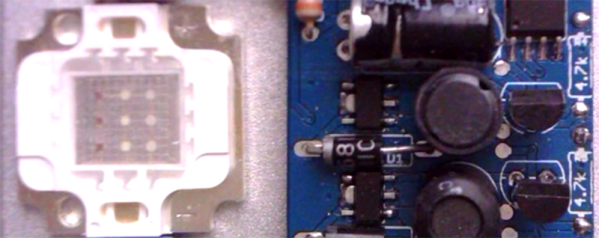
Individually addressable RGB LEDs like Neopixels, WS2812s, and  WS2811s are the defacto standard for making blinkey glowey projects. To build a very bright display, you need a lot of them, relegating very bright RGB displays to those of us who can afford the hardware and figure out how to drive that many LEDs. For his Hackaday Prize entry, [AJ Reynolds] is cranking these tiny RGB LEDs up a notch by building an individually addressable 10 Watt RGB floodlight.

Instead of building an RGB LED floodlight from scratch, [AJ] is leveraging the most mediocre of what China has to offer. He found 10 Watt RGBs for a dollar a piece and a few floodlight cases that cost about $5 a piece. By dispensing with the white LED in the floodlight case and replacing it with a 10 Watt RGB LED and some custom circuitry, [AJ] can build a powerful RGB floodlight with a BOM cost of under $15.

While there are big RGB floodlights out there, controlling them either means a custom proprietary protocol or messing around with DMX. A floodlight that speaks the same language as a WS2811 leverages an enormous amount of work from the world of Arduino and a lot of projects from around the Internet, making this a great entry for really bright blinkies and an excellent entry for The Hackaday Prize.

The 2015 Hackaday Prize is sponsored by:

Learning From Transparent Microchips

Microchips and integrated circuits are usually treated as black boxes; a signal goes in, and a signal goes out, and everything between those two events can be predicted and accurately modeled from a datasheet. Of course, the reality is much more complex, as any picture of a decapped IC will tell you.

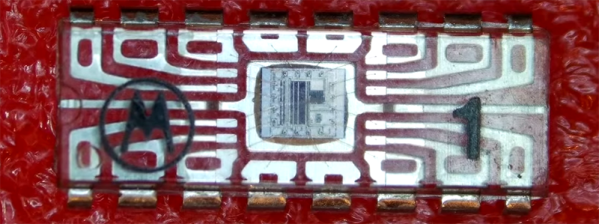
[Jim Conner] got his hands on a set of four ‘teaching’ microchips made by Motorola in 1992 that elucidates the complexities of integrated circuitry perfectly: instead of being clad in opaque epoxy, these chips are encased in transparent plastic.

The four transparent chips are beautiful works of engineering art, with the chip carriers, the bond wires, and the tiny square of silicon all visible to the naked eye. The educational set covers everything from resistors, n-channel and p-channel MOSFETS, diodes, and a ring oscillator circuit.

[Jim] has the chips and the datasheets, but doesn’t have the teaching materials and lab books that also came as a kit. In lieu of proper pedagogical technique, [Jim] ended up doing what any of us would: looking at it with a microscope and poking it with a multimeter and oscilloscope.

While the video below only goes over the first chip packed full of resistors, there are some interesting tidbits. One of the last experiments for this chip includes a hall effect sensor, in this case just a large, square resistor with multiple contacts around the perimeter. When a magnetic field is applied, some of the electrons are deflected, and with a careful experimental setup this magnetic field can be detected on an oscilloscope.

[Jim]’s video is a wonderful introduction to the black box of integrated circuits, but the existence of clear ICs leaves us wondering why these aren’t being made now. It’s too much to ask for Motorola to do a new run of these extremely educational chips, but why these chips are relegated to a closet in an engineering lab or the rare eBay auction is anyone’s guess.

Hackaday Prize Entry: Emoticon Keyboard

The Internet is raising an entire generation that can speak entirely in emoticons. This reverses the six thousand year old evolution of written language and makes us (╯°□°)╯︵ ┻━┻. It is, however, fun. There is a problem with these newfangled emoticons: no one actually types them; they’re all copied and pasted. This is inefficient, and once again technology is here to save us once again.

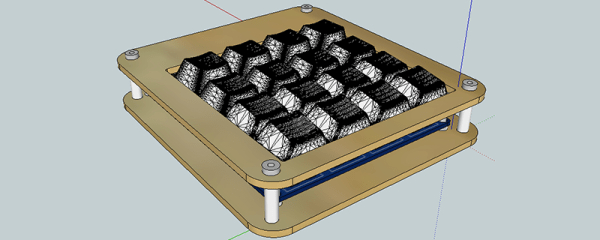
For his Hackaday Prize entry, [Duncan] is working on an EmojiPad. It’s a (mechanical!) keyboard for typing emoticons, but it can also be used for gaming, CAD design, or as a USB MIDI device.

The keyboard uses 16 Cherry MX switches in a standard diode matrix configuration. This is a USB keyboard, and for the controller, [Duncan] is using an ATMega328 with the V-USB library This is all well-worn territory for the mechanical keyboard crowd, so to spice things up, [Duncan] is going to add individually addressable LEDs underneath each keycap. The ATMega328 doesn’t have enough pins to do this the normal way, so all the LEDs will be Charlieplexed.

A keyboard for emoticons demands custom keycaps, but [Duncan] is having a hard time finding a good solution. Right now he’s planning on using blank keycaps with vinyl decals, a somewhat expensive option at $1 USD a keycap. A better, even more expensive option exists, but for something as ephemeral as an emoticon keyboard a sticker will do just fine.

The 2015 Hackaday Prize is sponsored by:

An Internet Speedometer With A Dekatron

[Sprite_tm], like most of us, is fascinated with the earlier ways of counting and controlling electrons. At a hacker convention, he found an old Dekatron tube hooked up to a simple spinner circuit. The prescription for this neon infatuation was to build something with a Dekatron, but making another spinner circuit would be a shame. Instead, he decided to do something useful and ended up building an Internet Speedometer with this vintage display tube.

Like all antique tubes, the Dekatron requires about 400V to glow. After a bit of Googling, [Sprite] found a project that drives a Dekatron with an AVR with the help of a boost converter. Borrowing the idea of controlling a boost converter with a microcontroller, [Sprite] built a circuit with the Internet’s favorite Internet of Things thing – the ESP8266 – that requires only a 12 volt wall wart and a handful of parts.

Controlling the rotating glow of a Dekatron is only half of the build; this device is an Internet speedometer, too. To read out his Internet speed, [Sprite] is using a managed switch that allows SNMP to read the number of incoming and outgoing octets on a network interface. By writing a simple SNMP client for the ESP8266, the device can read how clogged the Intertubes are, both incoming and outgoing.

With an acrylic case fresh out of the laser cutter and a remarkably good job at bending acrylic with a heat gun, [Sprite] has a tiny device that tells him how much Internet he’s currently using. He has a video of it running a speedtest, you can check that video out below.

Continue reading “An Internet Speedometer With A Dekatron”