DEF CON: The Proxy For ProxyHam

Two weeks ago, news broke of an incredible abuse of power from the National Security Agency. A DEF CON talk was cancelled, and speculation raged that information was not free. This was the ProxyHam, a device that puts you miles away from any agency hunting down your IP address.

Of course, as with just about every DEF CON talk picked up by the press, ProxyHam is an ill-conceived, terrible idea. You can replicate it with parts bought from newegg, and despite using a highly directional antenna the FCC – or any other government agency – can still track you down.

In lieu of a talk on using off-the-shelf networking hardware in the way it was intended, [Dave Maynor] and [Robert Graham] of Errata Security gave a talk at DEF CON that is the proxy to the ProxyHam. They completely debunked the outrageous speculation surrounding the cancellation of the DEF CON talk and managed to introduce a new version of Internet over radio that is actually useful for the security-minded individual.

The ‘debunking’ part of the Errata Security talk was exactly what anyone would expect; the talk was probably cancelled because the creator of ProxyHam exceeded radiated power limits, the FCC caught him, or simply because of ‘advice from counsel’. No big deal; someone was doing something illegal – encryption over ISM bands – and the things you would expect to happen in fact happened.

In the last two weeks, the guys replicated the ProxyHam build, but found a few major shortcomings. Even with a highly directional antenna, interested parties could still track you down. This led the guys at Errata Security to make this system better. They managed to do it in two weeks.

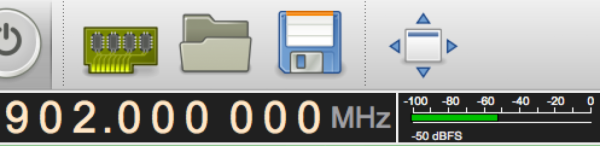
The Errata Security relies on JT65A – a radio mode made for very weak signals – to hide signals underneath the noise floor. By multiplexing data across multiple channels, this system has about the same bandwidth as a 56kbps modem from 1999. It’s not much, but it is possible to use this proxy for ProxyHam over 20 miles away from where you’re stealing WiFi from. That’s far better than ProxyHam could ever manage, and all the transmissions stay below the noise floor. The FCC and similarly equipped agencies might be able to find you, but no one with a $20 SDR dongle will.

There are no releases yet, but Errata Security plan to make the software that allows this multiplex transmissions available soon, and hope to have a Raspberry Pi-based hardware solution for this technique coming shortly. It’s a radio proxy solution that’s actually somewhat secure, and won’t immediately draw the ire of the FCC.

Hackaday Prize Entry: PICs And Arduinos, Cats And Dogs Living Together

Half of our little corner of the Internet complains about the Arduino, how the pin headers of the Arduino standard don’t make any sense, how the Arduino IDE is rubbish, gives well-reasoned arguments why the Arduino language is hindering the next generation of embedded programmers, and laments the fact that everything is commoditized into Arduino-compatible packages. The other half of our little corner of the Internet uses Microchip PICs.

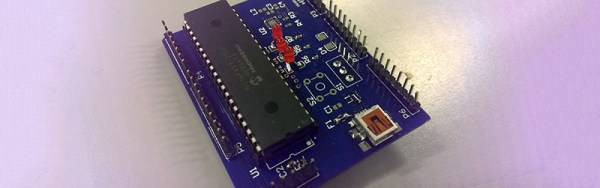
[Jarrett] is stubborn, and he wants to use a PIC with the distinctive Arduino pin layout. Thus was born PIC-On-The-Go. It’s a PIC18F4520 in the familiar goofy-pin package, made specifically for everyone who just wants to buckle down and get some work done.

This isn’t the only PIC-become-Arduino board out there; the Fubarino is a great board that speaks Arduino, but that doesn’t take advantage of our favorite Arduino shields. Either way, we’re surprised something like [Jarrett]’s project doesn’t exist yet, making it a great entry for The Hackaday Prize.

The 2015 Hackaday Prize is sponsored by:

Hackaday Prize Entry: Detecting New Meteor Showers

Go out to a field on a dark night, far away from city lights, and you might just see a shooting star. A single meteor is just a tiny fraction of all the space dust that hits our atmosphere every day; most of it goes completely unnoticed. To get a better idea of where these meteoroids come from, [Dario] and [Denis] have come up with a network of meteor-detecting ground stations to search for these extraterrestrial visitors and make it possible to retrieve the largest of these fallen stars.

This project started at the Croatian Meteor Network, a team with about two dozen surveillance cameras pointed skyward as an unblinking eye, looking for meteoroids entering the Earth’s atmosphere over the Balkans and the Adriatic sea. When two cameras detect a meteor, the path it came from – and its orbit around the Sun – can be computed. The team has already found a possible new meteor shower (PDF) that is active from late August to the middle of September.

With hundreds of cameras scattered around the globe, it’s possible to triangulate the position of these meteors and their orbit around the Sun, just like what was done with the innumerable Russian dash cams after the Chelyabinsk meteor. It’s a great project, and also one that requires a lot of computer image processing – a favorite around these parts.

The 2015 Hackaday Prize is sponsored by:

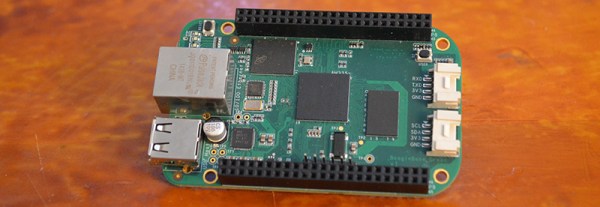
BeagleBone Green Hands-On: Lower Price, Same Horsepower

Although the BeagleBone Green was announced at the Bay Area Maker Faire last May, there hasn’t been much said about it on the usual forums and IRC channels. Now, it’s finally out and I got my hands on one of them. Through a cooperation between the BeagleBoard foundation and Seeed Studios, the best small Linux board for doing real work with small Linux boards is now cheaper, a little more modern, and green.

The BeagleBone Green is an update to the venerable BeagleBone Black, the dev board based on a TI ARM Cortex-A8. It’s an extremely capable machine with a few interesting features that make it the perfect device for embedded applications. With the BeagleBone Green, the BB Black gets a small hardware refresh and a drastic reduction in price. If you want to do real work on a Linux board, this is the one to get. Check out the review below for everything that’s been updated, everything that’s the same, and why this is one of the most interesting developments in small Linux boards in recent memory.

Continue reading “BeagleBone Green Hands-On: Lower Price, Same Horsepower”

Hackaday Prize Entry: 20,000 Weather Stations

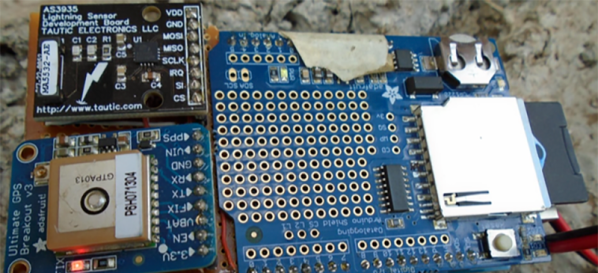
Team Tahmo has a plan to put a network of 20,000 weather stations across sub-Saharan Africa. That’s an impressive goal, and already they have pilot stations in Senegal, Chad, Nigeria, Uganda, and South Africa. For their Hackaday Prize entry, they thought it would make sense to add more advanced sensors to their weather stations, and came up with GPS, lightning, and large scale soil moisture sensors.

The sensors already deployed have the usual complement of meteorological equipment – thermometers, anemometers, barometers, and rain gauges. These stations are connected to a school’s Internet connection where students can monitor the local weather patterns and upload the data. Team Tahmo is building a small add-on board for their Prize entry using an AS3935 Franklin Lightning sensor and a GPS module.

In the interests of rapid design cycles, the team is using off-the-shelf modules for the lightning detector and GPS module. They hit up the Hackaday Prize Collabratorium for some advice on PCB design and have everything pretty much nailed down thanks to a few helpful hackers.

It’s a great project for one of the most ambitious crowdsourced data gathering projects ever conceived, and something that would vastly improve weather predictions across the African continent. Even if their entry does just monitor lightning strikes, it’s still an admirable goal and one of the most useful projects for this year’s Hackaday Prize.

The 2015 Hackaday Prize is sponsored by:

Amazon’s AI Escapes Its Hardware Prison

It’s the 21st century, and we’re still a long way from the voice-controlled computers we were all promised in the 60s, 70s, 80s, and 90s. The state of voice interaction has improved, though, and Amazon’s release of the Alexa Skills Kit (ASK) is another sure step towards a future of computers that will pay attention to you. This allows any hardware to become Alexa, your personal voice assistant with the ability to do just about anything you command.

amazon_echoUp to this point, Alexa was locked away inside the Amazon Echo, the ‘smart’ cylinder that sits in your living room and does most of what you tell it to do. Since the Amazon Echo was released, we’ve seen the Echo and the Alexa SDK used for turning lights on and off, controlling a Nest thermostat, and other home automation tasks. It’s not Google Now, Microsoft’s Cortana, or Apple’s Siri that is behind all these builds; it’s Amazon’s Alexa that is bringing us into a world where Star Trek’s [Scotty] talking into an old Mac is seen as normal.

Right now, the Getting Started guide for the Alexa Skills Kit is focused more on web services than turning lights on and air conditioning off. Sample code for ASK is provided in JavaScript and Java, although we would expect 3rd party libraries for Python to start popping up any day now. If you want to run ASK on a Raspberry Pi or other small Linux computer, you’ll need a way to do voice capture; the Jasper project is currently the front-runner in this space.

We hope this changes the home automation game in a couple of different ways. First, the ASK processes everything in the cloud so very low power devices are now ready for some seriously cool voice interaction. Second, Amazon’s move to open up what you can do with the software backend means a community developing for the hardware could eventually exert pressure on Amazon to do things like making the system more open and transparent.

Already working on some hacks with the Echo or ASK? Send in a tip to your write-up and tells us about it in the comments below.

Hackaday Prize Entry: Wearable Electrodermal Activity Monitor

Electrodermal activity, or galvanic skin response has a lot of practical applications. Everything from research into emotional states to significantly more off-the-wall applications like the E-meter use electrodermal activity. For his Hackaday Prize entry, [qquuiinn] is building a wearable biofeedback wristband that measures galvanic skin response that is perfect for treating anxiety or stress disorders by serving as a simple and convenient wearable device.

Detecting electrodermal activity has been within the capability of anyone with an ohmmeter for over a hundred years. [quin²] is doing something a little more complex than the most primitive modern means of measuring galvanic skin response and using a dual op-amp to sense the tiny changes in skin resistance. This data is fed into an ATMega328 which sends it out to a tiny LED display in the shape of an ‘x’.

Reading electrodermal activity is easy, but doing it reliably in a wearable device is not. There are issues with the skin contacts to work though, issues with the amplifier, and putting the whole thing in a convenient package. [qquuiinn] asked the community about these problems in group discussion on the hacker channel and got a lot of really good advice. That’s a great example of what a project on hackaday.io can do, and a great project for the Hackaday Prize.

The 2015 Hackaday Prize is sponsored by: