Hackaday Prize Entry: SnapVCC

While it’s the easiest way to lay out a simple circuit for prototyping, breadboards are a pain. They are the ultimate kludge; they work well enough, but no one will ever say that a solderless breadboard is the most elegant solution.

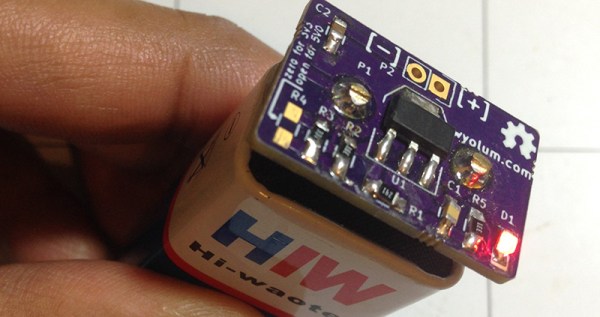
[Mahesh] isn’t completely fixing the problems of solderless breadboards, but he has come up with a better way to supply power to breadboards. It’s a project called snapVCC, and it turns a 9 volt battery into a regulated 3.3 or 5 volt supply.

The idea behind snapVCC is simple enough; just add a circuit board to the top of a nine volt and add a voltage regulator. [Mahesh] is using an LM317 adjustable regulator, with a switch to change the output voltage from 3.3 to 5 volts. An LED indicates the output active, and another switch disconnects the battery from the circuit. Yes, it’s very simple and very useful, confounding everyone who is wondering why this project didn’t already exist.


The 2015 Hackaday Prize is sponsored by:

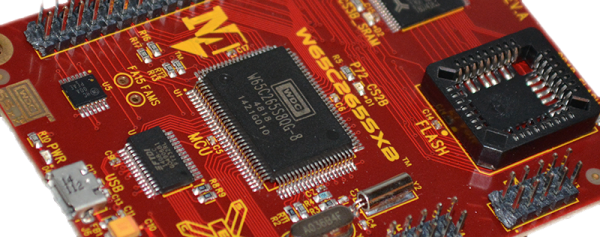
Review: Single Board 65C02 And 65C816 Computers

The 6502 is a classic piece of computing history. Versions of this CPU were found in everything from the Apple ][, to the Nintendo Entertainment System, and the Commodore 64. The history of the 6502 doesn’t end with video games; for the last forty years, this CPU has found its way into industrial equipment, medical devices, and everything else that doesn’t need to be redesigned every two years. Combine the longevity of the 6502 with the fact an entire generation of developers first cut their teeth on 6502 assembly, and you have the makings of a classic microprocessor that will, I’m sure, still be relevant in another forty years.

The cathedral of The 6502 is Western Design Center. For more than 35 years, WDC has been the home of 6502-related designs. Recently, WDC has been interested in the educational aspects of the 6502, with one of the VPs, [David Cramer], lending his time to an after-school club teaching opcodes.

The folks at WDC recently contacted me to see if I would give their hardware a close look, and after providing a few boards, this hardware proved to be both excellent. They’re great for educators adventurous enough to deviate from the Arduino, Processing, and Fritzing zeitgeist, and for anyone who wants to dip their toes into the world of 65xx development.

Continue reading “Review: Single Board 65C02 And 65C816 Computers”

Hackaday Prize Entry: Wearable Robotics Toolkit

The Internet overflows with prosthetics projects, and to a large extent this is somewhat understandable. Prosthetic devices are ultimately a custom made for each user, and 3D printers are trying to find a purpose. Put two and two together, and you’re going to get a few plastic limbs.

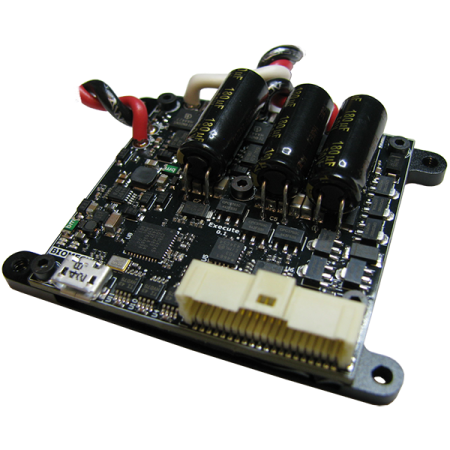
The electronics required for advanced prosthetics are a bit harder than a 3D scanner and a printer. If you’re designing a robotic leg, you will need to pump several hundred watts through an actuator to move a human forward. For the last few years, [Jean-François Duval] has been working on this problem at the MIT Media Lab Biomechatronics group and has come up with his entry for the Hackaday Prize. It’s a motor and motor control system for wearable robotics that addresses the problems no other project has thought of yet.

The goal of the FlexSEA isn’t to build prosthetics and wearable robotics – the goal is to build the electronics that drive these wearables. This means doing everything from driving motors, regulating power consumption, running control loops, and communicating with sensors. To accomplish this, [Jean-François] is using the BeagleBone Black, a Cypress PSoC, and an STM32F4, all very capable bits of hardware.

So far, [Jean-François] has documented the hardware and the software for the current controller, and has a few demo videos of his hardware in action. You can check that out below.

Continue reading “Hackaday Prize Entry: Wearable Robotics Toolkit”

Hackaday Prize Entry: Superb Audio With The Teensy

The Raspberry Pi and Teensy 3 both have I2S interfaces, and that means these boards can be used to play very high quality audio. A codec and an I2S interface is one thing, but turning that digital stream into a quality analog output is another thing entirely. You need only look at audiophile forums for enough mis- and disinformation for that evidence.

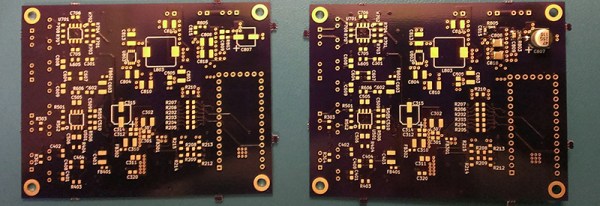
For his Hackaday Prize entry [William Hollender] is building an audio board for the Teensy 3.x. It features very high-end opamps, the right filters, and the correct topology to turn a digital audio stream into an analog signal that would please the most temperamental ear.

The Teensy Super Audio Board uses the Cirrus CS4272 audio codec chip, a high quality chip that can handle sample rates of up to 192kHz at 24 bit depth. This chip doesn’t include the analog input and output buffers, and this means [William] has quite a build in front of him. This means using high quality opamps, low noise power supplies, and knowing how to build a circuit and measure its noise.

So far, the tests revealed incredible dynamic range, flatness, and frequency response of this tiny little board. It also works with the Raspberry Pi. Now it’s just a matter of getting a few more of these boards put together for the Best Product part of the Hackaday Prize.


The 2015 Hackaday Prize is sponsored by:

A Handheld CNC Router

Over the last few years, the state of the art in handheld routers has been tucked away in the back of our minds. It was at SIGGRAPH in 2012 and we caught up to it at Makerfair last year. Now, it’s getting ready for production.

Originally called Taktia, the Shaper router looks a lot like a normal, handheld router. This router is smart, though, with the ability to look at a work piece marked with a tape designed for computer vision and slightly reposition the cutter in response to how the user is moving it. A simple description doesn’t do this tool justice, so check out the video the Shaper team recently uploaded.

With the user moving the Shaper router over a work piece and motors moving the cutter head, this tool is able to make precision cuts – wooden gears and outlines of the United States – quickly, easily, and accurately. Cutting any shape is as easy as loading a file into Shaper, calling that file up on a touch screen display, and turning on the cutter. Move the router around the table, and the Shaper takes care of the rest.

Accuracy, at least in earlier versions, is said to be on the order of a hundredth of an inch. That’s good enough for wood, like this very interesting bit of joinery that would be pretty hard with traditional tools. Video below.

Thanks [martin] for the tip.

Continue reading “A Handheld CNC Router”

Hackaday Prize Entry: Smart Low Voltage Lighting

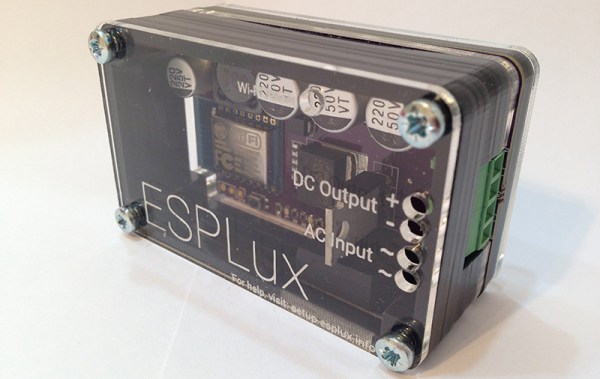
A common theme around Internet of Things things is connecting a relay to the web. It’s useful for everything from turning on a lamp from across the country to making sure your refrigerator is still running without the twice-hourly calls from the International Refrigeration Commission. For his Hackaday Prize project, [Matt] is turning lights on and off with an ESP8266 WiFi module, but not just any lights: he’s focusing on low-voltage lighting with the ESPLux.

Most downlights and landscape lights run off a 12 or 24 V transformer, and because [Matt] wanted to add dimming to his lighting box, he’s rectifying the low voltage AC to DC; PWMing an output to light an LED is a much better idea than chopping AC with a triac.

With a rectifier, MOSFET, and an ESP8266, the ESPLux is a simple build, but the project doesn’t end with electronics. for automation and control of these lights, [Matt] is turning to OpenHAB, automation software that works with everything you would ever use to make your home smart.

The 2015 Hackaday Prize is sponsored by:

Hackaday Prize Entry: From Q To NAND

The apocalypse is coming, and the last time I checked, not many people have a semiconductor fab in their garage. We’ll need computers after the end of the world, and [matseng]’s project for the Hackaday Prize is just that – a framework to build computers out of discrete components.

The apocalyptic spin on this project is slightly exaggerated, but there is a lot someone can learn by building digital devices out of transistors, resistors, and diodes. The building blocks of [matseng]’s computer are as simple as they come: he’s using three resistors, four diodes, and one NPN transistor to build a single NAND gate. These NAND gates can then be assembled into any form of digital logic. You’re never going to get a better visual example of functional completeness.

A project like this must be approached from both the top down and bottom up. To go from a high level to ones and zeros, [matseng] built an assembler and an emulator. Some ideas of what the instruction set will be are laid out in this project log, and for now [matseng] is going for a Harvard architecture with eight registers. It’s a lot of work for a computer that will be limited by how much memory [matseng] can be wired up, but as far as ambition goes, there aren’t many projects in the Hackaday Prize that can match this tiny, huge computer.

The 2015 Hackaday Prize is sponsored by: