Astronaut Or Astronot: The Final Round Is Over

For the last few months, we’ve been asking the Hackaday.io community for their thoughts on what the best projects are in the 2015 Hackaday Prize. We’ve also been giving away some fabulous prizes to people who have voted, and we just wrapped up the last round of voting? Did anyone win? Check out the video below.

Continue reading “Astronaut Or Astronot: The Final Round Is Over”

Hackaday Prize Entry: Synthetic Aperture Multispectral Imaging

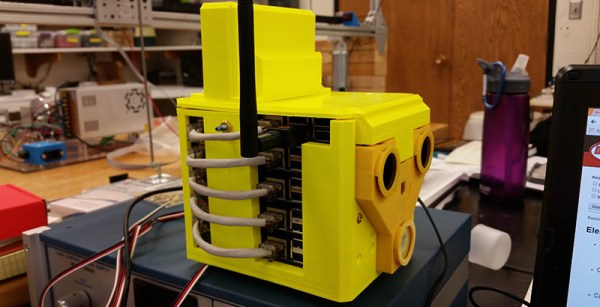
[Conrad] was tasked with building a synthetic aperture multispectral imaging device by his professor. It’s an interesting challenge that touches on programming, graphics, and just a bit of electrical engineering.

Tucked inside a garish yellow box that looks like a dumb robot are five Raspberry Pis, a TP-Link Ethernet switch, three Raspberry Pi NOIR cameras, and a Flir Lepton thermal camera. With three cameras, different techniques can be used to change the focal length of whatever is being recorded – that’s the synthetic aperture part of the build. By adding different filters – IR pass, UV, visual, and thermal, this camera can record images in a huge range of wavelengths.

[Conrad] has come up with a completely modular toolbox that allows for a lot of imaging experiments. By removing the filters, he can track objects in 3D. With all the filters in place, he can narrow down what spectra  he can record. It’s a mobile lab that’s completely modular, and we can’t wait to see what this little box can really do.


The 2015 Hackaday Prize is sponsored by:

No, Mounting A Gun To A Quadcopter (Probably) Isn’t Illegal

Earlier this month, [Austin Haghwout] posted a video on YouTube of a remote controlled quadcopter armed with a semiautomatic handgun. While there are no details of this build, it’s safe to say any reasonably sized quadcopter could be armed in such a manner; just strap a pistol to the frame, add a servo, and connect the servo to the RC receiver. We don’t think this is the first time it’s been done, but has garnered the most attention.

There is nothing novel about mounting a handgun to a quadcopter. Anyone with any experience with RC flying could replicate this build, and the only interesting part of watching a video of a quad firing a gun is seeing how the flight controller reacts to the recoil. However, in the pursuit of the exploitation of a fear of technology, this video has gone viral.

The Verge calls it, ‘totally illegal’, while The Christian Science Monitor asks how it is legal. Wired posits it is, ‘most likely illegal,’ while CNET suggests, ‘surely this isn’t legal.’ In a rare break from reality, YouTube commentors have demonstrated a larger vocabulary than normal, calling the build, ‘felonious.’

With so many calling this build illegal, there should be someone who could point out the laws or regulation [Austin Haghwout] is violating. This information is surprisingly absent. In a Newsweek post, a representative from the Bureau of Alcohol, Tobacco, Firearms, and Explosives is quoted as saying:

“ATF has reviewed the video with local law enforcement and other federal agencies. It does not appear that the device violates any existing firearms regulations…”

The Associated Press reports no state laws were broken by [Austin]. With the BAFTE and Connecticut State Police both signing off on this build, the issue of jurisdiction becomes more pronounced. How, exactly, is a gun mounted on a quad illegal?

The answer, as with all things involving quadcopters, comes from the FAA. We could find no regulations explicitly banning handguns on remote controlled quadcopters, but of all stories and posts on [Austin]’s handiwork, this is the closest anyone has come to providing the framework for calling this build illegal:

No pilot in command of a civil aircraft may allow any object to be dropped from that aircraft in flight that creates a hazard to persons or property. However, this section does not prohibit the dropping of any object if reasonable precautions are taken to avoid injury or damage to persons or property.

-FAR Part 91 Sec. 91.15

That’s it. The closest anyone has come to providing a reason why a semiauto quadcopter is illegal: because the cartridge (and bullet), are ‘dropped’ from a quad. The Feds charging [Austin] with “dropping” a bullet from a quadcopter is like taking down [Al Capone] for Income Tax Evasion. The difference being that [Al] was a notorious criminal who had obviously harmed a large swath of people and [Austin] doesn’t seem to be harming anyone.

Although [Austin]’s video of a gun toting quad is only fourteen seconds long, a few reasonable assumptions can be made about his small experiment in flying firepower. The video shows the quad hovering a few feet above the ground. This is surely allowed by the recently published safety guidelines for sUAS users. The gun itself appears to be firing into an offscreen hillside – a sensible precaution. If the only justification for the FAA’s investigation of [Austin]’s video is FAR 91.15, he’s on easy street.


Hackaday Prize Entry: An FPGA’d Propeller

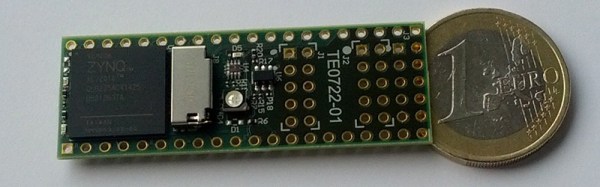
The Parallax Propeller is an exceptionally interesting chip that doesn’t get the love it deserves. It’s a 32-bit microcontroller with eight independent cores that are each powerful enough to do some real computation.  Around this time last year, the source for the Propeller was opened up and released under GPL 3.0, along with the mask ROM and an interpreter for the Propeller-specific language, Spin. This release is not only a great educational opportunity, but a marvelous occasion to build some really cool hardware as [antti.lukats] is doing with the Soft Propeller.

[antti]’s Soft Propeller is based on the Xilinx ZYNQ-7000, a System on Chip that combines a dual core ARM Cortex A9 with an FPGA with enough logic gates to become a Propeller. The board also has 16MB of Flash used for configuration and everything fits on a Propeller-compatible DIP 40 pinout. If you’ve ever wanted to play around with FPGAs and high-power ARM devices, this is the project for you.

[antti] already has the Propeller Verilog running on his board, and with just a bit more than 50% of the LUTs used, it might even be possible to fit the upcoming Propeller 2 on this chip. This build is just one small part of a much larger and more ambitious project: [antti] is working on a similar device with HDMI, USB, a MicroSD, and 32MB of DDR2 RAM. This will also be stuffed into a DIP40 format, making it an incredibly powerful system that’s just a bit larger than a stick of gum.

The 2015 Hackaday Prize is sponsored by:

Hackaday Prize Entry: Two Factor Authentication Key

Because people are generally idiots when it comes to choosing passwords — including people who should know better — Google created Google Authenticator. It’s two-factor verification for all your Google logins based on a shared secret key. It’s awesome, and everyone should use it.

Actually typing in that code from a phone app is rather annoying, and [Alistair] has a better solution: an Authenticator USB Key. Instead of opening up the Authenticator app every time he needs an Authenticator code, this USB key will send the code to Google with the press of a single button.

The algorithm behind Google Authenticator is well documented and actually very simple; it’s just a hash of the current number of 30-second periods since the Unix epoch and an 80-bit secret key. With knowledge of the secret key, you can generate Authenticator codes until the end of time. It’s been done with an Arduino before, but [Alistair]’s project makes this an incredibly convenient way to input the codes without touching the keyboard.

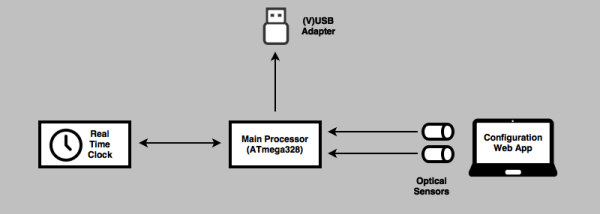
The current plan is to use an ATMega328, a real-time clock, and VUSB for generating the Authenticator code and sending it to a computer. Getting the secret key on the device sounds tricky, but [Alistair] has a trick up his sleeve for that: he’s going to use optical sensors and a flashing graphic on a web page to send the key to the device. It’s a bit of a clunky solution, but considering the secret key only needs to be programmed once, it’s not necessarily a bad solution.

With a small button plugged into a USB hub, [Alistair] has the perfect device for anyone annoyed at the prospect at opening up the Authenticator app every few days. It’s not a replacement for the app, it just makes everything easier.

The 2015 Hackaday Prize is sponsored by:

Automatically Designing 3D Printers From E-Waste

No one wants to design consumer electronics that last longer than a few years. This trend is an ecological disaster, with millions of tons of computers, printers, fax machines and cell phones ending up in landfills. In these landfills, all the lead and chemicals used to extract minuscule amounts of gold plating leech into the environment. Turning it all around is monumental, but reusing some of this waste can help make a difference.

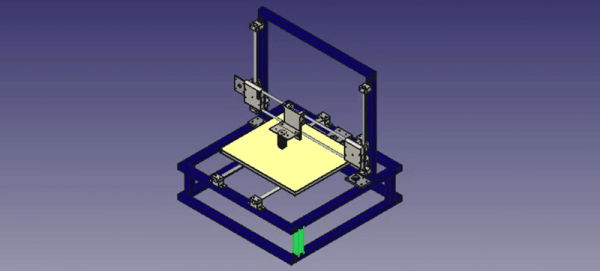
[Masterperson] and [Maaphoo] have been working on a way to turn those tons of e-waste into something useful. They’ve come up with a framework for turning e-waste into 3D printers. With a clever application of Python and FreeCAD Macros, this project can generate a model of a 3D printer using motors, shafts, and bearings taken from discarded 2D printers.

Right now a printer can be configured by adding the parts you have on hand to a configuration file, running a Python macro in FreeCAD, and waiting until the macro generates the parts to build a cartesian bot. This macro also spits out the files for the parts that need to be printed, and can interface with Plater to optimize the placement of these printed parts on an existing printer.

It’s a very cool project, but it’s not done yet: the team is looking for help to refine the printer designs and possibly growing more designs than a simple cartesian bot. Anything that is explicitly designed to pick the meat off of 2D printers is a great idea, and turning those into real 3D printers is the cherry on top.

Hackaday Prize Entry: An Arduino Alarm System

The last few years have seen an incredible increase in the marketing for home automation devices. Why this tech is just picking up now is something we’ll never understand – home automation systems have been around for decades, mostly in the form of security systems. For his Hackaday Prize entry, [IngGaro] is building an Arduino-based security system that does everything you would expect from a home automation system, from closing the shutters to temperature monitoring.

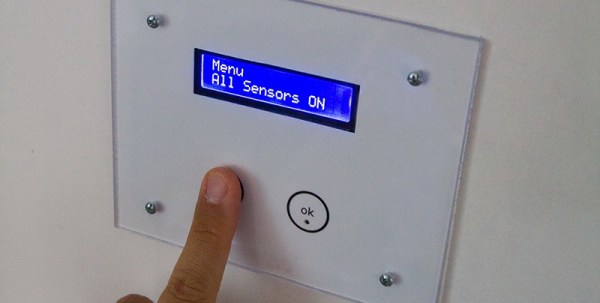
[IngGaro]’s system is built around a shield for an Arduino Mega. This shield includes connections to an alarm system, a GSM modem, temperature and humidity sensors, an Ethernet module, and IR movement sensors. This Arduino Mega attaches to a control box mounted near the front door that’s loaded up with an LCD, an NFC and RFID reader, and a few buttons to arm and disarm the system.

This project has come a long way since it was featured in last year’s Hackaday Prize. Since then [IngGaro] finally completed the project thanks to a change in the Ethernet library. It’s much more stable now, and has the ability to completely control everything in a house that should be automated. Now all [IngGaro] needs to do is create a cool PCB for the project, but in our opinion you can’t do much better than the mastery of perfboard this project already has.

The 2015 Hackaday Prize is sponsored by: