Gunpowder From Urine, Fighting A Gorn

[Cody] has a nice little ranch in the middle of nowhere, a rifle, and a supply of ammunition. That’s just fine for the zombie apocalypse, but he doesn’t have an infinite supply of ammo. Twenty years after Z-day, he may find himself without any way to defend himself. How to fix that problem? He needs gunpowder. How do you make that? Here’s a plastic jug.

There are three ingredients required to make gunpowder – saltpeter, charcoal, and sulfur. The last two ingredients are easy enough if you have trees and a mine like [Cody], but saltpeter, the a source of nitrates, aren’t really found in nature. You can make nitrates from atmospheric nitrogen if you have enough energy, but [Cody] is going low tech for this experiment. He’s saving up his own urine in a compost pile, also called a niter bed. It’s as simple as putting a few grass clippings and straw on a plastic tarp, peeing on it for a few months, and waiting for nitrogen-fixing to do their thing.
Calcium_nitrate
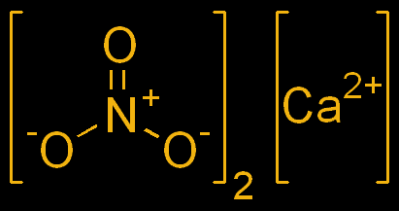
Calcium Nitrate

[Cody] doesn’t have to wait a year for his compost pile to become saturated with nitrates. He has another compost pile that has been going for about 18 months, and this is good enough for an experiment in extracting calcium nitrate. After soaking and straining this bit of compost, [Cody] is left with a solution of something that has calcium nitrate in it. This is converted to potassium nitrate – or saltpeter – by running it through wood ash. After drying out this mess of liquid, [Cody] is left with something that burns with the addition of a little carbon.

With a source of saltpeter, [Cody] only needs charcoal and sulfur to make gunpowder. Charcoal is easy enough to source, and [Cody] has a mine with lead sulfide. He can’t quite extract sulfur from his ore, so instead he goes with another catalyst – red iron oxide, or rust.

The three ingredients are combined, and [Cody] decides it’s time for a test. He has a homebuilt musket, or a piece of pipe welded at one end with a touch hole, and has a big lead ball. With his homebrew gunpowder, this musket actually works. The lead ball doesn’t fly very far, but it’s enough to put a dent in a zombie or deer; not bad for something made out of compost.

Historically, this is a pretty odd way of making gunpowder. For most of history, people with guns have also had a source of saltpeter. During the Napoleonic Wars, however, France could not import gunpowder or saltpeter and took to collecting urine from soldiers and livestock. This source of nitrates was collected, converted from calcium nitrate to potassium nitrate, and combined with charcoal and sulfur to field armies.

Still, [Cody] has a great example of what can be done using traditional methods, and the fact that he can fire a ball down a barrel is proof enough that the niter bed he’s peeing in will produce even better gunpowder.
Continue reading “Gunpowder From Urine, Fighting A Gorn”

A Revolutionary Input Device, 30 Years Too Late

Way before you kids had touch screens and mice, we had to walk uphill both ways to tell a computer where we were pointing at on the screen. I speak, of course, of light pens. When these photodiodes in a pen were pointed at a CRT, the display driver would tell the computer where the pen was pointing. It’s a pretty incredible video hack today, and these things were around in the 1970s. You could, of course, use a light pen with most of the old 8-bit home computers, including the Commodore 64.

[Jan] has a soft spot for the light pen on the C64. So much so he made a new input device using this tech. It’s great, and if this existed in 1985, all the cool kids would have known about it.

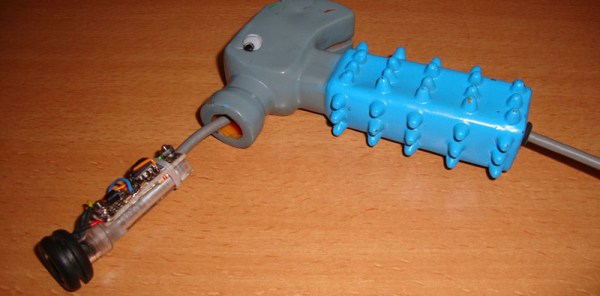
The build is called the LightHammer. It’s a light pen, inside the head of a plastic hammer, with a few springs, nuts, and washers to tell the computer to read the light pen input. The light pen itself is just a photodiode with a few transistors; it was a simple circuit in the 80s, and it’s a simple circuit today.

A new input device isn’t worth anything without an app to show off the tech, and [Jan] is about three steps ahead of us here. He wrote a game for this LightHammer – a digital version of Whac-A-Mole and Simon. They’re exactly what you think they are: the classic ‘repeat the computer’ and ‘murder rodents’ games.

If that’s not enough, [Jan] also built an arcade cabinet for his C64 setup, with the monitor, joysticks, a 1541, and a TV mounted in a cabinet that would look great in a bar. You can check out a video of that and the games using the LightHammer below.

Continue reading “A Revolutionary Input Device, 30 Years Too Late”

Hackaday Prize Entry: An Open Source Industrial Camera

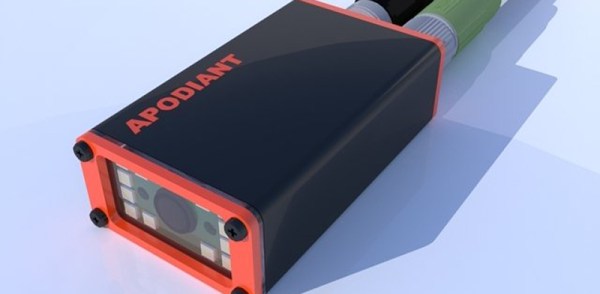
Over the last few years, connecting a camera to the Internet has gotten cheaper and cheaper. The advances that made this possible did not come through security cameras, but instead tiny cell phone camera modules, ARM boards, and embedded computing. Right now, if you want a livestream of your back yard, you’d probably get a Raspberry Pi and camera module. This will work for 90% of cases, but what if you want to livestream a slightly harsher environment? What if you want image processing right on the camera? What if you want this camera to have a rating for environmental protection?

[Apodiant]’s entry for the 2015 Hackaday Prize is solving the latter problem. It’s an Open Source Industrial Smart Camera with Ethernet, USB, and serial outputs, an ARM CPU for image processing, all tucked away in a sturdy aluminum enclosure.

The preliminary BOM for this camera is an iMX6 – a very capable microcontroller that can run Linux and OpenCV. The image sensor is a 1.2 megapixel unit [Apodiant] already has experience with, and the enclosure is an off the shelf deal for anyone who wants to build their own.


If this sort of setup sounds familiar, you’re right: there have been a few projects that have taken camera modules, added a powerful microcontroller, and run image processing on them. The latest in a long line of these projects is the OpenMV. That had a successful Kickstarter, and since [Apodiant] is going for the Hackaday Prize Best Product competition, it looks like a good fit.


The 2015 Hackaday Prize is sponsored by:

Hackaday Links Column Banner

Hackaday Links: June 14, 2015

You know we’re running this gigantic contest to build hardware and send someone to space, right? We’re doing community voting right now. If you’re on Hackaday.io, head over there and pick the best project. We’re giving away t-shirts and $1000 gift cards to people who vote. The drawing for this round is next Friday.

MicroPython is a pretty interesting development in the area of interpreted languages running on microcontrollers. It’s Python, the BASIC of the modern era, and now it’s being funded by the ESA. Great news, there’s going to be a port to SPARC, and it looks like MicroPython is going to be in a few satellites.

[EloquentlyMawkishBunny]’s calculator stopped working on the morning of his AP Physics test. It was the ribbon cable for the display. What did he do? He grabbed some magnet wire and made it work. If I’m reading this right, he did this the day of his AP test. Wow.

[Will] has made a name for himself by building roller coasters in his backyard. He’s also worked on the ProtoPalette, and now he’s building a hackerspace in Concord, California.

[Josh] needed to drill some very large holes with his mill. He decided a hole saw was the easiest way to do this, but his hole saw has a hex shank. He ended up chopping the shank of a hole saw extension, basically turning it into a hex to round adapter.

Did you know the Arduino IDE on Raspbian is stuck at version 1.0.5? The newest version is 1.6.4, and there’s useful stuff like autosave in the IDE now. Amazing. [CRImier] got the latest Arduino IDE working on the Raspberry Pi 2. Yes, there’s an issue up but if for some reason you’re programming Arduinos on the Pi, you should probably do this yourself.

Oooohhhh, case modding. The Intel NUC is a pretty interesting platform for case modding; it’s small, and I shouldn’t have to remind anyone of all the cool case mods that were created when the Mini-ITX format gained popularity in the early ‘aughts. [Femke] got herself an Intel NUC, made a case, and the results are amazing. How’d she get that metal bowl? Metal spinning. Very cool.

Crowdfunding Follies: Proof That Ohm’s Law Is Arcane Knowledge

This is a cell phone case that can recharge a cellphone using energy captured from its own radio. It’s been featured on dozens of tech blogs, wowed judges at TechCrunch Disrupt, and it’s a Kickstarter Staff Pick. It’s also proof that nearly everyone in the media who claims any knowledge of technology has no idea behind the foundational properties of technology.

What it is

The Nikola Phone Case from Nikola Labs is a very special phone case for the iPhone 6 and Samsung Galaxy S6. The claims behind this cell phone case state it will recharge your battery by capturing radio energy put out by the cell phone itself. This means capturing RF from the WiFi and cellular transmitters. This captured energy is then converted into something that can recharge the phone, is sent to the USB or Lightning port, and – theoretically – the cycle of electrons turning into photons begins again.

Why it’s crap

Astonishingly, this is not a perpetual motion machine, a device that is completely impractical, or an outright fraud. It’s deceptively correct when it comes to the physics of this device, and as always implementation is everything.

Inside each Nikola Phone Case is a small antenna, boost converter, and circuitry to capture the RF energy coming from the phone. This phone case will actually harvest RF energy, but it will never be able to extend the life of the phone’s battery. Nikola Labs claims their phone case will recover 30% of a battery’s life by harvesting RF energy and using that energy to recharge the phone. However, the energy for this RF energy harvesting scheme comes from the phone itself. The captured energy that would – ideally – end up at a cell phone tower or WiFi router will disappear into this cell phone case. This results in both a dramatic decrease in reception and most likely an increase in power draw due to the phone increasing its transmit power.

To Nikola Labs’ credit, the FAQ on their Kickstarter does address concerns that a phone’s transmitter and antenna may be affected:

The device may change the impedance and overall pattern slightly. We are performing detail characterization of these changes, if any.

Nikola Labs has not performed due diligence on their design. There is a method that will report the RSSI of the cellular radio in an Android phone. Any competent engineer would, upon first seeing this device, figure out if signal strength is affected. This can be done in a few dozen lines of Java. It can be done in under an hour by someone who has never programmed an Android device. Nikola Labs does not provide a comparison of the signal strength of a phone both with and without their case. This is evidence of incompetence, if not malice.

Simply by definition, any device that captures RF energy will ‘shadow’ the transmission. Just like putting a solar panel in front of a flashlight, energy will be captured, but the overall light output of the flashlight and solar panel system will decrease. Nikola Labs has an answer to that:

The device harvests the RF energy around the phone, which is usually absorbed by the hand holding the phone.

It is true that the human body will absorb RF coming out of a phone. WiFi works on the same frequencies as a microwave oven, and defrosting a piece of chicken in a microwave isn’t that much different from grabbing an antenna on a router. Lower powers and different geometries aside, you are right now absorbing microwaves from a WiFi router.

The best way of understanding why simply holding a phone isn’t a very big deal is coming at it from the direction of designing a smart phone. One of the biggest drivers behind the design of a cell phone is how long it will last on a single charge. You can design a phone with a powerful CPU and a huge screen, but the battery won’t last long. Likewise, the engineers that design cell phones will put the antennas in an out of the way place, where they won’t be absorbed by the human body. The Nikola Labs case destroys the engineering decisions inside each cell phone. Think about it; if power was wasted inside a cell phone, wouldn’t engineers at Apple and Samsung work to reduce that waste?

Why everything else is crap, too

There is simply no excuse why hundreds of people would give tens of thousands of dollars to a company that makes outrageous claims with zero evidence. One could attribute this to the public’s severe lack of understanding when dealing with electricity or radio. This, in my opinion, is far too kind.

Nikola Labs’ Kickstarter would not exist without the help of Kickstarter itself and members of the tech media. We first heard of Nikola Labs at TechCrunch Disrupt, where four judges could not find anything wrong with this technology. The presentation at Disrupt went on to be covered by Engadget and a flurry of other tech blogs. Now, dozens of other tech blogs have reported on this Kickstarter, and Kickstarter itself has named it a Staff Pick.

Yes, there are stupid people out there. There are people who will throw money at anything. There are also people who will Barnum up the place sell snake oil to rubes. The fact that Kickstarter would endorse something without a technical assessment defies belief. The only conceivable reason this could be a Staff Pick on Kickstarter is because Kickstarter believes it will be funded, thus earning them a percentage of gross.

This is the end of capitalism, folks. No longer do you need to innovate and make a better mouse trap. All you need to do is convince enough people that you’ve made a better mouse trap.

Neural Networks And MarI/O

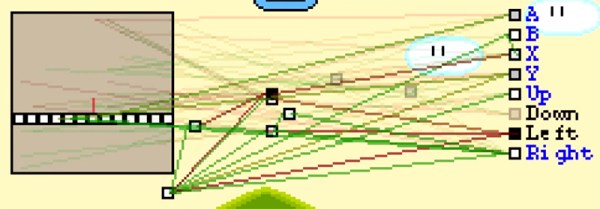
Minecraft wizard, and record holder for the Super Mario World speedrun [SethBling] is experimenting with machine learning. He built a program that will get Mario through an entire level of Super Mario World – Donut Plains 1 – using neural networks and genetic algorithms.

A neural network simply takes an input, in this case a small graphic representing the sprites in the game it’s playing, sends that input through a series of artificial neurons, and turns that into commands for the controller. It’s an exceedingly simple neural network – the network that can get Mario through an entire level is less than a dozen neurons – but with enough training, even simple networks can accomplish very complex tasks.

To train the network, or weighting the connections between inputs, neurons, and outputs, [SethBling] is using an evolutionary algorithm. This algorithm first generates a few random neural networks, watches Mario’s progress across Donut Plains 1, and assigns a fitness value to each net. The best networks of each generation are combined, and the process continues for the next generation. It took 34 generations before MarI/O could finish the level without dying.

A few members of the Internet’s peanut gallery have pointed to a paper/YouTube video by [Tom Murphy] that generalized a completely different technique to play a whole bunch of different NES games. While both [SethBling]’s and [Tom Murphy]’s algorithms use certain variables to determine its own success, [Tom Murphy]’s technique works nearly automatically; it will play about as well as the training data it is given. [SethBling]’s algorithm requires no training data – that’s the entire point of using a genetic algorithm.

Continue reading “Neural Networks And MarI/O”

Hackaday Prize Entry: A DIY Smartphone

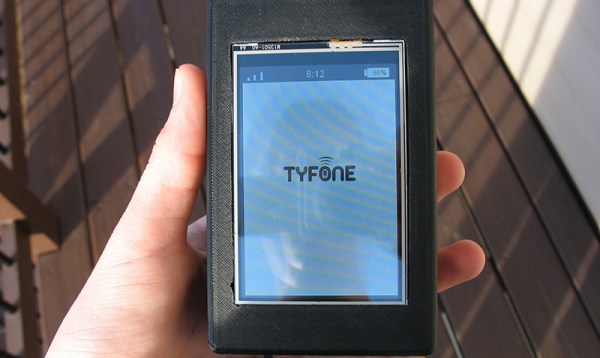
It may not change the world, but [Tyler]’s DIY smartphone is a great example of what you can do with off-the-shelf parts. He built a complete, working cell phone using a Raspberry Pi, a few parts from Adafruit, and a 3D printed enclosure.

Inside the Tyfone is a Raspberry Pi Model A, an Adafruit FONA cellular module, a PiTFT, and not much else. There’s a 1200 mAh battery in there, and a 3D printed case keeps everything together.

For the OS, [Tyler] isn’t running Android; that’s only for the Raspi 2, and the Raspberry Pi 2 Model A isn’t out yet. Instead, [Tyler] wrote his own not-OS in Python. It can send and receive SMS messages, make calls, take pictures, connect to WiFi networks, and do just about everything else a Nokia from 2003 can do.

[Tyler] put together a video going over all of the features of his Tyfone. You can check that out below.


The 2015 Hackaday Prize is sponsored by:

Continue reading “Hackaday Prize Entry: A DIY Smartphone”