Software USB On The STM8

STM8

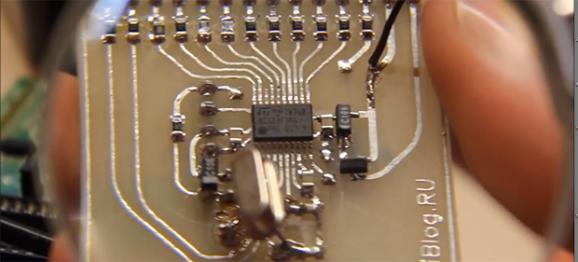
Thanks to V-USB, software-based USB is all the rage now, with a lot of uses for very small and low power microcontrollers.[ZiB] wondered if it would be possible to implement a USB controller on the STM8 microcontroller (Google translation) in software and succeeded.

The STM8 is a bit of a change from the usual 8-bit micros we see like AVRs and PICs. [ZiB] chose the STM8S103F3, although any chip in the STM8 family will work with this project when a 12MHz crystal is attached.

The build began by generating USB signals with the help of a whole lot of NOPs. This code doesn’t take up much space – only 300 bytes, and the receiving code (Google translation) is similarly sized.

The code isn’t quite there yet, but [ZiB] has proven a software-based USB implementation on the STM8 is possible. All the code is available for download (comments in Russian) and a video demoing the project available below. If anyone cares to translate this project to English, we’ll post a link to your work here.


Continue reading “Software USB On The STM8”

Turning A Tiny CRT Into A Monitor

TV

[GK] picked up a few tiny 2″ CRTs a while back and for the longest time they’ve been sitting in a box somewhere in the lab. The itch to build something with these old tubes has finally been scratched, with a beautiful circuit with Manhattan style construction.

[GK] has a bit of a fetish for old oscilloscopes, and since he’s using an old ‘scope tube, the design was rather simple for him; there aren’t any schematics here, just what he could put together off the top of his head.

Still, some of [GK]’s earlier projects helped him along the way in turning this CRT into a monitor. The high voltage came from a variable output PSU he had originally designed for photomultiplier tubes. Since this is a monochrome display, the chrominance was discarded with an old Sony Y/C module found in a part drawer.

It’s a great piece of work that, in the words of someone we highly respect is, “worth more than a gazillion lame Hackaday posts where someone connected an Arduino to something, or left a breadboard in a supposedly “finished” project.” Love ya, [Mike].


Hackaday Retro Edition: AppleTalk

retro

If you do a survey of what makes and models of classic computers manage to pull off a Retro Success by loading our Web 1.0 retro site, you’ll notice a disproportionate number of classic Macintosh computers, the cute, small all-in-one boxes with a nine-inch black or white screen. Part of this is the nigh indestructible nature of these boxes, and part of this is the networking built into every classic Mac – AppleTalk.

The physical connections for AppleTalk is just a small breakout box with two Mini-DIN connectors (or RJ11 phone jacks for PhoneNet) attached to one of the serial ports on the Mac. This isn’t just a null modem connection, though. An AppleTalk network can support up to 32 nodes, file transfer, networked printers, and in later updates booting an Apple IIGS from a networked drive. Whenever you have a few classic Macs in one room, an AppleTalk network is bound to appear at some point, especially considering the limitations of an 800kB disk drive for sneakernetting and the fact the AppleTalk software is supplied with every version of the operating system.

[Chris] had an old dual disk Macintosh SE he had brought back from the dead, but his modern expectations of Internet On Every Computer meant this cute little compy was severely lacking. Yes, SCSI to Ethernet adapters exist, but they’re surprisingly expensive. Modems are right out because of landlines. How did he solve this problem? With AppleTalk, of course.

After picking up a pair of PhoneNet adapters, [Chris] plugged one into a PowerPC mac running OS 9. MacTCP, the Apple TCP/IP control panel for classic Mac operating systems, is able to encapsulate IP traffic into AppleTalk Packets. After turning the PowerPC mac into a router, [Chris] managed to get his all-in-one SE on the internet.

The only problem with this setup is the browser. NCSA Mosaic doesn’t have the ability to send traffic to a proxy server, but another classic Mac browser, MacWeb 2.0c does. This allowed him to load up our retro site using forgotten and long unsupported technologies.


If you have an old computer sitting around, try to load our retro site with it. Take a few pictures, and we’ll put it up in one of our Retro Roundups

Stop Motion Water Droplets

logo

The folks at Physalia studio were asked by a company called IdN to produce a little bit of video with a logo. After tossing a few ideas around, they hit upon the concept of projecting the IdN logo inside a falling water droplet. CGI would never get this idea right, so the finished product is the result of stop-motion animation created inside several thousand falling drops of water.

Taking a picture of a falling water droplet was relatively easy; a small drip, a laser pointer and photodiode, and a flash trigger were all that was needed to freeze a drop of water in time. The impressive part of the build is a motion control system for the camera. This system moves the camera along the vertical axis very slowly, capturing one water droplet at a time.

Behind the droplet is a an animation that’s seemingly inspired by a Rorschach test, ending on the IdN logo. The frames for these animations were printed out and placed inside the test chamber/studio upside down to account for the optical effects of a sphere of water.

The end result is a product of over 20,000 pictures taken, all edited down into a single 30-second shot. An amazing amount of work for such a short video but as you can see in the videos below, it’s well worth the effort.

Continue reading “Stop Motion Water Droplets”

The Credit Card Sized GameBoy

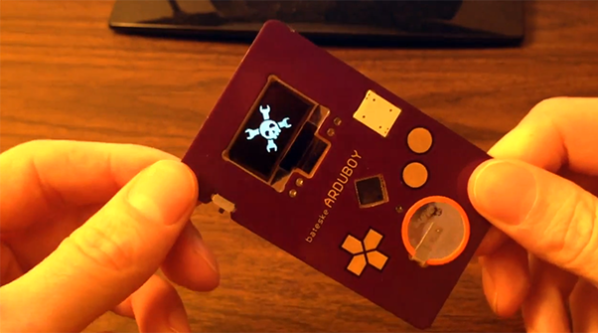
Think you’ve seen every possible type of Arduino based hand held video game? [Kevin] managed to coax something new out of the theme with a very clever credit card sized console that uses some very interesting construction techniques.

The inspiration for this project began when [Kevin] dropped an SMD resistor into a drill hole on a PCB. This resistor fell right through the hole, giving him the idea creating a PCB with milled cutouts made to fit SMD components. With a little experimentation, [Kevin] found he could fit a TQFP32 ATMega328p  – the same microcontroller in the Arduino – in a custom square cutout. The rest of the components including a CR2016 battery and OLED display use the same trick.

The rest of the design involved taking Adafruit and Sparkfun breakout boards, and modifying the individual circuits until something broke. Then, off to Eagle to create a PCB.

[Kevin]’s experiment in extremely unusual PCB design worked, resulting in a credit-card sized “Game Boy” that’s only 1.6 millimeters thick. The controls are capacitive touch sensors and he already has an easter egg hidden in the code; enter the Konami code and the Hackaday logo pops up to the tune of [Rick Astley]’s magnum opus.

Now [Kevin] is in a bit of a bind. He’d like to take this prototype and turn it into a crowd sourced campaign. In our opinion, this “Game Boy in a wallet” would probably do well on a site like Tindie, but any sort of large scale manufacturing is going to be a rather large pain. If you have any wishes, advice, of complaints for [Kevin] he’s got a few links at the bottom of his project page.

Homebrew Phase Laser Rangefinder

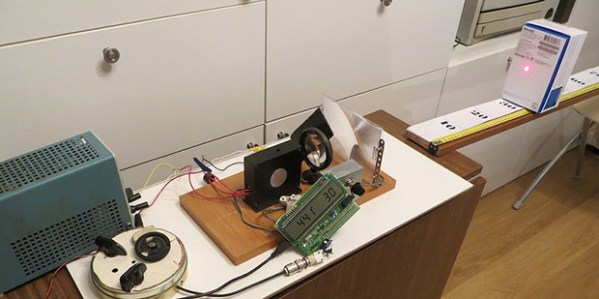
Just when you thought ARM micros couldn’t get any cooler, another project comes along to blow you away. [Ilia] created a phase laser rangefinder (.ru, Google translatitron) using nothing but a laser diode, a pair of magnifying glasses, a few components and an STM32F4 Discovery dev board.

The theory behind this build is using a laser’s phase to determine how far away an object is. By modulating the laser diode’s output at a few hundred Mhz, the reflection from the laser can be compared, giving a fairly reasonable estimate of how far away the target is. This method has a few drawbacks; once the reflection is more than 360 degrees out of phase, the distance ‘loops around’ to being right in front of the detector.

The laser diode used does not have any modulation, of course, but by using an STM32F4 ARM chip, [Ilia]was able to modulate the amplitude of the laser with the help of a driver board hacked out of a 74HC04 chip and a few resistors. Not ideal, but it works.

The receiver for the unit uses a photodiode feeding into the same microcontroller. With an impressive amount of DMA and PLL wizardry (the STM32F4 is really cool, you know), the phase of both the transmission and reflection can be compared, giving a distance measurement.

It’s all an impressive amount of work with a hacked together set of optics, a cheap dev board, and a few components just lying around. For any sort of application in a robot or sensor suite this project would fall apart. As a demonstration of the theory of phase laser rangefinding, though, its top notch.

You can check out a video of [Ilia]’s rangefinder below. Be sure to full screen it and check out the distance measurement on the LCD. It’s pretty impressive.

Thanks [Володимир] for the link.

Continue reading “Homebrew Phase Laser Rangefinder”

Mini Go Kart Built In A Day

kart

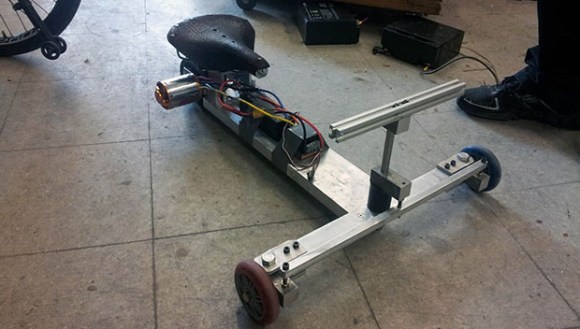
The crew at the MIT student-run shop MITERS love their go karts, and when sitting around a pile of parts in the middle of the night on Saturday, there was only one thing to do: build a mini electric go kart in a day.

The parts for this were all taken from the jumble of parts lying around the shop: a few scooter wheels, some aluminum tubing, a 1×4″ piece of extrusion, a huge motor, and a ton of A123 cells were enough to ge tthe project started. They began by bolting the back wheel and motor to the aluminum extrusion and machining a simple steering mechanism.

The real fun began when they realized they could fill the aluminum extrusion with batteries, creating a 6S5P pack with the balance connectors and – after a few tries – the proper insulation. Combine all the parts with a Kelly motor controller and an old Brooks saddle, and the MITERS have a fairly light mini go kart that can cruise around the halls at about 15mph. Not much, but it was built in a single sleep-deprived night.

Video of the kart in action below.

Continue reading “Mini Go Kart Built In A Day”