An Absurdly Small Tri-copter

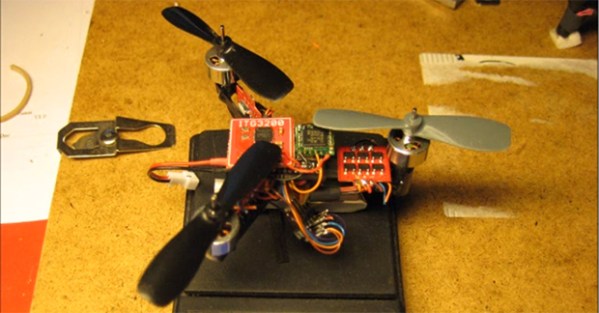
The team behind the Femtoduino – an extraordinarily small repackaging of the Arduino – sent in a few videos from YouTuber [phineasIV], a.k.a. [Eric] that shows one of the smallest multicopters we’ve ever seen.

Because this isn’t a traditional quad or hexcopter, the control system is a little weird. Two of the motors and props are fixed along the vertical axis, while the rear prop is connected to a small servo to rotate from side to side. Still, the electronics are fairly standard for any multi rotor vehicle – a triple-axis gyro provides the stability of the vehicle coupled with MultiWii, while an amazingly small servo receiver, Bluetooth module,, Femtoduino, and a trio of brushless ESCs tie everything together.

The end result is a tri-copter that weighs about the same as the Crazyflie Nano Quadcopter, but is just a bit smaller. As impressive as it is on video (seen below), we’d love to see this tiny robotic hummingbird in person.

Continue reading “An Absurdly Small Tri-copter”

Upgrading A Fluke Multimeter With A Masterful Addition

LCD

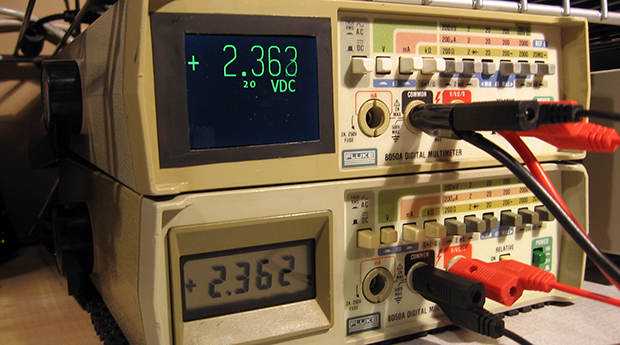
The old Fluke 8050a multimeter from the 80s is an awesome piece of lab equipment. It’s built like a tank, and thanks to the newer more portable models, this old meter is available for a pittance on eBay. [Ken] picked up a few of these meters and decided to give one of them a little upgrade – a 2.2″ 320×240 LCD display that is a vast improvement on the old stock seven-segment numerical display.

Inside the Fluke 8050a is a 40-pin DIP processor that handles all the computations inside the unit. [Ken]’s solution to tap into this processor was to take a 40-pin PIC microcontroller, bend some of the pins backwards, and use the remaining pins to drive the new LCD display. It’s actually somewhat brilliant in its simplicity and looks really cool to boot.

The rest of the circuitry consists of a level converter and a few wires going directly to the LCD display. [Ken] already has another Fluke 8050a on the bench waiting for a facelift and some plans for a few improvements that include a bar graph, histogram, and possibly even a touch display.

Put In Pocket Change, Get Bitcoins

bitcoin

[gbg] put together a neat little project to get people familiarized with Bitcoins. A lot of techies know what Bitcoins are, but the impetus to download the Bitcoin client and start mining is a bit too much for some. [gbg] has a solution for this – a Bitcoin vending machine. Just dump your pocket change in the coin slot, and out comes a QR code that allows you to add Bitcoins to your wallet.

Inside this Bitcoin briefcase is a Raspberry Pi that connects to a local WiFi connection. Every five seconds, the Raspi looks at the current conversion rate of USD to Bitcoins. Once coins are deposited into the briefcase, a receipt complete with a scannable QR code is printed on a small thermal printer.

When [gbg] took this to the latest DEFCON, a lot of people were interested in the project and started shoveling change into the machine. So many people were interested that [gbg] and his compatriots are planning on turning this into a proper open-source device, complete with a bill reader and possibly an ASIC miner so the Pi can sell the coins it produces.

Check out the video below for some more info.

Continue reading “Put In Pocket Change, Get Bitcoins”

Free Yourself From Social Media With Classical Conditioning

pavlov

While [Robert] and [Dan] should be working on their dissertation, they found they actually spend a whole lot of time whiling away their days on Facebook and other social media sites. Taking inspiration from a Skinner box, they rigged up their computer to shock them every time they surfed on over to Facebook.

Their build uses the UI inspector in OS X and a Python script to activate an Arduino connected to one of those trick ‘shocking chewing gum’ pranks. The contacts for this shocker are attached to a keyboard wrist rest, providing a wonderful tingling sensation whenever the guys surf on over to Facebook.

Because shocks just aren’t extreme enough, [Robert] and [Dan] took their build one step further by invoking the wrath of Mechanical Turk users. They wrote a Python script to look at their UI inspector and submit a job to Mechanical Turk whenever they logged on to Facebook. The result is a random person being paid $1.40 to yell at [Robert] or [Dan] over the phone for wasting time on Facebook.

Video below, and be sure to like this post on Facebook.

Continue reading “Free Yourself From Social Media With Classical Conditioning”

Ultrasonic Anemometer For An Absurdly Accurate Weather Station

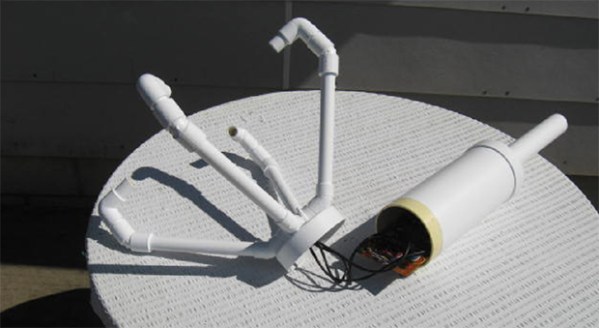
With his meteorological interests, [Carl] builds weather stations. Temperature and humidity sensors are a dime a dozen, but with his DIY ingenuity, [Carl] has built some very interesting and complicated devices. The latest of which is an ultrasonic wind sensor that uses the time of flight of ultrasonic pulses to detect how fast the wind is blowing.

[Carl]’s sensor uses four ultrasonic transducers aligned to North, South, East, and West to detect the wind speed. By measuring the time it takes an ultrasonic pulse to travel between the sensors indoors, Subtracting the in-situ measurement gives him the time of flight for each axis, and thus the wind speed.

It’s an impressive display of engineering that comes with an amazingly detailed design report. After three months of operation, [Carl] has found his ultrasonic anemometer is better than the traditional mechanical ‘egg-cup’ anemometer at measuring low wind speeds. The only real problem with the build is the fact the design makes a great bird perch, but some fine steel wire quickly corrected that problem.

An Arcade Controller For The Original PlayStation

I love it when you hit those switches

[Kevin] just finished a project for someone who lives in his apartment complex. This resident loves the game Pop ‘n Music – a Guitar Hero sort of game for the original Playstation and PS2 that uses nine colored buttons instead of five buttons along a fingerboard. His original idea was to wire up a few arcade buttons to a Playstation controller but this plan fell through, forcing [Kevin] to figure out the PSX bus all by his lonesome.

The initial code began with simply bit-banging the PSX controller interface with an AVR. This had a few problems, namely speed, forcing [Kevin] to move onto assembly programming to squeeze every last bit of performance out of a microcontroller.

The assembly route failed as well, dropping some transactions  Looking at the problem again, [Kevin] realized the PSX controller bus looked a little like an SPI bus. There were a few changes required – reversing the order of the bits, and using the MISO line to drive a transistor – but this method worked almost perfectly on the first try.

Now, [Kevin]’s building mate has a custom Playstation controller for his favorite game. Of course all the code is up on github for all your PSX controller emulation needs, but be sure to check out this completely unrelated Pop ‘N Music video from someone who desperately needs a piano.

Sensor Gloves From Joystick Pots

joy

After working on the DARPA Virtual Robotics Challenge this summer, visions of a Heinlenesque robotic actuator filled [Hunter]’s head. His lab had access to something called a Cyberglove that used flexible pots in each of the fingers, but each of these gloves cost the lab $15,000 each.

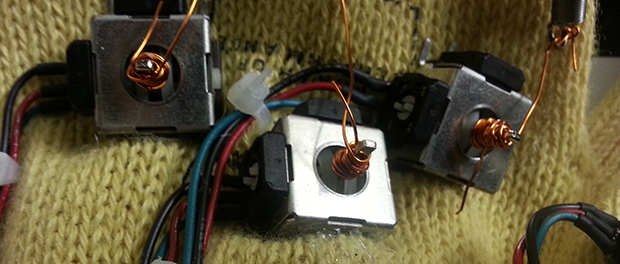
With a little help from some joystick potentiometers, [Hunter] whipped up a decent approximation of a $15,000 device that measures how much a user’s fingers are bent. The pots are tied into an Arduino and read with analogRead(), while a small Python script interprets the data for whatever application [Hunter] can imagine.

There are a few drawbacks to [Hunter]’s design – it’s not wireless, unlike the $15,000 version, and they certainly don’t look as cool as the real thing. Then again, the DIY version only cost 0.2% as much as the real deal, so we’ll let any apparent problems slide for now.