Turning Anyone Into A Casuality

Triage

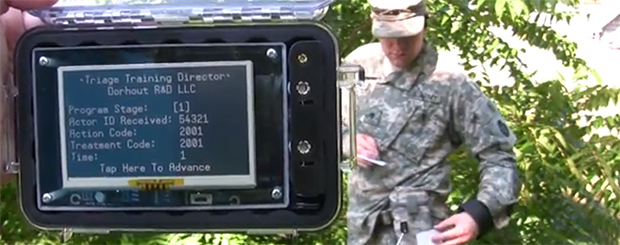
EMTs and other first responders don’t just sit around waiting for a disaster to happen. If they need to train for a disaster – environmental, terrorist, or otherwise – they put together a mass injury simulation, or their version of a war game. As you can imagine, coordinating one of these simulations is a nightmare, but [David] came up with a way to simulate a casualty with a few XBees, a Parallax Propeller, and a few RFID cards.

This triage training simulator consists of an ‘acting coach’ on each simulated victim that includes a speech-to-text module that speaks instructions into the actors ear, a pulse simulator and a readout for vital signs that correspond to twelve major injuries. When an EMT triages a victim, they swipe an RFID card for each medical procedure they perform – intubating is one card, while a bandage is another – and all this is sent back to the coordinator’s tablet.

The coordinator has direct control over each of the actors through a two-way radio link, and can initiate changes in each victim, monitor a paramedic’s responses, and “escalate” the situation by setting off another simulated bomb.

All this is created with off-the-shelf hardware, vastly reducing the cost of this type of training device. An amazing application of what we usually consider to be just robot parts, and we’re happy for [David] to share it with us.

Continue reading “Turning Anyone Into A Casuality”

Turning A Tiny Linux Box Into A Synthesizer

waveforms

For all the cool things the Raspberry Pi, BeagleBone, and other low-power Linux boards can do, there’s one thing we haven’t seen much of: creating music with software synthesizers. Yes, soft synths have been around for ages now, but compiling them for these ARM boards is something we haven’t seen much of (to say nothing of the Linux audio system). Luckily, [Paul] and [Trev] have put together a tutorial for making synthesizers on these small Linux boards using Csound, the premier audio programming language for Linux.

[Paul] and [Trev] have already put together a few Csound instruments that include a Vangelis-inspired synth, a Lorenz Strange Attractor FM synth, a drum machine, and a classic monophonic style synth. All these instruments are ready to play on a Raspi or BeagleBone and we’re sure we’ll see a few more applications of this great tool for creating musical instruments as more musicians are turned onto these small Linux boards.

Microcontrollers And Node.js, Naturally

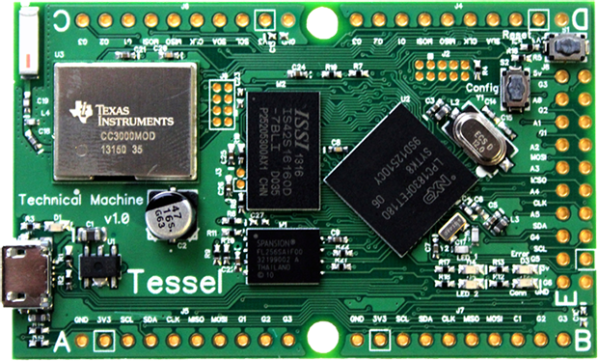
We see a surprising amount of projects using Node.js, but despite this we haven’t seen much JavaScript running microcontrollers, even the ARM powered Raspi or BeagleBone. The folks at Technical Machine want to change that with a very cool dev board designed to be an Internet-connected JavaScript running prototyping device from the very beginning. It’s called Tessel, and brings some very cool tools to any maker’s workbench.

On board this little… board is an ARM Cortex-M3 running at 180 MHz, 32 Megs of Flash, 32 Megs of SDRAM, and a TI CC3000 WiFi module that we’ve heard so much about. The 16-pin GPIO can connect to other Tessel modules that allow for servos, accelerometers, micro SD cards, and a whole bunch of other sensors for just about any project imaginable.

Aside from having WiFi built in from the get-go, Tessel also has some Arduino compatibility, allowing it to work with existing shields and code. It seems pretty cool, and we can’t wait to get our hands on one when it launches in September.

Stompy, The 18-foot, 2-ton Hexapod Is Ready For Production

Stampy

Over at the Artisan’s Asylum hackerspace in Somerville, MA, something terrifically awesome is happening. They’re building an 18-foot diameter, 2-ton ridable hexapod that can walk over a car. It’s called Project Hexapod and they need your help.

Over the last year or so, the team behind Project Hexapod has developed an amazingly inexpensive hydraulic control system for each of the six legs and created a 1:1 model of the leg fastened to a wheeled cart to get the kinematics down pat. Now, with thousands of pounds of steel already watercut for the legs, they’re turning to the community for a little help with the welding.

The Project Hexapod team estimates they have about 1100 hours of welding time in front of them. They’re looking for a few people around the Boston area that are familiar with steel fabrication and are willing to work on a two-ton robot that can walk over a Volkswagen Beetle.

The guys have put up a little application form if you meet those basic requirements. You can also check out their Facebook page for any announcements and a whole lot of pictures.

Controlling A Railroad With An Mbed

rr

The word hacking got its start with model railway clubs, and the state of the art belies the current advancements in computer control and very, very small microcontrollers. [Jim] put together a great tutorial for driving model locomotives with a microcontroller, in this case an ARM-powered mbed.

Low-end model locomotives are controlled with DC, so an H-bridge and a PWM out on the mbed makes sense to drive these trains. [Jim] wired up a Pololu H-bridge driver, connected it to his mbed, and everything ran great.

Rail switches are another matter entirely. These allow trains to move from one track to another, but having them go to the left or right requires powering a fairly high current solenoid with 15 to 24 volts. For this, [Jim] used a MOSFET power control board to switch the rails and came up with a pretty neat demo that shows a small locomotive going back and forth over a single rail switch.

There is another class of model locomotive – ones with Digital Command Control. This setup is just a small decoder chip that fits inside an engine and tells the locomotive to turn on a lamp or run a motor digitally, allowing the conductor to control multiple trains on the same track.

[Jim] goes through the basics of DCC using the mbed, allowing two trains to switch positions in a rail yard using computer control. It’s really cool stuff that leaves us wanting a little more room in the basement to start building a huge computer controlled model railway.

Continue reading “Controlling A Railroad With An Mbed”

3D Printering: Where Can I Get The Cheapest Filament?

printering

We’ve complained about the price of 3D printing filament, and cheered at the machine that makes filament out of plastic pellets. Still, the price of filament for our 3D printers is climbing ever higher, leaving us to wonder, where can I get the cheapest filament?

Now, I’m going to start this of by saying this is a work in progress. Canvassing suppliers on every continent for 1.75 and 3mm ABS and PLA for every possible color while accounting for different amounts of filament and shipping is a whole lot of work. Therefore, we’re going to do this in parts, first starting with how much it will cost me to get a kilogram of PLA shipped to my door. This should be a valid test for just about everyone in the USA.

The test criteria is simple: find a supplier of PLA on the Reprap wiki printing material suppliers page and figure out how much it would cost me to get 1 kg of white or natural PLA shipped to my front door. I’ve organized this in a spreadsheet (below) that contains the supplier, size (1.75 mm or 3mm), weight (usually 1 kg although some suppliers are about three ounces short), color, and price with shipping included.

Continue reading “3D Printering: Where Can I Get The Cheapest Filament?”

USB Adapter For An Old VT100 Keyboard

VT100

Ah, the VT100, the first dumb terminal that was controlled with a microprocessor. This ancient beast from the late 70s is quite unlike the terminals you’d find from even five years after its vintage – the keyboard connects via a TRS quarter-inch jack – the electronic and code design of this terminal is a bit weird. [Seth] was up to the challenge of making this mechanical keyboard work as a standard USB device, so he created his own USB adapter.

On the little quarter-inch to USB adapter, [Seth] included an HD 6402 UART to talk to the keyboard, along with a Teensy dev board and a few bits of circuits stolen from DEC engineers. The protocol between the keyboard and terminal is a little weird – first the terminal sets a bit in a status word, then the keyboard scans all the key rows and columns in sequence before telling the terminal it’s done. Yes, this gives the VT100 full n-key rollover, but it’s just weird compared to even an IBM Model M keyboard that’s just a few years younger.

[Seth] finally completed his circuit and wired it up on a perfboard. Everything works just as it should, although a little key remapping was done to keep this keyboard adapter useful for Mac and Windows computers. It’s a wonderful bit of kit, and any insight we can get into the old DEC engineers is a wonderful read in any event.

Vidias below.

Continue reading “USB Adapter For An Old VT100 Keyboard”