A Robotic Tattoo Artist

tattoo

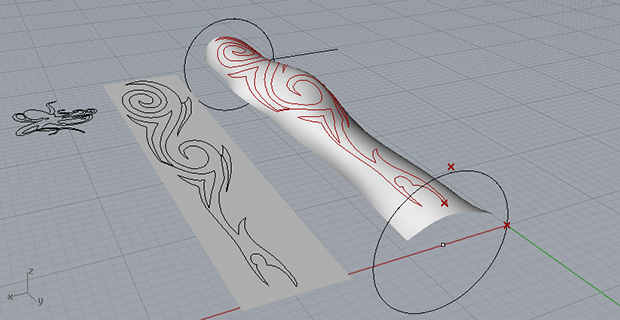
Here’s something we thought we’d never see: a robot that turns a computer drawing into a tattoo on the user’s arm.

The basic design of the robot is a frame that moves linearly along two axes, and rotates around a third. The tattoo design is imported into a 3D modeling program, and with the help of a few motors and microcontrollers a tattoo can be robotically inked on an arm.

Since the arm isn’t a regular surface, [Luke] needed a way to calibrate his forearm-drawing robot to the weird curves and bends of his ar.  The solution to this problem is a simple calibration process where the mechanism scans along the length of [Luke]’s arm, while the ‘depth’ servo is manually adjusted. This data is imported into Rhino 3D and the robot takes the curve of the arm into account when inking the new tat.

Right now [Luke] is only inking his skin with a marker, but as far as automated tattoo machines go, it’s the best – and only – one we’ve ever seen.


[Massimo] Talks About Arduino Clones

pick one

Back in 2005, the Arduino was just a twinkle in they eyes of [Massimo Banzi] and the other core developers. Since then, you can’t go to any electronics site without hitting something beginning with ‘ard~’ or ending with ‘~duino’. The platform has become so popular, people everywhere are piggybacking on the name to the point of trademark infringement or simply outright counterfeiting one of the many official Arduino boards. Now [Massimo] has something to say about these clones, ripoffs, derivatives, and ‘duino-compatible boards.

On the list of things bad for the open source ecosystem, [Massimo] points to direct clones of existing Arduino boards. While these boards are electrically identical to officially licensed boards, they simply don’t support the Arduino project financially and usually don’t contribute to the existing libraries and code. Even worse are counterfeits; these boards copy the trademarks of the Arduino project – sometimes terribly given the three examples above (guess which one is the real one) – and directly profit off of the Arduino project without giving any support in return.

There are other veins of Arduino that [Massimo] considers more acceptable. Arduino-compatible boards, seen by the dozen over on Kickstarter, usually add something of their own, be it a radio chip, or an entirely different microcontroller. Derivatives, like Teensy and Adafruit’s Flora actually bring new things to the table with improved hardware and new and interesting libraries.

As far as counterfeits and clones go, we can’t agree more with what [Massimo] has to say. You have to admire the folks in the Arduino project being so open about their creations and admiring the Arduino derivatives that bring some new hardware to the table. Then again, that’s the lesson of the Arduino project; you can make hardware open source and still be outrageously popular.

DIY Airbag, Explosions Included

AnAirbagSavedMyLife

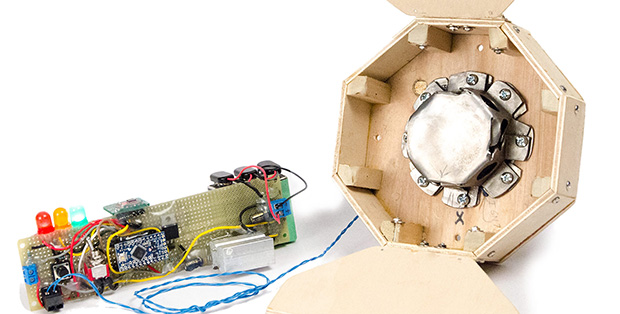
Your car’s airbag is one of the major engineering accomplishments of the auto industry. In an accident, a whole host of processes must take place in sequence to keep your face from slamming into the steering wheel, and  everything must happen in just a fraction of a second. [Steve] over at Make thought it would be a cool idea to discover what actually goes in to saving a life with an airbag and decided to build his own.

The electronics of the build consisted of an accelerometer and an Arduino. A lot of research, development, and experimentation has gone into the algorithms that trigger airbags, but [Steve] decided to keep things simple: when a sudden acceleration is detected, set off a small charge of black powder.

The airbag itself is ripstop nylon reinforced with canvas, contained in a small wooded box fitted with hinged doors. All these components are put on wheeled aluminum test rig, manned with a honeydew melon crash test dummy, and pulled into a short wall at a few miles per hour.

Despite [Steve] not putting hundreds of thousands of man hours into the development of his airbag – unlike the ones you’ll find in your steering column – his device actually worked pretty well. While not a complete success, he did manage to come up with something that both looks and acts like the familiar device that has saved countless lives.

A Love Note In 14 Segments

14

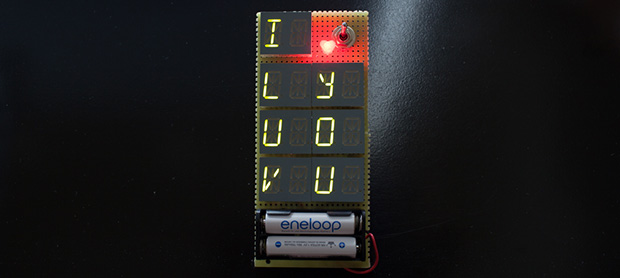
[Terry] wanted to come up with a little electronics project for his kids, and also came up with something to keep the wife happy. It’s an adorable 14-segment love letter, pieced together with some leftover LED displays and a bit of solder.

There isn’t a microcontroller anywhere to be seen in this project – all the illuminated segments are tied to a switch, and aside from a few resistors there isn’t much to this circuit. The simplicity means it’s a great way for [Terry] to get his kids involved in electronics.

If you’re wondering why [Terry] didn’t throw multiple Arduinos, shift registers, or LED drivers into the build, consider this: sometimes segment displays can be static. The time circuit prop from Back to the Future (but not this modern recreation) was wired up in a similar manner, as only a few specific dates needed to be displayed. Either way, we’re thinking good on [Terry] for introducing his kids to a soldering iron and doing something special for his lady friend.

Making PCBs And Waffles

waffle

The toner transfer method of fabricating PCBs is a staple in every maker’s toolbox. Usually, tutorials for this method of making PCBs rely on a clothes iron or laminating machine. They work perfectly well, but with both of these methods (sans high-end laminators), you’re only heating one side of the board at a time, making perfect double-sided PCBs somewhat of a challenge.

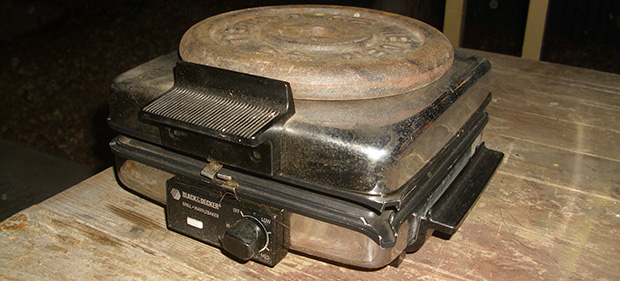
[Mark] just came up with an interesting solution to this problem. A waffle iron PCB press. Technically, [Mark] is using his ‘grill and waffle baker’ as a two-sided griddle, with a few aluminum plates sandwiching the copper board for good thermal conduction.

After a whole lot of trial and error, [Mark] eventually got a good transfer onto a piece of copper clad board. Now that he has the process dialed in, it should be a snap to replicate his results with a new project and a new PCB design.

Human Powered Flight Extravaganza

humanpoweredflight

In case you haven’t heard, the Sikorsky Prize, an aeronautical challenge to build a human-powered helicopter that can hover at three meters for a full sixty seconds, has been claimed. This incredibly difficult engineering feat was accomplished by AeroVelo, along with a lot of help from the University of Toronto and a host of companies involved in the design and manufacture of rotorcraft. This prize has stood unclaimed for thirty years, and it’s not from lack of trying; in the 80s and 90s, universities in Japan tried their hand at the challenge, and recently a team from the University of Maryland had a go at it.

But as far as human-powered flight goes, a helicopter is just about the least efficient way to get off the ground. Helicopters need power to provide their own lift and thrust, whereas airplanes only need to generate some forward momentum.

From the bicycle-powered crossing of the English channel in 1979, human-powered flight has come a long way, so far that next the Royal Aeronautical Society will be hosting the Icarus Cup 2013. It’s a competition where teams of human-powered aircraft enthusiasts will compete in challenges measuring distance, speed, endurance, and landing accuracy.

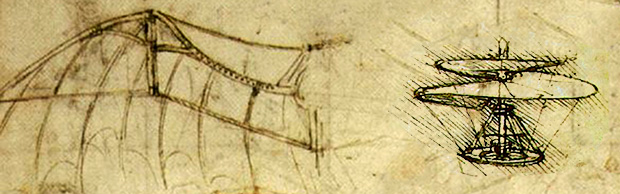
No, it’s not an ornithopter from Da Vinci’s notebook, but human pectoral muscles aren’t powerful enough for that anyway.

Thanks [DainBramage1991] for sending this one in.