Porsche 911 Made Electric

[Kurt] wanted an electric car, and always wanted to drive a Porsche. Killing two birds with one stone, he decided to combine these wishes and convert a 2002 Porsche 911 into an electric vehicle.

After removing the engine, fuel tank, exhaust, radiator, and all the other things that make an internal combustion engine work, [Kurt] installed a high power motor, controller and 72 lithium phosphate batteries weighing in at over 500 pounds. He’s put over 300 miles on the car in the last few months while working out the kinks, but now he’s finally gotten the bugs out of the system allowing him to take it up to some relatively high speeds.

Already [Kurt] has taken his new ride to 100 mph and done a little bit of range testing that told him he should expect around 40 miles per charge in his new ride. It’s not exactly what he hoped, but more than enough for a few trips around town while riding in style.

After the break is a video [Kurt]’s first test drive of his electric Porsche.
Continue reading “Porsche 911 Made Electric”

Google Books Team Open Sources Their Book Scanner

It’s no secret that Google has been scanning hundreds of thousands of books in the hope of recreating the Library of Alexandria. Publishers and authors really didn’t like that idea, so the Google books team is doing the next best thing: they’re releasing the plans for a very clever book scanner in the hope others will pick up the torch of creating a digital library of every book ever written.

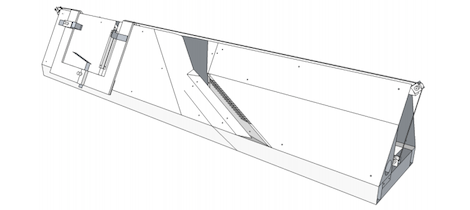
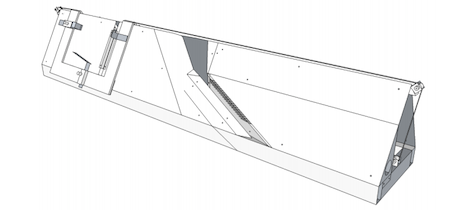
Unlike some other book scanners we’ve seen that rely on an operator manually flipping pages, this linear book scanner turns the pages automatically with the help of a vacuum cleaner and a cleverly designed sheet metal structure after passing them over two image sensors taken from a desktop scanner.

The bill of materials comes in at around $1500, but according to the official design documents this includes a very expensive scanner, something that could be replaced in true hacker style with a few salvaged flatbed scanners.

After the break you can check out a Google Tech Talk presented by [Dany Qumsiyeh] going over the design and function of his DIY book scanner. There’s also a relatively thorough design document over on a Google code page.

Continue reading “Google Books Team Open Sources Their Book Scanner”

Playing Led Zeppelin On A C64

[youtube=http://www.youtube.com/watch?v=Iikj5EfL770&w=470]

In the C64 demoscene there are a ton of awesome software hacks that push the Commodore 64, the 1MHz 6510-based computer from 1982, to its limits. Most of these C64 demos are very much limited by the hardware inside the C64, but the demoscene is always coming up with new ways of pushing the envelope. [No Quarter] just sent in one of these software hacks that propel the capabilities of the C64 into the realm of absurdity by playing full length songs directly from the floppy drive.

Playing a song on the C64 begins with an Amiga and a Perfect Sound digitizer to convert the digital audio file into a 4-bit sample. Once this sample is transferred over to the C64 where it was manually timed so streaming it off a 1581 disk drive would result in the song playing at the correct pitch. It’s an amazing work of optimization; the audio data is streamed off the disk just as fast as it’s played from memory, an amazing data throughput rate for the ‘ol C64

After the break you can see [No Quarter] playing Led Zeppelin, Bon Jovi, Shania Twain, and Extreme. A very, very cool project and with the addition of a C64 hard drive makes it possible to have a media player for the C64.
Continue reading “Playing Led Zeppelin On A C64”

Building A Thermal Imaging Sensor From Scratch

[youtube=http://www.youtube.com/watch?v=pIb1scnD67o&w=470]

[Rob] lives in a 100-year-old house, and with these antique lath and plaster walls and old window frames comes a terrible amount of drafts. The usual way to combat this energy inefficiency is with a thermal imaging camera, a device that overlays the temperature of an object with a video image. These cameras are hideously expensive so [Rob] did what any of us would do and built his own.

The build centers around a Melexis MLX90620 far infrared thermopile that can be had for about $80. Basically, this sensor is a very, very low resolution camera (16×4 pixels) that senses heat instead of light. By sticking this sensor on a breadboard with an Arduino Mini and WiFly network adapter, [Rob] is able to pull the data down from the IR sensor to his iPhone and overlay it on the feed from the camera.

The result, as seen in the video above, is a low-resolution but still very useful thermal imaging camera, perfect for looking for cold drafts in an old house or tracking down [Arnie] just like a Predator.

Tip ‘o the hat to [Ronald] for sending this one in.

Giving An Apartment Keyless Entry

The key for [rybitski]’s apartment is a copy of a copy of a copy, and the landlord lost the original key years ago. The lock itself still works, but opening it with [rybiski]’s key is a chore. He wanted to make it easier to get into his apartment, and with Arduinos and such he figured he could make a keyless entry device for his front door.

After figuring out how to open his deadbolt with an Arduino and a rather powerful servo, [rybiski] looked into wireless control options. He found a keyless entry remote, complete with receiver, that integrated perfectly to just about any microcontroller project.

After mounting the Arduino, receiver, and servo on a piece of plastic, he attached his contraption to the deadbolt. In the video after the break, you can see his key fob remote locking and unlocking the deadbolt, all without jamming an ill-fitting key into the lock.

Continue reading “Giving An Apartment Keyless Entry”

Turning The Hexbug Spider Into A Line-following Robot

[youtube=http://www.youtube.com/watch?v=quDHhuEsxEg&w=470]

You may be familiar with the Hexbug Spider, a small electronic robot toy sold at Target and Walmart for $20. While they’re able to be commanded to move forward, backward, and spin around on a dime, there aren’t any external sensors to make it really exciting. [Eric] sought to remedy this and came up with a line-following board replacement for the Hexbug Spider.

The stock Spider has a small circuit board that allows for the control of two motors with a remote. [Eric] removed this control board and replaced it with his own, powered by a TI MSP430 microcontroller. On this board, [Eric] included a pair of IR LEDs, able to detect the path of a white line drawn on the ground. With just a little bit of code, [Eric] made his $20 Hexbug Spider into a very cool looking robot.

[Eric] figured out how to improve his robot toy, but the power of the MSP430 microcontroller he used doesn’t limit him to only following lines. By using an MSP430 Launchpad, anyone can upload new code to the improved Spider, and even add new sensors to this creepy walking robotic toy.

$4 Volt Meter From A Dollar Store Pedometer

[Paulo]’s got a few solar panels on his shed, and while he does have a fairly nice setup with a battery charge controller, he found himself looking around for a panel voltmeter. Of course you can buy a panel voltmeter for under $20, but [Paulo] wanted something that fit his 4-4-4 plan; his voltmeter should cost under $4, draw less than 4mA, and last for 4 years. The jury is still out on the 4 year qualifier, but he did manage to meet his other goals by repurposing a dollar store pedometer as a voltmeter.

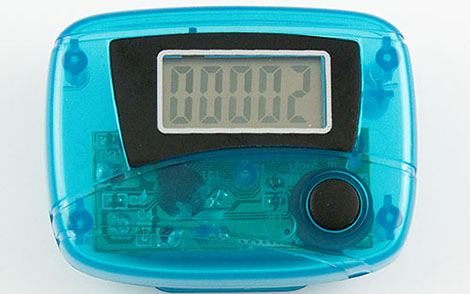
The pedometer in question is a very simple device. After inspecting the PCB, [Paulo] found it operates by looking at a trigger pin and incrementing the number on the display each time the circuit closed. [Paul] designed a very small PIC12F-powered circuit that reads the voltage of his batteries and triggers the pedometer’s LCD for every 10th of a volt. To display 12.6 Volts, [Paulo]’s code triggers the LCD 126 times, for example.

After wiring up the reset button so the display will go back down to zero for each new reading, [Paulo] encased his new volt meter in a plastic box. It’s not exactly a fast way of measuring voltage, but seeing as how that won’t change very fast, it’s the perfect solution for [Paulo]’s solar charger setup.