Control Everything In Your Car With The Car Kracker

If your whip is a Honda, Toyota, BMW, Chrysler, VW, or Mini made in the last decade or so, the Car Kracker is for you. This project allows you to connect directly to your car’s computer system, allowing you to display messages on your stereo, play music off an SD card, and even override factory settings like always-on daytime running lights.

The Car Kracker uses ISO 9141, an in-car communications protocol that is now mostly used in foreign (for the US) cars. The build uses a Gadget Gangster Propeller board to connect to the CD changer port and OBD-2 port in the trunk, and the diagnostic port located under the hood.

With the Car Kracker, it’s easy to connect the Aux In on your stereo to an SD card loaded with music, or even plug in an iPod for the poor souls without a 1/8″ jack. Dealer customizations such as turning the ‘door is ajar’ noise off, toggling daytime running lights, and throwing a nav warning up are also possible.

Check out the two videos after the break, and if anyone has any more info on getting this deep into a car’s computer system (a wiki, maybe?), send a link in on the tip line.

Continue reading “Control Everything In Your Car With The Car Kracker”
Magic Clock Locates Your Friends

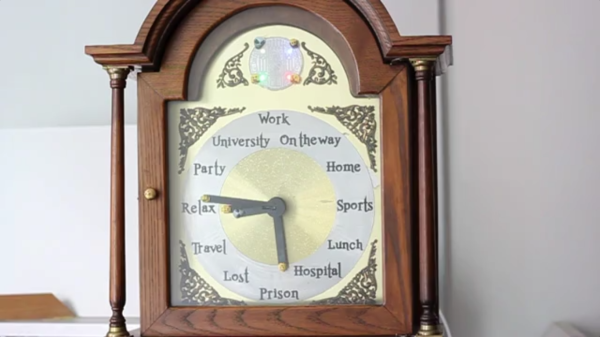
Just like the clock from Harry Potter, a team of media informatics students at the University of Munich built a grandfather clock that doesn’t keep track of time; instead, it keeps track of where everyone is, whether it be their university, work, or in prison.

The build uses Android and iOS apps on each team member’s cell phone to send their current location to a web server. A circuit built inside an old grandfather clock the team picked up from eBay communicates with the web server through a WiFly Shield to control a quartet of servos and drive the clock hands.

Because the grandfather clock only came with two clock hands, the team used a series of four concentric shafts to move each hand around the dial. With a bit of clever gear fabrication on their laser cutter, they were able to use unmodified servos move the hands all the way around the clock.

The avatars on the tip of each clock hand are the remains of decapitated LEGO minifigs, a choice that makes sense after viewing the build video available after the break.

Continue reading “Magic Clock Locates Your Friends”

[Dino] Builds A Fetch-O-Matic For This Month’s Make

Perennial Hackaday favorite [Dino] has an article in this months Make magazine. It’s an automated ball launcher that allows you to play fetch with your dog without wearing your arm out.

The powerhouse inside [Dino]’s ball launcher is a windshield wiper motor powered by an 18 Volt cordless drill battery pack. When a ball in dropped into the hopper, it turns on a switch sending some power to the motor.

The swing arm that actually launches the ball is anchored to the frame of the ball launcher with a spring. This stores energy for one half of a rotation of the motor until the arm rotates half way around inside the box. Then, the arm quickly accelerates and launches the ball across the yard.

[Dino] says he’s working on training his dog to drop the ball into the chute after retrieving it, creating a perpetual game of fetch. At least until the battery runs down, that is. Video after the break.

Continue reading “[Dino] Builds A Fetch-O-Matic For This Month’s Make”

Reading Punch Cards With An Arduino And Digital Camera

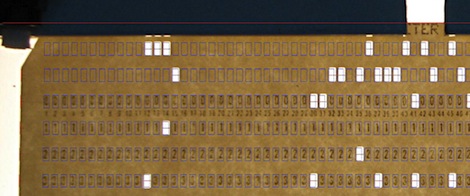
[digitaltrails] wanted the data on a few old IBM 80-column punch cards he had lying around, but didn’t have decades old computer hardware in his garage. He decided to build his own out of LEGO, an Arduino, a digital camera, and a bit of Python.

The hardware portion of [digitaltrails] build includes a crank-operated feed mechanism made entirely out of LEGO. For each turn of the crank, the feed mechanism sends one card down a chute where a photodetector wired into an Arduino tells a camera to take a picture. After that, a servo is activated, sending the card into the ‘already scanned’ bin.

On the software side of the build, [digitatrails] used the Python Imaging Library to scan one row of pixels where each column is expected to be. The software outputs the code and data contained on the 80-column card as well as a very cool ASCII art version of each card.

Considering you just can’t go down to Fry’s and buy an IBM 80-column punch card reader, we’re loving [digitatrails]’ clever way of getting data off an otherwise unreadable storage medium. Check out the video of the card reader in action after the break.

Continue reading “Reading Punch Cards With An Arduino And Digital Camera”

Gumball Machine Delivers Ebooks And Games To Your Phone

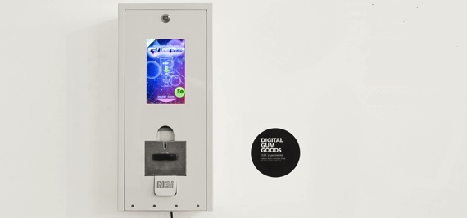
Instead of rock-hard bubble gum that loses its flavor after 2 minutes, this gumball machine delivers apps and games directly to your smartphone.

The communications protocol used by this app-delivering gumball machine isn’t bluetooth or WiFi but near field communication. This protocol allows for a point-to-point network between the app dispenser and a phone to deliver games, music, videos, and ebooks to any compatible portable device.

The hardware for the gumball machine is a Galaxy Tab, an Adafruit NFC shield, two Arduinos, and a few switches and other components stuffed into an old gumball machine. To get purchase an app, just put a quarter or two in the machine, turn the crank, and put your phone up against the dispenser. Through the magic of near field communications, you phone or tablet receives whatever media you purchased.

Near field communication has been a standard for a while, but hasn’t been available in most phones. With oracles of Apple speculating the upcoming iPhone will have NFC capability other phone manufacturers are sure to pick up the tech. Very cool project, and we can’t wait to see some truly home-brew versions of this build.

Vidia after the break.

Continue reading “Gumball Machine Delivers Ebooks And Games To Your Phone”

Refurbing An Old Piano With Carbon Fiber

[Chris] picked up a baby grand. Of course for a complex mechanical device made out of wood, it wasn’t in the best shape. He’s doing his best to refurbish this $350 piano and turn it into something that plays and sounds like a $200,000 concert grand

The 1941 Kimball baby grand piano [Chris] picked up for $350 was a complete mess when it arrived in his house. After cleaning up the wood and replacing some felt the piano looked much better, but [Chris] wanted to make it play better.

After picking up a set of hammers from a 1909 Steinway, [Chris] tore apart the action on his Kimball. The Steinway hammers were removed from their shanks, carbon fiber shanks glued into place, and the entire assembly put back into the piano.

With new felt, new hammers, and light weight shanks on every key, [Chris] has a remarkable piano that is most likely better than new. Not a bad result for a $350 piano.

You can check out [Chris]’ build video after the break along with a little [Mozart] (we think) after the break.

Continue reading “Refurbing An Old Piano With Carbon Fiber”

Building The Most Offensive Video Game Ever

[youtube=http://www.youtube.com/watch?v=4pZ70teW678&w=470]

[Autuin] created the most offensive video game ever. Inside a small cocktail arcade cabinet, he installed his own video game that recreates the experiences of the Space Shuttle Challenger and her crew on their last flight.

The build started off by picking up an old cocktail version of Space Zap from The Hackery, a neat little recycling place that turns old computers, monitors, and even old arcade machines into something useful again. After [Autuin] lugged his arcade machine back to his home base at Free Geek Vancouver.

After drooling over the 30-year-old circuitry, [Autuin] disassembled the old machine and installed a mint condition 19″ VGA monitor where an ancient black and white CRT once resided. The control panels replete with their comically large buttons were refurbished and connected to an Arduino and the whole shebang hooked up to a slightly outdated computer.

The real magic happened when [Autuin] coded his game. He created a few sprites from NASA archival footage and made a game where a shuttle takes off and is controllable by each player. As the most offensive video game ever, the space shuttle blows up shortly after launch, declaring ‘game over’ for both players.

[Autuin] will be showing off his new arcade game with a new bezel and cabinet graphics during Vancouver’s Eastside Culture Crawl this November. The game will probably be updated by then; we suggested editing the ‘time to explosion’ to T+73 seconds, but [Autuin] said he’s thinking of ways to make it even more awful.