Turning A 1942 Lathe Into A Functional Piece Of Art

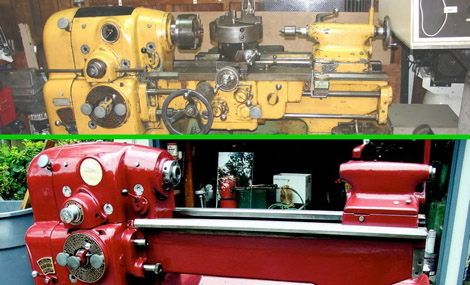
A couple of years ago, [macona] picked up a 1943 Monarch 10EE lathe. This monstrous machine is not only an amazing piece of engineering but an awesome work of art; not only can this lathe manufacture parts with exacting precision, it’s also a wonderful piece of machine age design.

The Monarch 10EE lathe was extremely high-tech for its time, and the War Dept Detroit Ordinance District tag on the cooling pump bears this machines lineage: this lathe was most likely used to make very precise military equipment such as the Norden bombsight.

After 60 years of faithful service, [macona]’s lathe picked up several coats of paint in different colors and generally fell into a state of disrepair. [macona] spent a great deal of time overhauling this lathe by replacing a bent feed rod, troubleshooting the motor problems, and eventually replacing the whole motor with a modern AC brushless servo. You can check out the improvement the AC servo made in a video after the break.

Of course no post about a rebuilt lathe would be complete without a few beauty shots. We’re extremely thankful for [macona] for not only restoring this machine, but also for sharing it with us. Thanks to [macona]’s restoration, this machine will hopefully be around for another 60 years.

Continue reading “Turning A 1942 Lathe Into A Functional Piece Of Art”
Reading RFID Cards From Afar Easily

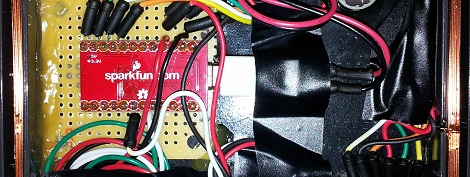
RFID hacking has been around for years, but so far all the builds to sniff data out of someone’s wallet have been too large, too small a range, or were much too complicated for a random Joe to build in his workshop. [Adam]’s RFID sniffer gets around all those problems, and provides yet another reason to destroy all the RFID chips in your credit cards.

The project was inspired by this build that took a much larger RFID reader and turned it into a sniffer capable of covertly reading debit cards and passports from the safety of a backpack or briefcase. [Aaron]’s build uses a smaller off-the-shelf RFID reader, but he’s still able to read RFID cards from about a foot away.

[Aaron]’s build is very simple consisting of only an Arduino and SD card reader. [Aaron] is able to capture all the data from an RFID card, write that data to the SD card, and emulate a card using his RFID cloner.

What’s really impressive about the build is that [Aaron] says he’s not a programmer or electrical engineer. His build log is full of self-denegration that shows both how humble [Aaron] is and how easy it is for anyone with the requisite skill set to clone the bank card sitting in your wallet. We don’t know about you, but you might want to line your wallet with aluminum foil from now on.

Ask Hackaday: Troll Physics Super Deluxe Edition

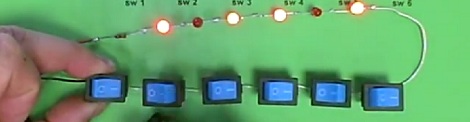
Here’s a brain bender for you: YouTube user [Fredzislaw100] put up a video of six LEDs and six switches wired up in series. After soldering a resistor and 9V battery connector, the first switch turns on the first LED, the second switch turns on the second LED, and so on for the rest of the circuit.

We’ve seen this trick before from [Fredzislaw100], only this time he’s moved up from 3 LEDs to 6. In the reveal of the previous trick, [Fredzislaw] built two AC power supplies inside a nine volt battery connector; one high frequency and one low frequency. The low frequency AC line powers the first two LEDs with the help of diodes in the switches and LEDs. The high frequency AC line turns on the third LED with the help of an inductor inside an LED. Apparently [Fredzislaw] still has some soldering skills to show off; the circuit powering this trick is most likely the work of a soldering god.

From a close viewing, it looks like LEDs are wired up in pairs, i.e. LED 1 works the same as LED 2, LED 3 works the same as LED 4, etc. We’ll let Hackaday readers argue it out in the comments as to how this trick is possible.

Tip ‘o the hat to [Th0m4S] for sending this one in.

Electric Motorcycle Is Awesome, Goes 54 Mph

The folks over at the Cincinnati hackerspace Hive13 were wowed last week by an electric motorcycle built by one of their own.

[Rick]’s new ride is built from a 1989 Honda VTR 250. After removing the 24 HP motor, the frame was loaded up with four deep cycle batteries and a DC golf cart motor. Even with the addition of the four heavy batteries, the new electric bike only weighs about 70 pounds more than the stock Honda, allowing all that power to be translated into speed. Right now, [Rick]’s build can reach 54 mph; comparable to an earlier ebike we saw, but [Rick] can also go 100 about 20 miles on a single charge.

After the break you can see a short time lapse of [Rick] tearing down his bike, the first ride though the Cincinnati hackerspace, and a very nice road test showing off the speed of [Rick]’s new ride. There’s also a great Flickr slideshow with some really great pics of the build in progress. Very nice work, [Rick].

Continue reading “Electric Motorcycle Is Awesome, Goes 54 Mph”

Making A Digital Delay From A Simple Microcontroller

If you’d like to start experimenting in DSP, or just want to build a guitar pedal, here’s the project for you. It’s an audio echo using just a microcontroller from the fruitful workshop of [Vinod].

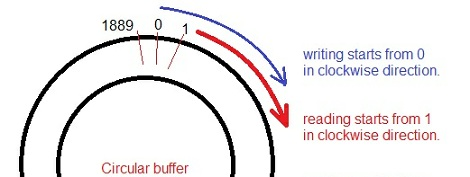
For his circuit, [Vinod] fed the output of a small electret microphone into a small amplifier, and then into the ADC of an ATMega32. Inside the microcontroller, [Vinod] set up a circular array which writes the voltage from the microphone and sends it out to a speaker. Because the array is circular (i.e. it loops around when it gets to the end), [Vinod] has a digital version of a loop of magnetic tape, perfect for recording sounds and playing back echos.

Because [Vinod] is using an ATMega32, he only has a limited amount of RAM to record audio samples. The delay time could be lengthened with a more capable microcontroller, or even the addition of a large RAM chip. With his setup, [Vinod] can do some really interesting experiments with audio and DSP, so we wouldn’t be surprised if an enterprising musician used this project as the basis for a digital delay stomp box.

You can check out [Vinod]’s demo of his echo machine after the break.

Continue reading “Making A Digital Delay From A Simple Microcontroller”

Making Instagram With An Old CRT

If you’re not familiar with Instagram, it’s a mobile app that takes pictures, applies low-fi ‘lomographic’ digital filters, and shares them on the Internet. For reasons we can’t comprehend, Instagram has been wildly successful as of late and was recently purchased by Facebook for a Billion dollars. [Martin Ström] figured he could do something much cooler than applying digital filters to a cell phone picture, so he built InstaCRT, an app that turns your pictures into grainy CRT images and satiates the geek and hipster in everyone.

From [Martin]’s project page, InstaCRT uses a small black and white CRT from an old camcorder and a Canon 7D to apply real-world analog filters to all the uploaded pictures. Once the pictures are uploaded to the MacBook Pro server, they’re displayed on the CRT and a picture is taken with the 7D. Once an Android/iOS device sends a picture to the server, it’s displayed on the CRT, the 7D snaps a picture, and the resulting ‘filtered’ picture is sent back to the mobile device.

While we’re sure a few Hackaday commentors are going to ask ‘why’, it’s still a very cool build that is the first real world digital camera filter we’ve seen. You can check out the video demo of InstaCRT after the break.

Continue reading “Making Instagram With An Old CRT”

Review And A Build: Makey Makey, A Banana Piano, And Mario

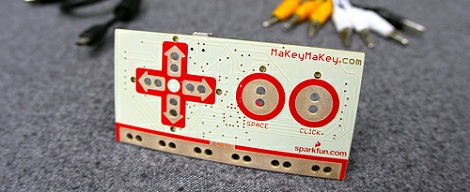
We’ve been getting a lot of emails on the Hackaday tip line about the Makey Makey. This business-card sized circuit board turns everything – bananas, Play-Doh, water, and people – into a touch interface.

There have been a ton of blogs that have written about the Makey Makey Kickstarter and debut at the Bay Area Maker Faire, but Hackaday has been mum on the pending release of the Makey Makey. There’s a reason for that: [Jay] and [Eric], the MIT Media Lab rats who came up with the Makey Makey, offered to send a demo board out to somebody at Hackaday. Well, here’s the review of all the cool stuff you can make with the Makey Makey.

Continue reading “Review And A Build: Makey Makey, A Banana Piano, And Mario”