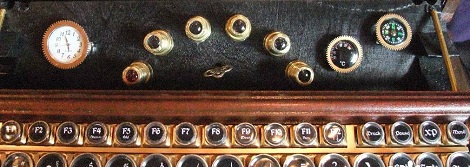
Edwardian Laptop From A Steampunk Master

After receiving a Marconi from [Admiral Aaron Ravensdale] informing us of the completion of an exquisite steampunk laptop, we were simply delighted. [The Admiral]’s computational device, or Uhlian Calculator as is the preferred nomenclature, is a remarkable combination of design and function suitable for any remarkable gentleman bent on the domination of the fast approaching electrical frontier.

[Ravensdale]’s new steampunk laptop is built off his first laptop, an old Toshiba Satellite 1100. Not a speed demon by any means, but the quality of this build is phenomenal. The hinged keyboard tilts up into an ergonomic position when the laptop is opened, reveling a set of six LED jewels for the power, battery, and hard drive lights. To the left and right of the screen, a pair of miniature brass horns contain a set of stereo speakers.

The keyboard is an awesome modification of the stock keyboard very reminiscent of [Admiral Ravensdale]’s previous keyboard steampunkification.

[The Admiral] put up an Instructable going through the many hours he put into this fine piece of craftsmanship. There’s also a video showing the keyboard lifting mechanism and skeleton key power switch available after the break.


Continue reading “Edwardian Laptop From A Steampunk Master”

[Ian Lesnet]’s Guide To The Bay Area Maker Faire

[youtube=http://www.youtube.com/watch?v=39xX4xi0Uh8&w=470]

It may be a week after the fact, but former Hackaday alum and inventor of the Bus Pirate [Ian Lesnet] made a great guide to the Bay Area Maker Faire.

The San Francisco-area Maker Faire attracts 100,000 makers, tinkerers, hackers, and general geeks to a bazaar of DIY and generally cool stuff. All the regulars were there, including [Jeri Ellsworth] and her Commodore 64 bass keytar along with a huge assortment of cosplayers including a steampunk Boba Fett and a couple space marines. Outside the building there was a 40-foot steamship and the amazing DeLorean hovercraft of [Matthew Riese].

During his interviews with fellow makers, [Ian]’s most received advice is, “take it slow.” There are thousands of builders in the bay area during Maker Faire, and it’s very easy to get very overwhelmed.

In case you’re wondering, [Ian] also picked up a ton of awesome schwag from all the vendors at the Maker Faire. Radio Shack had a box filled with random components,and [Kenneth] from Texas Instruments gave [Ian] a TI Launchpad, a capacitive test booster pack, and the king of all freebies, a Chronos watch.

After the break you can check out a few of the video project interviews [Ian] put up. Very awesome work from literally thousands of makers.

Continue reading “[Ian Lesnet]’s Guide To The Bay Area Maker Faire”

Making An Audio Spectrum Analyzer With A Microcontroller

While [Vinod] says he’s not an expert in this sort of thing, we really like his audio spectrum analyzer build from a simple microcontroller and LCD display.

It is a well-studied fact that every audio waveform – a recording of your voice, for instance – is just the sum of many, many sine waves. These sine waves can be plucked out using Fourier analysis, using a Discrete Fourier transform. This is the principle that spectrum analyzers operate under; [Vinod] wrote a bit of code using DFT to take apart audio captured from a microphone and output their frequency on an LCD display.

To output the spectrum on his LCD, [Vinod] stacked horizontal bars up into 8 custom characters in his display. Like [Vinod]’s previous audio on an ATMega32 experiment, an LM324 amplifier is connected to the ATMega through an analog pin. [Vinod] has a very clever build on his hands with his spectrum analyzer, and a great answer to the perennial ‘how do I build a guitar tuner’ questions we’re constantly asked.

After the break, you can see [Vinod]’s spectrum analyzer in action. Be forewarned; you may want to turn down the volume.

Continue reading “Making An Audio Spectrum Analyzer With A Microcontroller”

Hackaday Links: May 29, 2012

Teensy CNC mill

The guys at Inventables put together a neat CNC router kit that looks very interesting. It uses Makerslide linear bearings and CNC’d parts to make a surprisingly cheap frame for something that can engrave wood and metal. Inventables is running a Kickstarter-esque preorder to fund this production run but right now they’re 30 orders short. We’d like to see how these routers turn out in the real world, so if you’re on the fence (or just want a CNC router), this might be the time to buy.

DIY solder fume extractor

[Jared] sent in a fume extractor he put together. It’s a small PC case fan with a carbon filter sandwiched between a pair of grilles. Not much, but if should keep those wonderful flux fumes away from your face.

A million fake Internet points to the first person to come up with a DIY clone

[filespace] shared an awesome Electrofishing video with us. Electrofishing pulses a DC current through two electrodes attached to a boat. This current causes galvanotaxis in fish, causing them to swim towards the anode. The fish can be caught with a net and released afterwards; there’s no damage to the fish at all. We’d love to see a DIY solution, but throwing M-80s into a lake doesn’t count.

Improving GSM reception with a bit of metal

[Raivis] lives in the country, so even his voice reception on GSM is terrible, let alone data. Inspired by an earlier post, [Raivis] built a discone antenna to improve his cell signal. Now everything is crystal clear and his Huawei E1752 USB/GSM modem improved from 3 mbps down to 5 mbps down.

CNC halftone photos

[Dana] sent in a few pics of a project he’s working on. He’s making halftone prints with a CNC and metal. We’ve seen this before, but we’re really loving [Dana]’s take on it. He’s using two-layer engraving plastic with a .005” engraving tool on his CNC. There’s a gallery of his work after the break; [Dana]’s portrait is 14000+ dots and took 6 hours, his bosses kids are 16000+ dots and took 4 hours, and [Dana]’s niece is 5500 dots and took 35 minutes. Very awesome work, and now [Dana] has fulfilled a lifelong dream of machining his face.

Continue reading “Hackaday Links: May 29, 2012”

A Wedding Cake Made Out Of LEDs

[Andrew] wanted to do something special for his wedding. Since he and his fiance [Missy] decided on a cupcake wedding cake, [Andrew] decided to wow his guests with an RGB LED cupcake holder.

The tiers of [Andrew] and [Missy]’s cupcake holder are made of acrylic laser etched with a damask pattern. These tiers are supported by a cylinder embedded with RGB leds that provide edge lighting for the acrylic panels. The effect is a series of permutating lights that illuminate the cupcake holder with every imaginable color. On the top of the cupcake cake, there’s a great cake topper made of frosted and laser cut acrylic that has the same color fade effect as the cupcake holder.

On the electrical side of things, the cupcake holder has 44 LEDs on all it’s levels. FETs driven by a 40-pin PIC18F control all the LEDs and the whole piece is powered by a computer power supply.

It’s an awesome build, especially considering it was finished just days before the wedding. After the break, you can check out a few more videos showing off the beauty of [Andrew] and [Missy]’s wedding cake.

Continue reading “A Wedding Cake Made Out Of LEDs”

Turning A Pedal-powered Tractor Into A Power Wheels

A while back, [Stefan] bought a pedal-powered tractor for his son. It was a fun toy, but what it really needed was an electric motor. After a fair bit of tinkering, [Stefan] turned a pedal-powered tractor into a battery-powered Power Wheels.

Before turning his son’s pedal tractor into a battery-powered ride, [Stefan] ordered a 250 Watt motor and a Pololu motor controller. After tearing out the pedal parts, the motor was attached to the tractor with a few bits of wood (giving the tractor running boards), and a bike chain was run between the rear axle and motor. A pair of small 12 Volt batteries provide all the power and a Hall effect sensor in the handlebars provides the throttle.

Right now, [Stefan] has his son’s new battery-powered tractor set to a top speed of 5 km/h, or just a little bit faster than walking speed. [Stefan] says the tractor has a top speed of about 15 km/h, or about 10 mph; much too fast for a kid’s toy. After the break there’s a video of the tractor rolling along, and [Stefan]’s son having a great time.

Continue reading “Turning A Pedal-powered Tractor Into A Power Wheels”

Mini Pinball MAME Machine Is Small Enough To Fit In Any Game Room

A huge collection of pinball machines in your basement is one of the crowing achievements of a geek, but what if you could have a huge library of physical pinball machines at you fingertips? [veriix] shared an imgur gallery in a reddit post documenting his wee little pinball machine he built from scratch.

Inside the pinball cabinet, there are two monitors. A 4:3 Samsung monitor serves as  the backglass for the machine while a 23″ HDTV provides the playfield. On the software side of things, [veriix] used PINMAME and Visual Pinball 9 running on an old motherboard he had lying around. The result is impressive. The HD monitor playfield provides the right perspective to fool [veriix]’s brain into thinking he’s playing a real pinball machine.

We’ve seen PINMAME builds before, but those were encased in full-size pinball cabinets that took up far too much room. [veriix]’s machine is much smaller, and perfect for the garage, den, basement, or anywhere you’d like to set up an awesome game room.

You can check out [veriix] playing his mini pinball machine after the break. Thanks [Johnny] for sending this one in.

Continue reading “Mini Pinball MAME Machine Is Small Enough To Fit In Any Game Room”