Hackaday Links: January 5, 2012

Now make it life size

Here’s a scale model of the classic Playstation game Wipeout. It uses quantum levitation, superconductors, liquid nitrogen, and incredibly detailed models of the cars in Wipeout. They’re able control the speed and direction of the cars electronically. Somebody get on making one of these I can drive. Never mind, it’s totally fake, but here’s a choo-choo that does the same thing. Thanks for the link, [Ben].

Found a use for eight copies of Deep Impact

Where do you keep all your wire? [Paul] keeps his inside VHS tapes. It’s one of the most efficient ways of storing wire we’ve seen, just don’t touch those VHS copies of the original Star Wars trilogy.

There’s MAME machines for pinball?

MAME arcade machines are old hat, but we’ve never seen something to emulate pinball. The build uses two LCD monitors, a small computer and PinMAME. There’s videos in the build log; tell us if we’re stupid for wanting to build one. Thanks go to [Adrian] for sending this one in.

LEGO binary to decimal conversion

[Carl] is doing a few experiments to see if it’s possible to build a calculating machine out of LEGO. He managed to convert four bits of binary into decimal. We’ve seen a LEGO Antikythera mechanism but nothing on the order of an Analytical Engine or some Diamond Age rod logic. Keep it up, [Carl].

Lubs and Dubs that aren’t for dubstep

The folks at Toymaker Television posted a neat demo of heart rhythms emulated with a microprocessor. It cycles through normal sinus rhythm, atrial fibrillation, atrial flutter, and everything else that can go wrong with your heart. We know some nurses that would have loved this in school.


Reading NAND Flash With An Arduino

[HC] took a gander around the Googles and saw a number of people trying to read NAND flash chips with an Arduino. It’s an interesting problem; at 16 Megahertz, [HC] is looking at about 60 nanoseconds per instruction cycle, and flash chips normally operate around 20 ns. He got the build working, and was able to read the memory contents and ID of a flash chip.

Right now, it’s just a proof-of-concept to demonstrate that reading flash memory is possible. [HC] used an Arduino Mega to pull the manufacture ID off a flash chip. Because there isn’t exactly a whole lot of storage on an Arduino to hold Megabytes of data, so [HC] is looking for a way to pull data off his flash chip. He’s considering sending it over Ethernet or storing it on an SD card.

This isn’t the first time we’ve seen a roundabout way to use those cheap, ubiquitous NAND flash chips. Considering we’ve got a few dozen of them housed in unused thumb drives, [HC]’s work shows a lot of potential. He posted a topic on his forum to see if there’s any interest in further developments, something we’d like to see.

Power Protection Circuit Tutorial

Building your first circuit is empowering, but make sure it’s not too empowering. [Jon] sent in a great tutorial of power protection circuits to make sure you don’t release the mystical blue smoke that make electronics work.

There’s an in-depth tutorial of the classic series diode that’s the simplest of all power protection circuits. There’s not much to it – just a diode that provides reverse polarity protection. A fuse and parallel diode doesn’t have the voltage drop a series diode has, but doesn’t do anything for an overvoltage. A P-channel MOSFET gets around the problem of voltage drop, and [Jon] gives us some really nice empirical data to demonstrate his testing setup.

There’s a ton of nice write ups on [Jon]’s site that are perfect for getting ideas for projects like ten switches on one pin and some strange stuff [Jon] picked up at his Goodwill. If you’ve got any tutorials on general electronics, be sure to send them in on our tip line.

Easy Camera Tracking With A Quadrocopter

[DJ Sures] has been pulling all-nighters lately to get his AR Drone Parrot build off the ground. Now that it’s up and flying around, he managed to get it to follow objects around the room using on board cameras.

For the build, [DJ Sures] used the AR Drone ‘flying video game’ quadrocopter. This toy has two on board cameras that can viewed over wifi. All that’s needed is some interesting software to make things fun. The camera tracking of EZ-Builder software was brought into the mix so the AR Drone can be controlled via object or speech recognition, wiimotes, tablets, or terminals.

[DJ Sures] has come up with some slightly terrifying awesome builds like a Bluetooth Teddy Ruxpin, realistic Wall-E, and an awesome Omnibot 2000 refurb. This is his first flying hack, and the first to fully exploit the camera tracking of the EZ-Builder software. Check out [Sures]’ copter following him around a room after the break.

Continue reading “Easy Camera Tracking With A Quadrocopter”

Laser Shooting Gallery Made From Scrap

When he’s not being completely awesome hosting a radio show on electronic music, [Gaston Klares] is busy in his workshop coming up with some awesome stuff. One of his most recent builds is a laser gun shooting gallery that brings a classic carnival game to his back yard. (Google translate link)

The laser gun itself is made up of 95% recycled components. The purpose of the laser gun is pretty simple – just make a sound effect and fire a laser downrange when the trigger is pulled. The shooting gallery is where all the fun happens. Five dog food cans are lined up at the far end of the range. There’s a small hole in each can and a phototransistor inside each can that activates the ‘fall over’ mechanism. When all the cans are knocked down, a windshield wiper motor puts all the cans upright again.

Thanks to [Kris] for sending this one in. Check out the shooting gallery in action after the break.

Continue reading “Laser Shooting Gallery Made From Scrap”

Voting Is Open For The Buildlounge Laser Cutter Contest

A few months ago, Buildlounge and Full Spectrum Laser started a contest to win a 40 Watt laser cutter. The only requirement? Submit a project that uses light in some way. The deadline is now over and voting is open, right on the buildlounge.com page.

First place gets a 40 Watt laser cutter provided by Full Spectrum Laser. Second place is a neat green laser courtesy of Wicked Lasers, and Third place is an EL wire starter kit  from Adafruit.

There’s a lot of really awesome projects that were submitted for this contest. The laser terminal looks really cool, as does the friggin huge LED wall and choreographed light show. We would be remiss if we neglected to mention that there’s a home-made x-ray machine in the running, and of course there’s the mathematical precision of fellow Hack a Day-er [Jack]’s solar clock that isn’t a sundial.

The guys at Buildlounge got a lot of submissions for this project, so head on over and vote for your favorite. The winners will be announced next week, Friday, the 13th of January.

Neural Networks Control A Toy Car

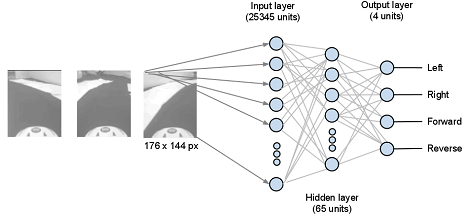
After taking the Stanford Machine Learning class offered over the Internet last year, [David Singleton] thought he could build something really cool. We have to admit that he nailed it with his neural network controlled car. There’s not much to the build; it’s just an Android phone, an Arduino and a toy car. The machine learning part of this build really makes it special.

A neural network takes a whole bunch of inputs and represents them as a node in a network. Each node in [Davids]’s input layer corresponds to a pixel retrieved from his phone’s camera. All the inputs of the input layer are connected to 64 nodes in the ‘hidden layer’. The nodes in the hidden layer are connected to the four output nodes, namely left, right, forward and reverse.

After training the network and weighting all the connections, [David] got a toy car to drive around a track. Weird, but it works. All the code is up on github, so feel free to take a look behind the inner machinations of a neural net. Of course, you could check out the video of [David]’s car in action after the break.

EDIT: We originally credited [icebrain] as the author. Our bad, and we hope [David] doesn’t hate us now.

Continue reading “Neural Networks Control A Toy Car”