Physical Computing Just Got A Lot Easier

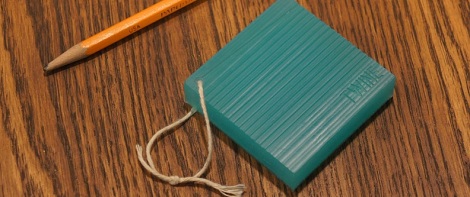
Putting microcontrollers in everything and tying appliances into the internet has become the DIYers’ bread and butter. There’s a ton of benefits from an Internet-enabled coffee maker, but actually building these projects takes a little bit of knowledge. Enter [Dave] and [John] with Twine – a little Internet enabled box that connects physical reality to the digital world.

The hardware inside a Twine is a small board that combines WiFi, an accelerometer and temperature sensor. The Twine is programmed ‘in the cloud’ with a simple if/then condition. A Twine will send you a text, email or tweet when the condition is met. For example, you could put a Twine on a door and program the accelerometer to text you when someone comes knocking.

Twine isn’t an entirely closed system; there’s a plug for additional sensors (moisture detection, for example), and the data from sensors can be pushed out to a server. You can pick up a twine for $100 from the Kickstarter; it’s a little rich for our blood, but we’re sure it’ll be a useful device.


Hackaday Links: December 7, 2011

LED Neurons

[Alexandra Olivier] put up an art installation at Wellesley College that looks like a bunch of neurons built out of LEDs. The neurons are connected to a couple PIR sensors and ‘fire’ whenever movement is detected. The result is a lot like being inside a brain. Fitting, then, that the installation is called Social Synapses.

Last year’s big toy was always evil, though

Last year, [Andrew] had to fight the throngs of shoppers to get the must have toy of the season, a Zhu Zhu pet. Since these robotic hamster things have spent the last 11 months in the back of a closet, it seems reasonable to make them evil. They’re still not as evil as a demonic Furby….

So we call it a bifocal, right?

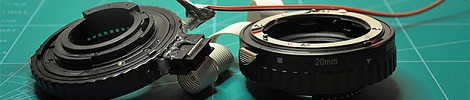
There’s an old photography trick for a really hacky macro setup – just turn the lens around. Well, what if you wanted automatic metering and flash control? Simple, just electrically reverse the lens. Bonus points for being able to use the lens regularly as well.

Control all the bands

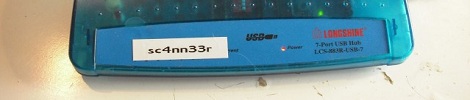
Well here’s something cool: an all-in-one USB 315mhz, 433mhz, and 868mhz transceiver. What can you do with it? Well, [codeninja] can control the outdoor lights for two of his neighbors, open gates and doors, crash his weather station, and just about anything else in those bands. It’s pretty much like war driving for important stuff nobody cares about.

So this is our favorite holiday now

There’s a Dutch tradition to play Sinterklaas and make someone a present. [Jenor] decided to build an antique-looking DC voltmeter with a pair of vacuum tubes. The tubes don’t work anymore, but the heaters still provide a nice warm glow. It’s a bit large to be regularly used as a piece of test equipment, but it really does look awesome. Very steampunkey, and it’s the though that counts anyway.

Aluminum Bending Tutorial And A DIY Brake

What makes a project really exceptional? Part of it is a, ‘gee, that’s clever’ angle with a little bit of, ‘that’s actually possible.’ One thing the Hack a Day crew really appreciates is awesome enclosures. Altoids tins will get you far, but to step up to the big leagues you’ve got to bend some aluminum. Luckily, [Rupert] sent in a great tutorial on bending aluminum sheets for enclosures.

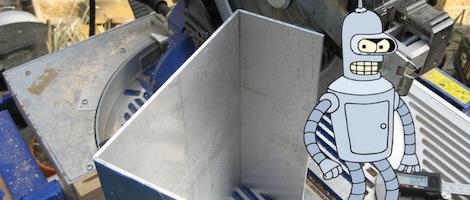
To make his press brake, [Rupert] scavenged a few pieces of 38mm bamboo worktop scraps. After assembling a few of these pieces with some hinges, he was ready to bend some aluminum.

One trick [Rupert] picked up is scoring the sheet metal on the inside of a future bend. For [Rupert]’s project, he sent his 3mm aluminum sheet through a table saw set to cut 1mm deep. Of course this should only be done with a blade designed for non-ferrous metals with as many carbide teeth as possible. Judging from [Rupert]’s homebuilt Hi-Fi that used this construction technique, the results are phenomenal.

Awesome Little UAV Flies 1 Km

After going to an SMD soldering workshop at the Stuttgart hackerspace ShackSpace, [Corvus] decided to be an over achiever and build a flight controller for his very own unmanned aerial vehicle.

The airplane itself is a regular store-bought foam contraption, and not terribly interesting in and of itself. Autonomous flight piques some interest, though. A custom flight controller PCB was designed and built by [Corvus] to work alongside a tiny STM32 Linux board. These two boards, combined with the OpenPilot project allow the plane to keep altitude, bearing, speed, and position in check autonomously. Telemetry between the ground station and vehicle is handled by UAVTalk and a ThinkPad.

In the video after the break, [Corvus] piloted the plane up to altitude, then directed it to fly 500 meters North and turn around. The result was an autonomous flight of over one kilometer. The next stage of the project is implementing some SLAM applications with optical path finding and obstacle avoidance.

Continue reading “Awesome Little UAV Flies 1 Km”

Web-enabled Kinect

There are Kinect hacks out there for robot vision, 3D scanners, and even pseudo-LIDAR setups. Until now, one limiting factor to these builds is the requirement for a full-blown computer on the device to deal with the depth maps and do all the necessary processing and computation. This doesn’t seem like much of a problem since [wizgrav] published Intrael, an HTTP interface for the Kinect.

[Eleftherios] caught up to [wizgrav] at his local hackerspace where he did a short tutorial on Intrael. [wizgrav]’s project provides each frame from the Kinect over HTTP wrapped up in JSON arrays. Everything a Kinect outputs aside from sound is now easily available over the Internet.

The project is meant to put computer vision outside the realm of desktops and robotic laptops and into the web. [wizgrav] has a few ideas on what his project can be used for, such as smart security cameras and all kinds of interactive surfaces.

After the break, check out the Intrael primer [wizgrav] demonstrated (it’s Greek to us, but there are subtitles), and a few demos of what Intrael ‘sees.’

Continue reading “Web-enabled Kinect”

Sound Treating A Studio

Looks like [Dino] is getting the band back together. After a junkyard tube amp and a DIY tremolo stompbox, he’s back again, this time doing a bit of sound treatment in his studio.

Most rooms naturally have a bit of flutter echo. You’ll notice this when you move into an apartment or new house – rooms sound a lot more cavernous without rugs, drapes and furniture. Unfortunately, having a bunch of couches doesn’t bode well for the workflow in a studio despite what MTV Cribs may have told us. The usual solution is to put up some sound-absorbing material on the walls, and a metric ton of cardboard egg cartons don’t work.

[Dino] found a bunch of acoustic panels his neighbor threw out during a renovation (yes, we know, he’s very lucky). After doing some pre-installation tests, the panels were hung. Afterwards, the amount of echo was drastically reduced.

The good news is we finally get a look inside [Dino]’s studio. We saw the junkyard tube amp we covered earlier, but not the neat tremolo pedal he made.

Check out [Dino]’s video of sound treating a room after the break.

Continue reading “Sound Treating A Studio”

Two Telescope Improvements

Despite being a college class everyone regarded as an easy ‘A,’ astronomy is very hard work. Not only do many hours go into capturing a single image, the equipment itself must be constantly monitored well into the freezing cold of night. [Jerry] sent in a few neat projects that have made his nights much more comfortable.

First up is a mod for a focus controller. The focus of a telescope changes constantly with temperature, atmospheric conditions, and especially what filter is being used. The stock USB-nSTEP focuser [Jerry] used required hard-to-find unipolar steppers, so he modded his USB-nSTEM to accept bipolars with a Pololu A4988 driver.

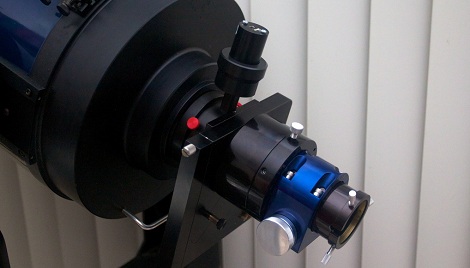
Next up is [Jerry]’s very impressive DIY Off-axis guider that he machined himself. An off-axis guider allows an astronomer to guide the ‘scope without having to deal with a dinky, surprisingly flexible guide scope. We’re really impressed with [Jerry]’s machine skills, but that’s what you get when you’ve got an awesome mill like his.