Mineable Minecraft Block

At Hack A Day, we’re pretty big Minecraft fans so you can imagine our interest when we saw [Ben Purdy]’s real-life Minecraft block. The build uses a projector system to display a block onto a cardboard box and reacts to being ‘mined’ just like in the game.

Block animation is handled by a piezo sensor, an Arduino and a Processing sketch. From earlier posts on [Ben’s] blog, we’re going to guess that he used the keystone video projection library his own solution to map the Minecraft block onto the cardboard box. Animation is handled just as in Minecraft – overlaying the breaking animation onto the block and adding some particle effects.

We’ve seen a few Minecraft hacks before, like using it as a 3D design tool, and connecting your redstone CPU to the outside world. [Ben]’s build follows in the tradition of its forebears and is something we really want to try out. Check out the demos after the break.


Continue reading “Mineable Minecraft Block”

Run Unsigned Code On Any Xbox

A ton of people sent in the latest development on the Xbox homebrew front. A console hacker that goes by the name of [GliGli] released a new exploit that boots any Xbox into a Linux loader.

The hack requires some hardware – in this case an Xilinx CLPD. The hack works by sending a tiny reset pulse (no word on what ‘tiny’ means) that glitches the hardware and gets around the hash checks during boot. If that’s not technical enough for you, check out the readme on the project’s github.

This isn’t a silver bullet to cracking Xboxen wide open. The glitch only has about a 25% chance of success for each boot. The glitch also take a few minutes to boot into unsigned code. This being said, the hack works on all 360s, including the slim models that can’t be opened up with the JTAG method.

Check out the demo of one of the beta testers demonstrating the exploit after the break. Again, thanks to everyone for sending this one in.

Continue reading “Run Unsigned Code On Any Xbox”

BASIC Programming On An Arduino

[Mike] sent in a project he’s been working on – a port of a BASIC interpreter that fits on an Arduino. The code is meant to be a faithful port of Tiny BASIC for the 68000, and true to Tiny BASIC form, it fits in the very limited RAM of the Arduino.

True to Tiny BASIC’s assembler roots, [Mike]’s C port makes extensive use of the “infinitely-abusable” goto statement. Kernighan and Ritchie said themselves, “code involving a goto can alway be written without one” but [Mike] found that using goto left a lot more room available for BASIC code. The BASIC interpreter eats up around 600 bytes in the Arduino RAM, leaving about 1.4 kB for BASIC code. Not much, but more than the lowest-end BASIC Stamp.

[Mike] says he started this project to see how ‘old bearded ones’ conjured up so many impressive programs with a few kB of RAM. Tiny BASIC was originally conceived for the Altair 8800 that shipped with 256 bytes of RAM stock, so it seemed like a perfect fit. Right now, all we know is we’ll be spending the weekend digging through our copies of Dr. Dobb’s Journal.

High Voltage Hacks Finale: Do Not Try This Under Any Circumstances

Over the last two weeks, we’ve seen some pretty crazy and potentially dangerous stuff, like a stun glove and modern day alchemy. For our high voltage theme finale, we couldn’t pass up [Photonicinduction]’s YouTube channel.

Best known for his self-destructing washing machine (the source of this animated .gif), [Photonicinduction] is also the brainchild behind the hair dryer flame thrower and his homemade fifty thousand amp transformer.

While we do like his Not Safe For Work ammeter (yes, it really is NSFW), some of [Photonicinduction]’s videos – charging a car battery in 4 minutes, making a kettle boil without a heater element, pressurizing coconuts to over 200 psi, and exploding rabbits – are hilariously dangerous and should not be attempted by anyone.

We need to say you should not attempt to emulate [Photonicinduction]’s hijinks under any circumstances. Cleaning up a puddle of burning gasoline with a vacuum cleaner may sound like fun, but copying [Photonicinduction] will eventually get you killed. This man must know his stuff, because we’re honestly shocked he hasn’t exploded yet. The best way to enjoy three hundred thousand volts is probably grabbing a coffee and watching [Photonicinduction]’s YouTube channel.

High Voltage Hacks: Transmute The Elements In Your Garage

The magnum opus of alchemy was the Philosopher’s stone, a substance that was able to turn common metals into gold. Unlike alchemists, [Carl Willis] might not be poisoning himself in a multitude of ways, but he did build a Farnsworth fusor that’s capable of turning Hydrogen into Helium.

To fuse Hydrogen in his device, [Carl] first evacuates a vacuum chamber. Deuterium (Hydrogen with an added neutron) is injected into the chamber, and a spherical cathode made of Tungsten is charged to 75 kV. The deuterium gas is heated and confined by the cathode and fuses into Helium. The electrostatic confinement of the plasma isn’t very much different from some old CRT tubes. This isn’t a coincidence – both the fusor and CRTs were invented by the same man.

While no fusion experiments – including some billion dollar experiments – have ever produced a net energy gain, this doesn’t mean it’s not an impressive engineering feat. If you’d like to try your hand at building your own fusor, drop by the surprisingly active research forum. There’s a lot of really good projects to look through over there.

Dev Board From An AVR Programmer

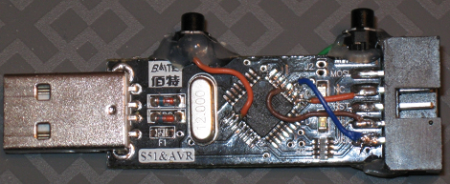
[jethomson] sent in a build he’s been working on that turns an inexpensive AVR programmer into a development board. The build is based on the very affordable USBasp programmer that’s based on an ATmega8. With hundreds of these boards available from China for less than a Hamilton, we’re wondering how soon it will be before we see these boards end up in other projects.

After fiddling with the AVR fuse settings, [jethomson] managed to burn some code to the microcontroller. After that, all that was required to upload software to the programmer is a bit of solder, a push button, and an external programmer. [jethomson] also managed to make this little AVR programmer compatible with the Arduino environment with a small addition to the boards.txt file.

[jethomson] included a few bits of software as an example – he ported the haunted USB cable and adapted the USB business card to print out, “All work and no play makes Jack a dull boy.” Nice work, and we can’t wait to see it in future projects.

High Voltage Hacks: A 1000 Watt Tube Amp

Normally when we hear of a Champ guitar amp, we think of a sweet-sounding rig that puts out 6 Watts through an 8-inch speaker. [John Chambers] of Champ Electronics wanted to build a true champion for the field of battle and came up with The Champ 1000 Watt Tube Amp, an amplifier that probably puts out enough heat to keep an igloo warm.

The amp is based on 807 valves. With some clever engineering [John] managed to coax 100 watts out of a pair of 807s, so the entire amp “only” requires 20 power tubes. The build log shows some pretty impressive examples of electrical prowess. We can’t recall the last time we featured a build with point-to-point wiring on tagboard, and [John]’s work is some of the best we’ve ever seen.

[John] has been working on this amp off and on for a few years now, but he should be wrapping up the build sometime soon. We haven’t seen this amp in action, but we imagine it would look something like this 36×10 monstrosity. Send us a message or post a comment if you can find a video and we’ll put it up.