Highway Based Soundtrack Recordings

[Urpo Lankinen] has a father who is a huge movie buff, and once you care deeply about something it begins appearing everywhere you look. While driving on a back-country road one day, [Urpo]’s dad noticed that the shadows of the trees on the road looked like an optical film soundtrack, so it was up to the son to make it happen.

Early sound-on-film technologies like the RCA Photophone, and Movietone recorded audio onto the film stock with a variable area exposure. This exposure corresponds to the waveform of the audio signal. [Urpo] figured that his small digital video camera served the same purpose as the audio sensors inside the projector, so he put a piece of tissue paper over the lens and wound up with a video that was just frames of gray.

[Urpo] built an app in Processing that averages the pixels in each frame of the video. Of course, recording at 30 frames/second won’t produce any audio this way, so he modulated a triangle wave with this data in Audacity. In the end it really doesn’t sound like much, but it’s great to see such a geeky build.

We’d love to post the video after a break but [Urpo] doesn’t believe in YouTube embeds. We’ll honor his wishes, so you can check out the video here.


Using Nixie Tubes As Robot Eyes

[radmeck] on the ez-robot.com forums came up with a great use for Nixie tubes. Instead of using Nixies for clocks, or indicating values, he used them as robot eyes.

He used the arduNIX Arduino-powered Nixie tube driver to power the tubes. [radmeck] was very impressed with the arduNIX kit. The kit is able to drive eight Nixies or eighty neon bulbs, but there’s no word from [radmeck] on additional Nixies or neons in his build. The eventual goal of the project is to rebuild the Omnibot while adding more servos and motors. The EZ-B robot controller will be used to control the robot, something we’ve seen before.

[radmeck]’s Omnibot looks a lot better after the retr0bright bath, and with Nixie eyes its even more adorable. While the Omnibot didn’t live up to the original promise of impressing your girlfriend, Nixie tube eyes will give you some blog cred.

Check out the video of the much-improved Omnibot after the break.

Continue reading “Using Nixie Tubes As Robot Eyes”

Engine Hacks: Liquid Fuel Amateur Rocket Roundup

When the idea of an engine hacks theme was being kicked around at Hack a Day, the subject of rocket engines was one of the first to come up. There was a problem though; solid rocket motors are far too common to be interesting, and even hybrid rocket engines are becoming passĂ©. We’ve never seen a liquid-fuel rocket build before, so that’s what this roundup evolved into.

First up is [Robert Watzlavick], who has been has been building liquid fueled engines for the last decade. He started out with an uncooled kerosene/LOX whose death is seen in the title pic for this post. Lately he’s been working on a monster of an engine that is projected to deliver over 1,000 Newtons of thrust. As with many of the early rockets that launched man into space, [Robert] uses kerosene and liquid oxygen for fuel. This man knows his stuff.

Next up is a ‘kit’ liquid fuel rocket, the SS67B-3, that’s based on the German WWII Taifun missile. This engine is about as basic as you can get. There’s one fuel tank that holds both the Hydrogen Peroxide oxidizer and gasoline fuel. Both are blasted into the combustion chamber with pressurized gas. we found a write-up on this kit with some good pictures, but no video.

If high pressures, glowing metal, and huge flames pique your interest, there’s also a fabulous e-book (PDF warning) available that is a reprint of How to Design, Build and Test Small Liquid-Fuel Rocket Engines by [Leroy J. Krzyck]. This book was originally written in 1967, but lathes and mills haven’t changed that much over the past 44 years. Why not give it a go? There’s still plenty of time to complete the build before the 100th anniversary of Goddard’s first flight.

Bare-bones Electronic Advent Calendar

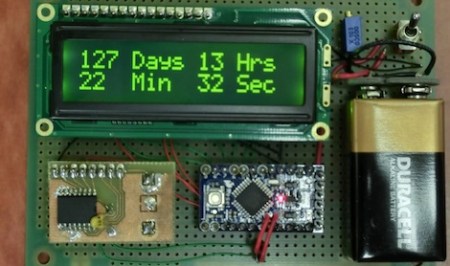
It’s officially September now (in some parts of the world), and that means we’ve been watching the Christmas decorations go up on the floor of Costco, Walmart and Target for the last few weeks. As a small test of reality, [Eric] decided to build an electronic advent calendar that counts down the days until Christmas. As a simple build using parts lying around on the bench, [Eric] did a pretty good job at deferring his kid’s questions of, “How long until Christmas?” to a machine.

The build is fairly bare-bones, using only an Arduino Pro Mini, RTC and LCD display. For the real-time clock, [Eric] used the ever popular DS3231 RTC. The software reads the time from the clock and calculates the number of seconds between the present time and the hard-coded target date.

Everything is powered by a 9 Volt battery that wouldn’t last the remaining 115 days until Christmas. There is a power switch and the RTC has a battery backup, so the build will probably suffice for all but the most fanatical child.

Insects Turned Into Orchestra; Not Harmed But Terribly Inconvenienced

[Jochem] has always been fascinated by chaos in nature, whether it’s a swarm of ants or evolution in action in a petri dish. His insect orchestra takes the chaos in the natural world and changes it into something completely artificial. In this case, MIDI.

For the build, a light sensor was placed at the bottom of a test tube. A cricket (or grasshopper, or locust) is then put into the test tube. The test tube is then closed up with a cap that houses a LED. An Arduino reads the light sensors and then transmits the data over MIDI. The MIDI commands are picked up in Abelton Live which converts everything to audio.

[Jochem] rigged up Abelton to have the insects perform in four different modes – instrument, synthesis, samples, and drums. Definitely an improvement over the humble Mexican Jumping bean.

You can check out the insect orchestra in action after the break.

Continue reading “Insects Turned Into Orchestra; Not Harmed But Terribly Inconvenienced”

Knock Lock With Logic Chips

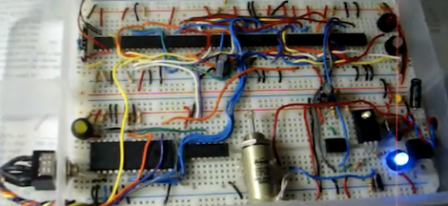
[Eric] needed a project for his digital logic design class, and decided on a lock that open in response to a specific pattern of knocks. This is a fairly common project that we’ve seen a few builds with ‘knock locks,’ but this one doesn’t use a microcontroller. Instead, it uses individual logic chips.

The lock senses the knocks with a piezo, just like every other build we’ve seen. Unlike the other builds, the knock pattern is then digitized and stored in an EEPROM. [Eric] only used 12 chip for this build, a feat he could accomplish with a few digital tricks, like making an inverter by tying one XOR input high.

We’ve seen a 555-based knock lock before, but getting the timing right with that seems a little maddening. [Eric]’s build seems much more user-friendly, and has the added bonus of being programmed by knocking instead of turning potentiometers. Check out [Eric]’s knock lock after the break.

Continue reading “Knock Lock With Logic Chips”

Guitar Pickup Winding Workstation

After a bit of inspiration, [Pete] decided to build a solid body electric guitar for himself. Instead of assembling a conglomeration of off-the-shelf parts, he plans on building just about everything from scratch. This includes the guitar pickups, so he built himself a pickup winder that has measures RPM, ETA until done, and auto stop for when the pickup is complete.

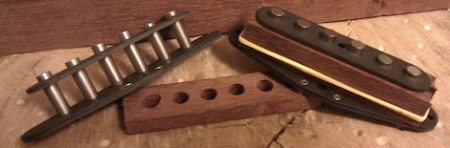
Electric guitar pickups are simple devices – just a magnet for each string wrapped in thousands of turns of wire about as thin as a human hair. [Pete] began his build with a cheap sewing machine and added a tachometer and pickup mount. As an added bonus, [Pete] threw in an ohmmeter to measure the coil resistance and a Gauss meter to measure the magnetic flux and polarity of the pole pieces. It’s a very nice build that’s designed to be as functional as commercial pickup winders.

[Pete] was originally inspired to build a pickup winder by the Les Paul Google doodle, and he plans on continuing Les Paul’s tradition of guitar innovation by building his own solid body guitar. The wood has been cut already, and we can’t wait to see the final product.

Check out a video of [Pete]’s coil winder in action after the break.

Continue reading “Guitar Pickup Winding Workstation”