Coffee Cupping Is A Grind — Spectroscopy Could Brew Better Beans

If you’ve ever bought whole coffee beans, chances are good that there was all kinds of information on the bag that led to your decision, like the origin, the roast type, and the flavor notes. Traditionally, coffee grading — that’s judging the aroma of both dry and wet grounds and slurping the coffee evenly across the tongue to determine the flavor profile — is done by humans in a process called cupping. To call it a process is too clinical — it’s really more like a ceremony performed with the grave sincerity that coffee deserves.

A traditional cupping ceremony. Image via Kaldi’s Coffee

There’s an industry standard coffee flavor wheel, so why not leverage that to make a robot that can remove the human bias and possible error of doing things the traditional way? That’s exactly what Demetria, a Columbian-Israeli company is doing.

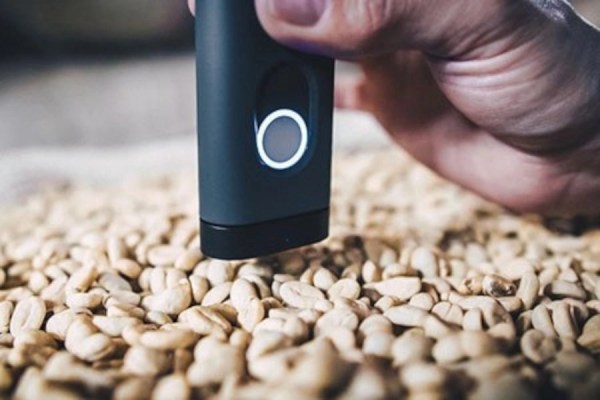
They’ve developed an AI platform that can determine bean quality as judged by handheld scanners that were born on Kickstarter. The scanner uses near-infrared to look for biochemical markers in the bean, which it uses to match up with a profile backed by the all-knowing coffee flavor wheel.

Demetria is using SCiO scanners and a custom app to judge beans before they’re even roasted, which greatly speeds up the process but makes us wonder how green bean spectroscopy stacks up against roasted beans as judged by humans. You may remember the SCiO, a pocket-sized, connected spectrometer made by Consumer Physics that finally started delivering the goods a few years after funding. If you got your hands on a SCiO, you might like to know that there’s an open project out there to hack them. Sparkfun did a nice, thorough teardown, and it seems to be a well-engineered piece of hardware.

On the one hand, cupping is a tradition and thus may people feel that robbing coffee of this tradition will rob coffee of its soul. On the other hand, cupping is wasteful, as the coffee must be roasted and ground immediately prior to the ceremony and it requires the availability of Q graders who have been trained in the ways of coffee grading.

Want to know more about coffee production? Might as well learn the Retrotechtacular way.

[Main and thumbnail images via Demetria]
Apple-Picking Robot Stems From Labor Shortage

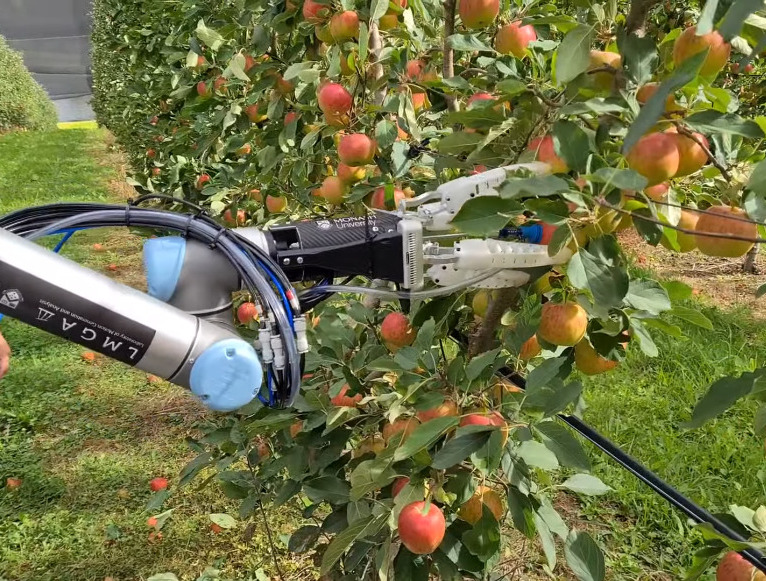
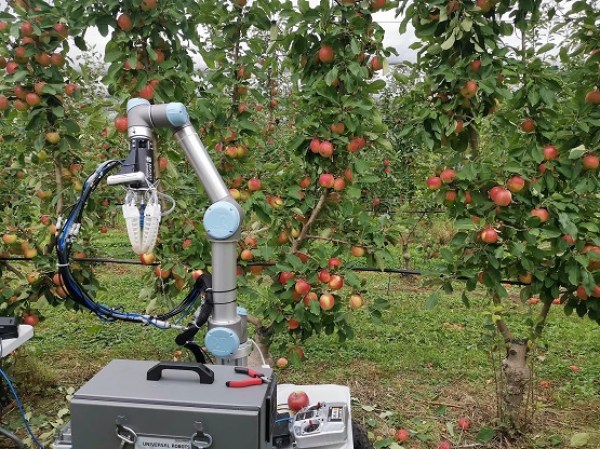
Among all the job-related problems wrought by the pandemic, here is another one that comes as the result of people generally staying home: there are hardly any backpackers to do traditional transient backpacker jobs like picking apples. Researchers at Monash University’s Department of Mechanical and Aerospace engineering found a way to fill in the gap by building a pneumatic robot arm that can harvest an apple every seven seconds at top speed.

A suite of cameras and algorithms look for fruit amongst the foliage and carefully remove it by gripping it gently and twisting, much like a human would. In order to do this, the robot must consider the shape of the fruit, the way it’s hanging, and where to separate it from the tree while keeping damage to a minimum. A suction system helps pull the apple into the soft, four-fingered grip and then the arm twists and turns to deposit the apple into the bin.

There are a lot of upsides to this robot, including the fact that it works in any lighting and weather conditions and can ID an apple in less than 200 milliseconds. The only problem is that this operation results in the occasional missing stem — a cosmetic problem that sounds nit-picky, but would definitely prevent some stores from buying the fruit. Well, that, and there only seems to be one of these robots so far.

There are two videos after the break — a short one that gives you the gist, and a much longer one that offers a view of the suction cup, which emerges from the middle of the fingers like a xenomorph’s little mouth.

Some readers may be wondering why apples are still picked individually when shaking harvesters exists. “Shake-and-catch” tends to bruise apples, making them undesirable for produce sellers, however, apples destined for juicing have no issue with being handled roughly by the harvesters as shown in this fascinating harvest video. Robot grippers are gentle and we’ve seen all shapes and sizes that are suited to a particular need. When the needs are more general, rollers or squishy spheres might be the answer.

Continue reading “Apple-Picking Robot Stems From Labor Shortage”

Mice Develop Inside An Artificial Womb

Well, it looks like those fetus fields from The Matrix (1999) just became a little bit more plausible. Although people-growing is probably a long way off, mice can now mostly develop inside an artificial uterus (try private window if you hit a paywall) thanks to a breakthrough in developmental biology. So far, the mice can only be kept alive halfway through gestation. There’s a point at which the nutrient formula provided to them isn’t enough, and they need a blood supply to continue growing. That’s the next goal. For now, let’s talk about that mechanical womb setup.

Carousel of Care

The mechanical womb was developed to better understand how various factors such as gene mutations, nutrients, and environmental conditions affect murine fetuses in development. Why do miscarriages occur, and why do fertilized eggs fail to implant in the first place? How exactly does an egg explode into 40 trillion cells when things do work out? This see-through uterus ought to reveal a few more of nature’s gestational secrets.

Continue reading “Mice Develop Inside An Artificial Womb”

Airports Are Now AirBNBs For Honeybees

In the summer of 2012, honeybees swarmed the Pittsburgh airport, probably because the conditions are favorable there. Like many airports, the tarmac is surrounded by wild, wide-open fields that exist to contain the cacophony. And a couple of nearby creeks are dotted with plenty of forage-worthy wildflowers.

Free honey? Wúnderbar!

Now, nearly a decade later, the airport is home to 110 colonies that house around 4 million honeybees. And they aren’t alone. Several other US airports are getting in on the apiary action, including O’Hare, Sea-Tac, and Minneapolis-St. Paul.

The relationship between honeybees and airports is a symbiotic one — the honey the bees produce is a litmus test for air pollution levels around the airport, which must fall within regulations. German airports have employed bees as ‘bio-detectives’ for over twenty years, and they give the honey away for free inside the terminal. It’s okay, though — analysis reveals that the hydrocarbon and heavy metal levels in the airport honey aren’t any higher than honey from non-industrial bees.

Given that honeybees pollinate around $15 billion in crops annually in the US alone, it’s a wonder that we aren’t doing everything possible to fight colony collapse disorder and other problems around the world. This mysterious issue has grown in the last few years, and 2020 saw highest death toll since 2016. Colony collapse disorder aside, plenty of problems persist for our fuzzy friends — pests, pesticides, pathogens, and poor nutrition.

What’s the deal with bees, anyway? How do they fly? Because they aren’t supposed to fly.

Grinding Coffee Beans The Machine Shop Way

Okay, so you bought a bag of heavenly-smelling single-origin beans down at the hipster coffee shop, but forgot to have them ground. What do you do? If you’re [Jimmy DiResta], there’s no way you can run down to Walmart and pick up a grinder for $15. You commune with your tools and spend a few hours building a grinder from stuff lying around in the workshop.

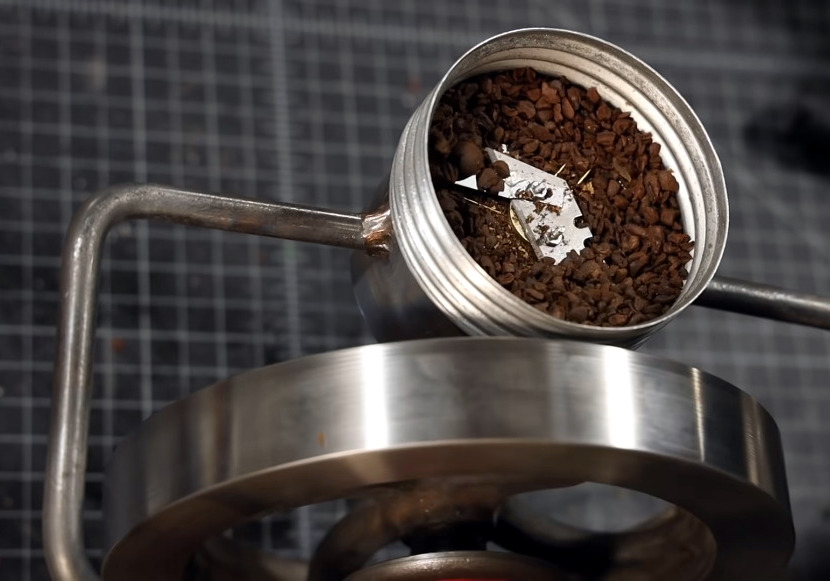
This hand-crank grinder would make a great post-apocalyptic appliance, as long as we still have a way to heat water. [Jimmy] started with an old manual abrasive disc grinder, like for grinding metal, not beans.

After oiling it up to run without a hitch, he pulled out a couple of conical gears and got to work mounting one to the grinder shaft and the other to the business part of a vintage industrial light fixture.

We thought for sure this was going to be a burr grinder, but were a bit disappointed to watch [Jimmy] drill holes through a utility knife blade in order to make a blade grinder. Honestly, we’re kind of surprised that he didn’t machine some burrs, but the result is impressive and lovely nonetheless.

We love that the whole thing quick-disconnects from the grinder thanks to a custom cuff that holds the light bulb just so, we just hope that [Jimmy] gave that light bulb a good cleaning first. Grab a cup of whatever and check out the build video after the break.

Not exactly your kind of shop? You could always print an emergency coffee grinder.

Continue reading “Grinding Coffee Beans The Machine Shop Way”

DIY Grader Box + Rocks = No Need For Shocks

Between the mini bike and the nearby woods, [HowToLou] has a lot for the rest of us to be envious of. Unfortunately, the terrain on the dirt path is too bumpy and uneven for a nice ride. But rather than spend hundreds to buy or rent an official grader box, [Lou] looked at his riding mower and said, I can do that myself (YouTube, embedded below).

This grader box is made from a heavy-duty oak pallet, plus a piece of particle board to complete the rocks box. [Lou] hooks up tow straps to the hooks and drags it behind the riding mower a few times to get the path nice and even. The line of lag bolts busts up the bumps, and the boards smooth out the surface under the weight of several large rocks. We think the result looks great, and doubt that [Lou] could have done any better with a fancy grader box. Check it out in action after the break.

Don’t have a riding mower? This is a pretty good excuse to buy one, but if that’s not in the cards, maybe you could build something suitable out of plywood and bike parts.

Continue reading “DIY Grader Box + Rocks = No Need For Shocks”

Paper Pi Is An Ergonomic Cyberdeck Meant For Thumbs

What’s the fastest way to master console stuff like screen or emacs? Force yourself to use it exclusively, of course. But maybe you’d be tempted to cheat with a desktop. We know we would be. In that case, you ought to build a console-only cyberdeck like this sweet little thing by [a8skh4].

This cyberdeck serves another purpose as well — the keyboard layout is Miryoku, so [a8ksh4] can get more practice with that at the same time. Fortunately, the layout is built for emacs.

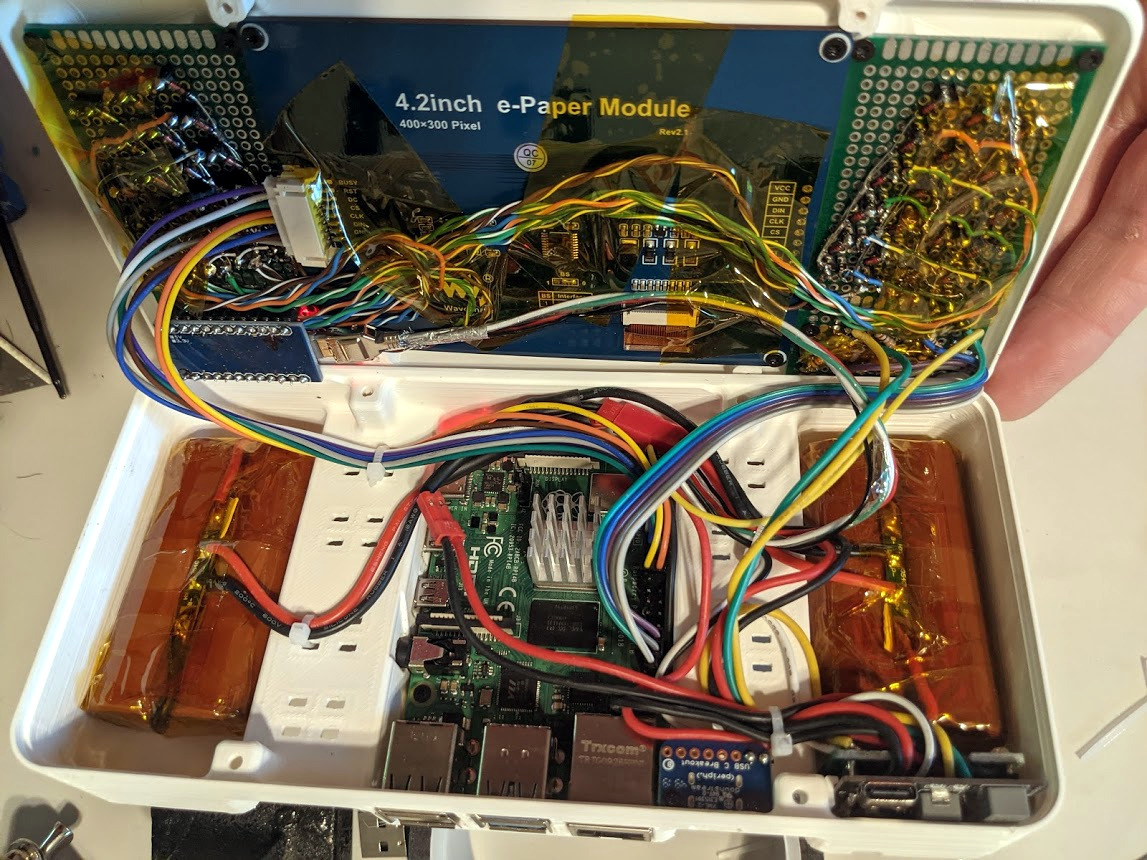
Inside is a Raspberry Pi 4 and what looks to be an Arduino handling the keyboard input. The Paper Pi spotlights a 4.2″ e-ink screen between a split thumb keyboard that’s made of soft, silent, tactile switches.

Since they’re SMD, [a8ksh4] made clever use of header pins to get them to work with protoboard. As much as we love the keyboard, it would be awesome to see a few switches on the shoulders or even the back that make use of the rest of the fingers. Check out more build pictures in the gallery.

We love to see cyberdecks with split keyboards, because you shouldn’t have to sacrifice ergonomics in a portable computer. Here’s one that comes in three pieces, making it easy to get the spacing between the halves just right.

Via r/cyberdeck