Go Ape With A Banana Macropad

The super fun thing about macro pads is that they’re inherently ultra-personalized, so why not have fun with them? This appealing little keeb may have been a joke originally, but [dapperrogue] makes a valid point among a bunch of banana-related puns on the project page — the shape makes it quite the ergonomic little input device.

Inside this open-source banana is that perennial favorite for macro pads, the Arduino Pro Micro, and eight switches that are wired up directly to input pins. We’re not sure what flavor of Cherry those switches are, hopefully brown or green, but we suddenly wish Cherry made yellow switches. If you want to build your own, the STLs and code are available, and we know for a fact that other switch purveyors do in fact make yellow-stemmed switches.

Contrary to what the BOM says, we believe the sticker is mandatory because it just makes the build — we imagine there would be fewer double takes without it. Hopefully this fosters future fun keyboard builds from the community, and we can’t wait to sink our teeth into the split version!

There are a bunch of ways to make a macropad, including printing everything but the microcontroller.

Via r/mk and KBD

Realistic Mission Control Box Is A Blast For All Ages

A lot of electronic busy boxes that are built for children are simply that — a mess of meaningless knobs and switches that don’t do much beyond actuating back and forth (which, let’s be honest, is still pretty fun to do). But this Mission Control Center by [gcall1979] knocks them all out of orbit. The simulation runs through a complete mission, including a 10-minute countdown with pre-flight system checks, 8.5 minutes of powered flight to get out of the atmosphere that includes another four tasks, and 90 minutes to orbit the Earth while passing through nine tracking stations across the world map.

That’s a lot time to keep anyone’s attention, but fortunately [gcall1979] included a simulation speed knob that can make everything go up to 15 times faster than real-time. This knob can be twiddled at any time, in case you want to savor the countdown but get into space faster, or you don’t have 90 minutes to watch the world map light up.

The main brain of this well-built box is an Arduino Mega, which controls everything but the launch systems’ mainframe computer — this is represented by bank of active LEDs that blink along with the voice in the sound clips and runs on an Arduino Uno and a couple of shift registers. To keep things relatively simple, [gcall1979] used an Adafruit sound board for the clips.

We love everything about this build, especially the attention to detail — the more important pre-flight tasks are given covered toggle switches, and there’s a Shuttle diagram that lights up as each of these are completed. And what Shuttle launch simulator would be complete without mushroom buttons for launch and abort? Grab your victory cigar and check out the demo video after the break.

Is your child too young to be launching the Shuttle? Here’s an equally cool busy box with toddler brains in mind.

Continue reading “Realistic Mission Control Box Is A Blast For All Ages”

Piggy Bank Slot Machine Puts A Spin On Saving

Saving money is inherently no fun until the time comes that you get to spend it on something awesome. Wouldn’t you be more likely to drop your coins into a piggy bank if there was a chance for an immediate payout that might exceed the amount you put in? We know we would. And the best part is, if you put such a piggy bank slot machine out in the open where your friends and neighbors can play with it, you’ll probably make even more money. As they say, the house always wins.

Drop a coin in the slot and it passes through a pair of wires that act as a simple switch to start the reels spinning. Inside is an Arduino Uno and a giant printed screw feeder that’s driven by a small stepper motor and a pair of printed gears. The reels have been modernized and the display is made of four individual LED matrices that appear as a single unit thanks to some smoky adhesive film.

This beautiful little machine took a solid week of 3D printing, which includes 32 hours wasted on a huge piece that failed twice. [Max 3D Design] tried rotating the model 180° in the slicer and thankfully, that solved the problem. Then it was on to countless hours of sanding, smoothing with body filler, priming, and painting to make it look fantastic.

If you want to make your own, all the files are up on Thingiverse. The code isn’t shown, but we know for a fact that Arduino slot machine code is out there already. Check out the build and demo video after the break.

As much as we like this build’s simplicity, it would be more slot machine-like if there was a handle to pull. Turns out you can print those, too.

Continue reading “Piggy Bank Slot Machine Puts A Spin On Saving”

Sit Pretty On Would-Be Garbage With An Upcycled Chair

What’s the coolest thing about doing upholstery work? Aside from the fact that you end up with a new thing to sit on, sometimes the work only involves clever stapling, and no sewing is necessary. Such is the case with [wyldestyle]’s upcycled jeans chair, which started as a bare-wood swivel number from the dump. In fact, this project is almost completely made from recycled materials, except of course for those staples that hold it all together. And really, that heavy-duty stapler is likely the fanciest tool you’d need to make your own.

[wyldestyle] didn’t have any furniture foam, and we think that stuff is too expensive, anyway. So the padding treatment begins with a piece of thick Styrofoam that covers the seat screws and bolts. This is glued in place and trimmed down to match the contours of the chair’s seat and back.

Here’s where things gets tricky: the next step is wrapping over the stiff foam board with a few layers of that foam sheeting stuff that’s often used as packing material. This sheeting needs to be taut, but pull it too tight, and it will rip.

To add some loft to the chair, [wyldestyle] stretched and stapled the stuffing from an old pillow that was headed for the garbage. The final step is strategically scissoring jean scraps to fit, then stretching and stapling those to cover all the layers underneath. We like the way this chair looks, and would probably try to place pockets somewhere useful, like the back of the chair.

It’s a shame that so much denim goes to waste all over the world. There’s often a lot of life left in most of the fabric, which can be repurposed into all kinds of things, including eyeglasses frames using a wicked set of jigs.

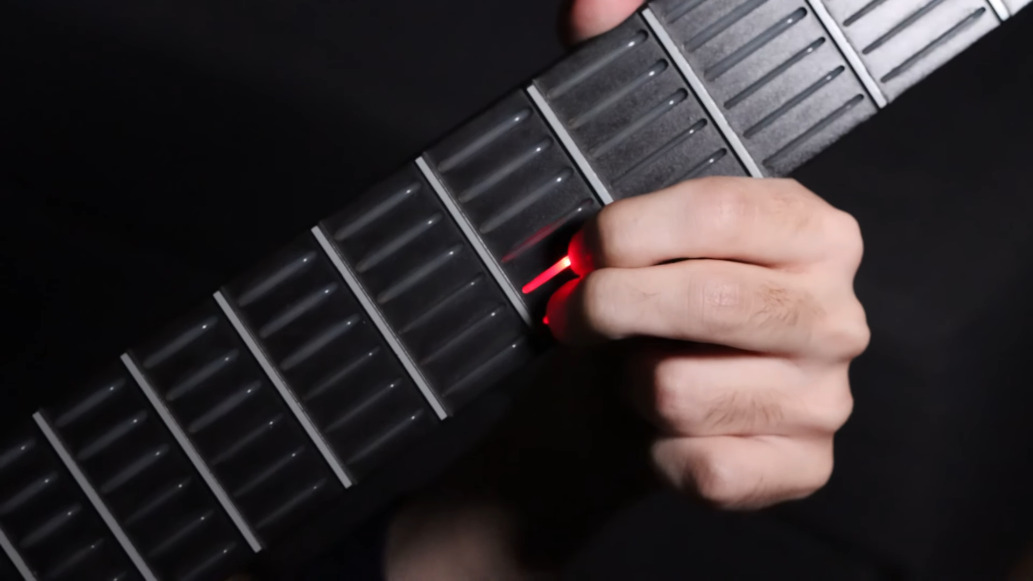
Guitar With Hot-Swappable Pickups Lights Our Fire

There’s a story that goes something like this: Chet Atkins was playing his guitar when someone remarked, ‘that guitar sounds great!’ Mr. Atkins immediately stopped playing and asked, ‘how does it sound now?’ While it’s true that the sound ultimately comes from you and your attention to expression, we feel that different pickups on the same guitar can sound, well, different from each other.

However, this is merely speculation on our part, because changing pickups is pretty serious surgery, and there’s only one company out there making guitars with hot-swappable pickups. Since their low-end model is out of most people’s price range, [Mike Lyons] took one for the team and decided to build a guitar from scratch to test out various pickups of any size, from lipstick to humbucker. [Mike] can swap them out in under a minute, and doesn’t need any tools to do it.

[Mike] modeled the swapping system on that one company’s way of doing things, because why reinvent the wheel? The pickups are inserted through the back and held in place with magnets and a pair of cleverly-designed printed pieces — one to mount the pickup to, and the other inside the pickup cavity.

As far as actually connecting the things up, [Mike] went with a commercially-available quick-connect pickup solution that uses a mini four-conductor audio plug and jack. The body is based on the Telecaster, while the headstock is more Stratocaster — the perfect visual combination, if you ask us.

We are particularly fond of [Mike]’s list of caveats for this project, especially the requirement that it had to be built using only hand tools and a 3D printer. Although a drill press would have been nice to use, [Mike] did a fantastic job on this guitar. Whether you’re into guitars or not, this is a great story of an awesome build.

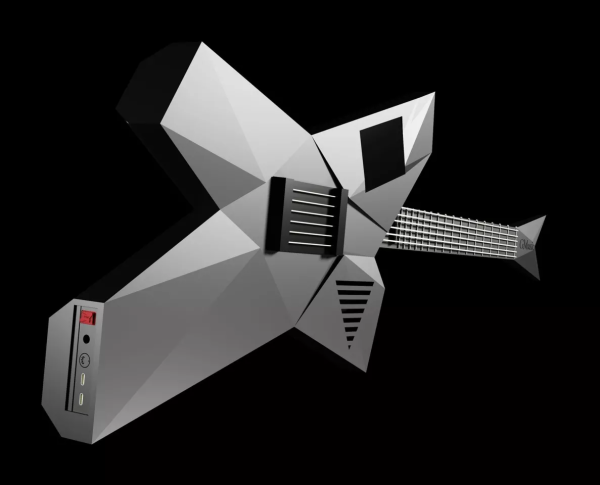
What, you don’t even have hand tools? You could just print the whole guitar instead.

The Russian Woodpecker: Official Bird Of The Cold War Nests In Giant Antenna

On July 4th, 1976, as Americans celebrated the country’s bicentennial with beer and bottle rockets, a strong signal began disrupting shortwave, maritime, aeronautical, and telecommunications signals all over the world. The signal was a rapid 10 Hz tapping that sounded like a woodpecker or a helicopter thup-thupping on the roof. It had a wide bandwidth of 40 kHz and sometimes exceeded 10 MW.

This was during the Cold War, and plenty of people rushed to the conclusion that it was some sort of Soviet mind control scheme or weather control experiment. But amateur radio operators traced the mysterious signal to an over-the-horizon radar antenna near Chernobyl, Ukraine (then part of the USSR) and they named it the Russian Woodpecker. Here’s a clip of the sound.

The frequency-hopping Woodpecker signal was so strong that it made communication impossible on certain channels and could even be heard across telephone lines when conditions were right. Several countries filed official complaints with the USSR through the UN, but there was no stopping the Russian Woodpecker. Russia wouldn’t even own up to the signal’s existence, which has since been traced to an immense antenna structure that is nearly half a mile long and at 490 feet, stands slightly taller than the Great Pyramid at Giza.

This imposing steel structure stands within the irradiated forest near Pripyat, an idyllic town founded in 1970 to house the Chernobyl nuclear plant workers. Pictured above is the transmitter, also known as Duga-1, Chernobyl-2, or Duga-3 depending on who you ask. Located 30 miles northeast of Chernobyl, on old Soviet maps the area is simply labeled Boy Scout Camp. Today, it’s all within the Chernobyl Exclusion Zone.

It was such a secret that the government denied it’s existence, yet was being heard all over the world. What was this mammoth installation used for?

Continue reading “The Russian Woodpecker: Official Bird Of The Cold War Nests In Giant Antenna”