Superconference Interview: Ted Yapo

We’re just two weeks away from the fifth annual Hackaday Superconference, the single biggest gathering of hardware enthusiasts on at least one continent. It’s gearing up to be great, and we’re super excited for the opportunity to bring you such a diverse array of talks, workshops, and more.

What makes Supercon so great? All the awesome people you meet there. One of them is [Ted Yapo], who joined the Hackaday writing crew this year after gracing our pages and winning our contests for so long. You might remember him as the guy who turned an innocent USB-to-serial adapter into an SDR transmitter, or as the guy who tried to jump-start a car with a coin cell.

At last year’s Supercon, [Ted] gave a talk about dealing with cheap spectrum analyzers, which doubled as a live look into the article he wrote for the Hackaday Journal of What You Don’t Know. [Mike Szczys] caught up with [Ted] last year for a brief interview in the hardware hacking area, which you can catch after the break.

[Ted]’s back again this year with a talk about building an open-source multi-GHz sampling ‘scope, and why that’s harder than it seems. You really should be there, you know. Oh, what? It’s sold out? Don’t worry, just kick back and watch the live stream! Subscribe to our YouTube channel and you’ll be notified when it starts, which will be around 10:00 am Pacific on November 15th.

If you do already have a Supercon ticket, but didn’t get tickets for the workshop you wanted, go check again! We released a limited amount of tickets this morning and emailed everyone about it. See you there!

Continue reading “Superconference Interview: Ted Yapo”

Godot Machine Is The Project You’ve Been Waiting For

Are you waiting for something that may never happen? Maybe it’s the end of your ennui, or the release of Half Life 3. While you wait, why not build a Godot Machine? Then you can diversify your portfolio and wait for two things that could happen today, tomorrow, or at sunrise on the 12th of Never.

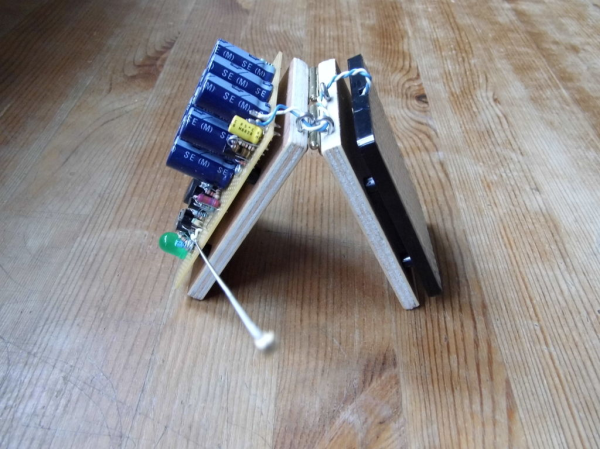
The Godot Machine is a functional art piece that uses a solar panel and a joule thief to charge a bank of capacitors up to 5V. Whenever that happens, the Arduino comes online and generates a 20-bit random number, which is displayed on an LED bar. If the generated number matches the super-secret number that was generated at first boot and then stashed away in EEPROM, the Machine emits a victory beep and lights a green LED. Then you can go back to complaining about whatever.

We like that [kajnjaps] made his own chaos-based random number generator instead of just calling random(). It uses a guitar string to collect ambient electronic noise and an entropy generator to amplify it. Then the four least significant digits are used to seed the logistical map, so the initial value is always different.

You don’t have to create your own entropy for truly random numbers, though it’s probably more fun that way. Did you know that someone wrote an Arduino entropy library?

Josephine Peary, First Lady Of The Arctic

In the late nineteenth century, there was only one Earthly frontier left to discover: the North Pole. Many men had died or gone insane trying to reach 90°N, which, unlike the solidly continental South Pole, hides within a shifting polar sea.

One of history’s most driven Pole-seekers, Robert Peary, shocked the world when he announced that his wife Josephine would accompany him on his expedition to Greenland. The world responded, saying that she, a Washington socialite with no specialized training, had absolutely no business going there. But if it weren’t for Jo’s contributions, Robert would probably have never made it to the Pole, or even out of Greenland. Sewing and cooking skills may not seem like much, but they are vital for surviving in the Arctic climate. She also hunted, and managed the group’s Inuit employees.

Josephine Peary was more than just the woman behind the man. An Arctic explorer in her own right, she spent three winters and eight summers on the harsh and unforgiving frontier. Back at home, her Arctic accounts painted a picture of a frozen and far-off world that most could only wonder about. Jo’s writing career brought in expedition money for her husband, which sometimes turned into bailout money.

Josephine Peary, DC debutante. Image via Bowdoin College

Woman About Washington

Josephine Cecilia Diebitsch was born May 22nd, 1863 to German immigrant parents who encouraged her to explore the world. Her father, Hermann, was a linguist at the Smithsonian Institute. Because of his position, the Diebitsch family rubbed elbows with much of high society. Though Jo was raised to be a Victorian lady and upheld those values, she had progressive ideas about what women could do with themselves in addition to being wives and mothers.
Continue reading “Josephine Peary, First Lady Of The Arctic”

Peep These Ultra-Real 3D-Printed Eyeballs

For humans, life is in the eyes. Same deal with automatons. The more realistic the eyes, the more lifelike (and potentially disturbing) the automaton is. [lkkalebob] knows this. [lkkalebob] is so dedicated to ocular realism in his ultra-real eyeballs that he’s perfected a way to make the minuscule veins from a whisper of cotton thread.

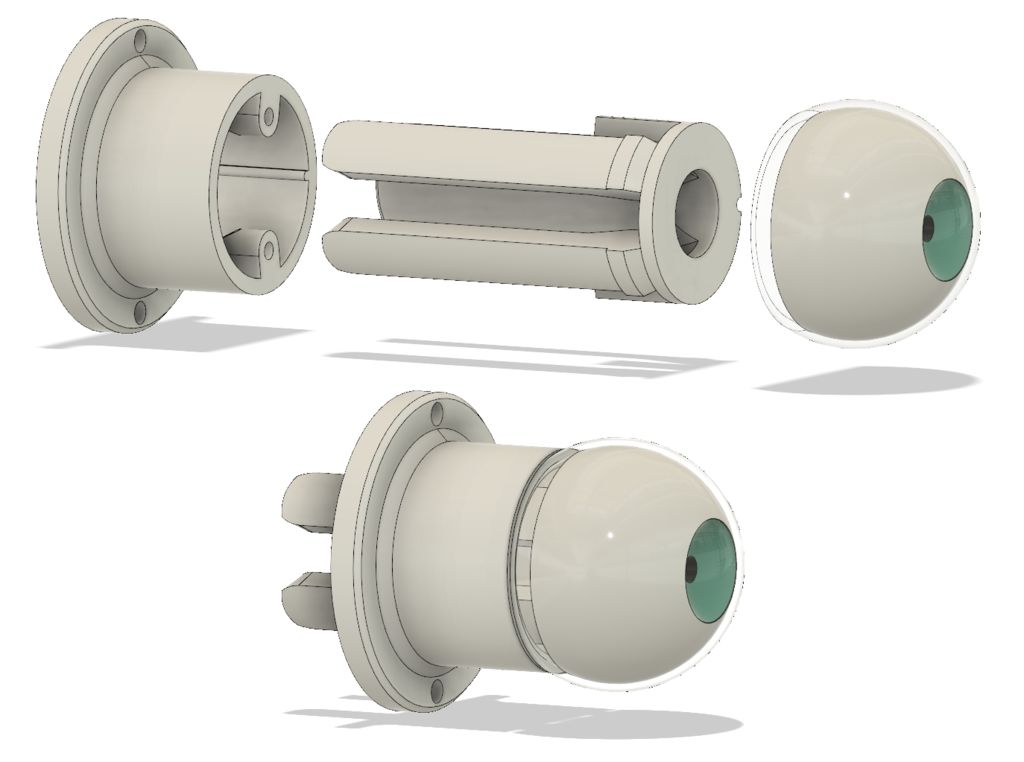
First he prints an eyeball blank out of ABS. Why ABS, you ask? It has a semi-translucence that makes it look that much more real. Also, it’s easier to sand than PLA. After vigorous sanding, it’s time to paint the iris and the apply the veins. [lkkalebob] shaves strands of lint from red cotton thread and applies it with tweezers to smears of super glue.

Here comes our favorite part. To make the whole process easier, [lkkalebob] designed a jig system that takes the eyeballs all the way through the stages of fabrication and into the sockets of the automaton. The hollow eye cups pressure fit on to prongs that hold it in place. This also gives the eyeball a shaft that can be chucked into a drill for easy airbrushing. In the build video after the break, he uses the eye-jig to cast a silicone mold, which he then uses to seal the eyes in resin.

Don’t have a printer or any desire to make human automata? It doesn’t take much to make mesmerizing mechanisms.

Continue reading “Peep These Ultra-Real 3D-Printed Eyeballs”

Electricity Makes Soft Robotics More Like Us Meatbags

Building a future where robots work alongside humans relies heavily on soft robotics. Typically this means there will be an air compressor or a hydraulic system nearby, taking up precious space. But it doesn’t have to.

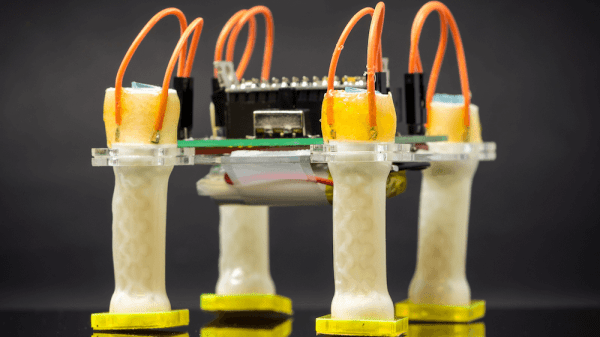
Engineers at the UC-San Diego Jacobs School have created a soft robotics system that uses electricity to control flexible actuators, much like our brains move our muscles. It works like this: sheets of heat-sensitive liquid crystal elastomer are sandwiched between two layers of standard elastomer. These layers are rolled into cylinders that can twist and bend in different directions depending on which of its six element(s) get electricity. Light up all six, and the tube contracts, forming the foundation for a good gripper. The team also built a tiny walker, pictured above.

The project is still in its infancy, so the actuators are slow to bend and even slower to return to their original shape, but it’s still a great start. Imagine all the soft robotic projects that can get off the ground without being shackled by the bulk and weight of an air compressor or fluid handling system. Watch it do various sped-up things after the break, like claw-machine gripping a bottle of chocolate rocks.

Speaking of delicious candy, edible soft robotics is totally a thing.

Continue reading “Electricity Makes Soft Robotics More Like Us Meatbags”

Horse Racing Game Hits Trifecta Of Fun, Skill, And Competition

Out in the neon-painted desert of Las Vegas, if you know where to look, you can find an old, 1980s electromechanical horse racing game called Sigma Derby. In this group game, you and several drunk strangers sit around a machine the size of a pool table and bet on tiny horses at 25 cents a throw. There is no skill involved, it’s all chance. This is not that game.

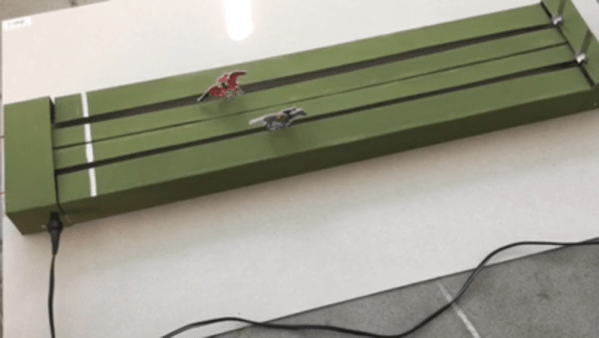
[Alex Kov]’s electromechanical horse racing game is a unicorn compared to Sigma Derby, or at least a zebra. This game takes patience, skill, and cunning. And unlike Sigma Derby, you can easily replicate it at home with a few shakes of the old junk bin. You just need a couple of motors, transistors, electrolytic caps, and some passives.

The idea is simple — advance horse, be first, win prizes — but it’s not that easy. While the switch is unpressed, the circuit charges up a capacitor. Press it and the horse noses forward, draining the cap. There is never enough chooch in the cap to reach the finish line, so the real game is in building up more juice than the other guy, and then staying ahead or overtaking him with the next spurt. Place your bets and catch the action after the break.

A scoreboard would be a great addition to this game. If you want to keep it electromechanical, we have some tote board inspiration for you.

Continue reading “Horse Racing Game Hits Trifecta Of Fun, Skill, And Competition”

TI-99/4A KSP Controller Has A Handle On Vintage NASA Styling

[MelkorsGreatestHits] had an extra USB MAME board burning a hole in his parts bin, so he turned it into fuel for this far-out Kerbal Space Program controller. Cool your jets — no fully-functioning TI-99/4As were harmed in the making of this baby. Besides, this is a KAL 9000 from Kexas Instruments. See the badges?

After donating the usable parts deemed unnecessary for space exploration, [MelkorsGreatestHits] had even more room inside the case for the throng of toggles that make this controller so touchable. We love the two tiers of toggles here — the important ones are separated with 3D-printed Space Shuttle-style switch guards, and the super-important toggles have flip-up covers to protect them from errant flicks of the hand. The vintage embosser labels are an impressive touch, and make us wish we had one that stamps vertically.

[MelkorsGreatestHits] modeled the combo throttle/roll handle and the joystick after the Apollo 11 command module controls. Unfortunately, the MAME board didn’t like his 3-axis analog joystick, so both are 2-axis and give WASD control. Good enough to get to the Mün!

We’ve seen more than a few KSP controllers around here, but none so overdone as this wonderful stand-up command station.

Via r/DIY