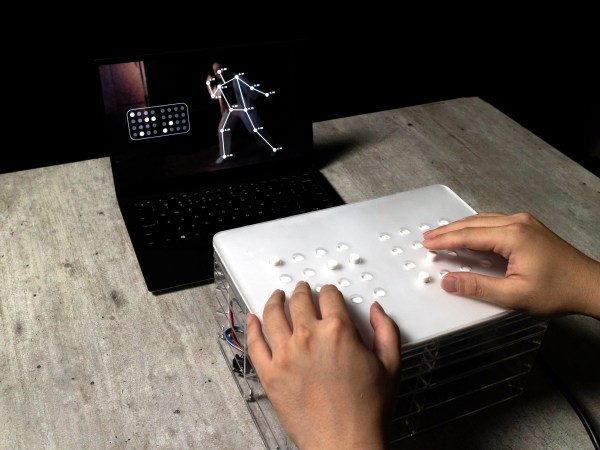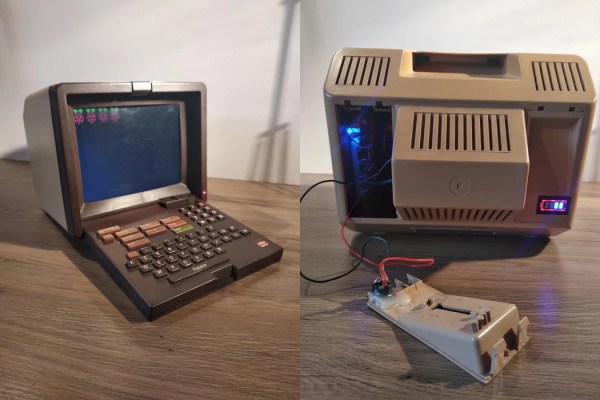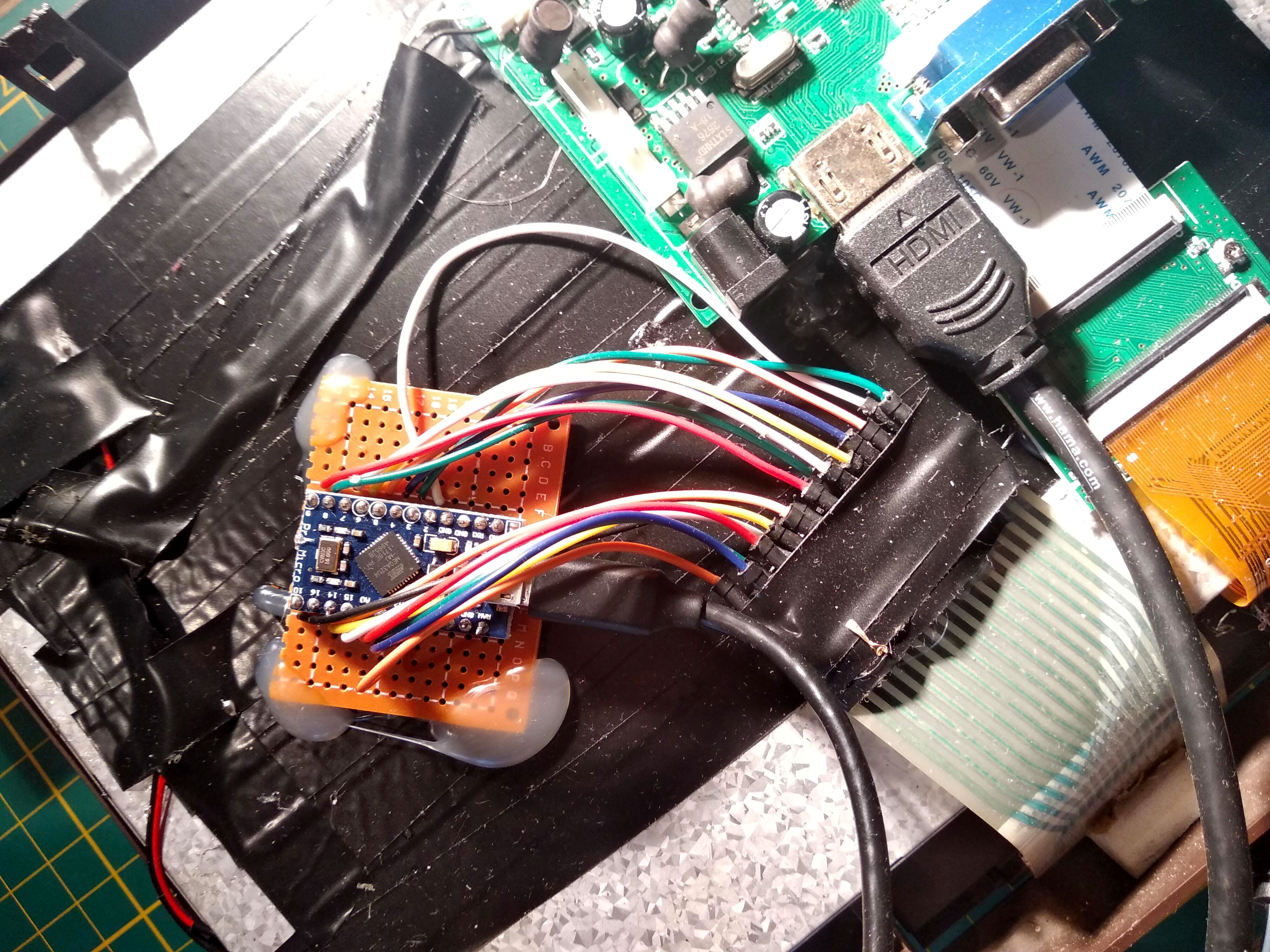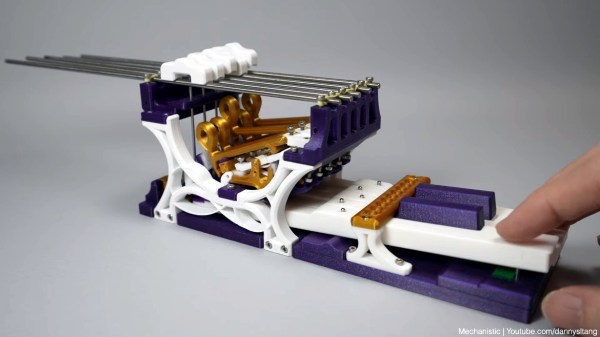
Left: kids stomping spiders projected on a driveway. Right: the setup.

Make This Halloween A Spider-Stomping Good Time

We can count on one hand the number of times that we haven’t needed a coat on Halloween night around here. Even if it was fair and sunny the day before, you can count on Halloween being appropriately windy, cold, and spooky. Trick-or-treating only keeps a kid so warm, and we would have loved to happen upon a house with a spider-stomping sugar-burning good time of a game going on in the driveway.

[Kyle Maas] built this game a few years ago, and it has proved quite popular ever since. It’s so popular, in fact, that they have to have someone on duty with a vaudeville hook to yank spectators off the playing field. The point is to stomp as many spiders as you can in a set amount of time, though you only need to stomp one to win. It can handle one to four players, depending on the size of the projection, but [Kyle] says it’s kind of hard to track more than two at a time.

The setup is fairly simple, provided you can reliably affix your projector to something sturdy. [Kyle] used a Structure sensor for the 3D scanner, but you could easily use a Kinect instead. Conversely, the calibration was challenging. [Kyle] ended up using a DSP math trick known as the inverse bilinear transform to be able to calibrate the system using the 3D scanner itself.

If you’re more into scaring the children, just rig up a coffin bell. Either way, don’t forget about our Halloween Hackfest contest, running now through Monday, October 11th. There are more details over on IO. While you’re there, why not check out the list of entries?

A conventiongoer plays Pokemon on a working Color Game Boy costume.

Convention Plays Pokemon On Giant Color Game Boy Costume

Standard cosplay is fun and all, but what is there for admirers to do but look you up and down and nitpick the details? Interactive cosplay, now that’s where it’s at. [Jaryd Giesen] knows this, and managed to pull together a working color Game Boy costume in a few days.

The original plan was to use a small projector on an arm, like one of those worm lights that helped you see the screen, but [Jaryd] ended up getting a secondhand monitor and strapping it to his chest. Then he took the rest of the build from there. Things are pretty simple underneath all that cardboard: there’s a Raspberry Pi running the RetroPie emulator, a Pico to handle the inputs, and two batteries — one beefy 12,000 mAH battery for the monitor, and a regular power pack for the Pi and the Pico.

As you’ll see in the build and demo video after the break, nearly 100 people stopped to push [Jaryd]’s buttons. They didn’t get very far in the game, but it sure looks like they had fun trying.

Since we’re still in a pandemic, you may want to consider incorporating a mask into your Halloween costume this year. Just a thought.

Continue reading “Convention Plays Pokemon On Giant Color Game Boy Costume”

A r0tring CS-50 scriber. You type, it writes the letters with a pen on your blueprint or technical drawing.

Plotting To Restore A R0tring CS-50

If you’re of a certain vintage and have ever done any technical drawing, chances are good that you used a r0tring of some kind, be it pencil or pen. Well, r0tring makes more than writing implements.  They also made electronic scribers — a small plotter that pens ISO lettering on technical drawings based on typed input. This was a huge time saver over doing it freehand or stenciling each letter. The CS-50 is designed to hold the top-of-the-line r0tring drawing pen, which turned out to be the most expensive part of this restoration aside from the time spent sniffing out issues.

[Atkelar] likes to open things up and give them a visual inspection before powering them on. We think this is good practice, even if the suspense kills you. But really, [Atkelar] did so much more than that. He started by replacing the likely late-80s-era coin cell even though it registered north of 3 V. Then he swapped out all the electrolytic caps and one tantalum, cleaned the rubber dome keyboard parts with a cheap electric toothbrush, (another great idea), and completely disassembled the x-y mechanism to clean and re-oil it.

Continue reading “Plotting To Restore A R0tring CS-50”

A shirt with carbon nanotube threads stitched into a shirt monitor the wearer's heart rate.

Sew-able Carbon Nanotube Thread Could Spin A Lot Of Awesome

Plenty of people just plain dislike wearing jewelry, even (or especially) smart watches. Nevertheless, they’d like to have biofeedback like everybody else. Well, we watch-less ones have something to look forward to, because a group of graduate students at Rice University have created extremely strong conductive thread woven from carbon nanotubes, which can be sewn into standard athletic clothing and used as electrodes, antennas, or simply as ballistic protection.

At 22 microns wide, the original carbon nanotubes were too skinny to use as thread. Instead, the team braided together three bundles of seven ‘tubes each using the type of machine that model boat builders use to make tiny rigging. Then they zig-zag stitched the threads into a shirt, which gives the stitches added flexibility. This thread maybe as strong and conductive as metal, but the fibers are soft and flexible, and most importantly, machine-washable. Between its strength and conductivity, this thread could have a long list of applications from military down to civilian. Check out the introduction in the video after the break.

For now, the shirt has to be pretty snug, but future garments could easily have higher concentrations of nano-threads in order to get a better signal. Good thing, because we’re still carrying around our COVID nineteen — aka the weight we’ve gained since the longest March of anyone’s life, and never liked tight shirts anyway.

What else can carbon nanotubes do? Plenty, like keep 3D prints from delaminating.

Continue reading “Sew-able Carbon Nanotube Thread Could Spin A Lot Of Awesome”

Illustrated Kristina with an IBM Model M keyboard floating between her hands.

Keebin’ With Kristina: The One Where Shift Happens

It’s been an exciting few weeks for me personally on the clacking front. I got a couple of new-to-me keyboards including my first one with ALPS switches, an old TI/99A keyboard with Futaba MD switches, and a couple of what are supposed to be the original Cherry switches (oh man they clack so nicely!) But enough about my keyboard-related fortuitousness, and on to the hacks and clacks!

Putting My Pedals to the Metal

Kinesis Savant Elite triple foot pedal. It's a keyboard for your feet!I picked up this Kinesis Savant Elite triple foot pedal from Goodwill. It works fine, but I don’t like the way it’s programmed — left arrow, right arrow, and right mouse click. I found the manual and the driver on the Kinesis website easily enough, but I soon learned that you need a 32-bit computer to program it. Period. See, Kinesis never wrote an updated driver for the original Savant Elite pedal, they just came out with a new one and people had to fork over another $200 or figure something else out.

I’m fresh out of 32-bit computers, so I tried running the program in XP-compatibility mode like the manual says, but it just doesn’t work. Oh, and the manual says you can brick it if you don’t do things correctly, so that’s pretty weird and scary. It was about this time that I started to realize how easy it would be to open it up and just replace the controller with something much more modern. Once I got inside, I saw that all three switches use JST plugs and right angle header. Then I though hey, why not just re-use this set-up? I might have to make a new board, but it how awesome would it be to plug these pedals’ JSTs into my own board?

Continue reading “Keebin’ With Kristina: The One Where Shift Happens”

Regular coffee grounds and lab-grown coffee.

Is Lab-Grown Coffee Worth A Hill Of Beans?

Historically, coffee has needed two things to grow successfully — a decent altitude and a warm climate. Now, a group of scientists from the VTT Technical Research Centre of Finland have managed to grow coffee in a lab. They started by culturing coffee plant cells, and then planted them in bioreactors full of nutrient-rich growing medium. But they didn’t grow plants. Instead of green beans inside coffee cherries, the result is a whitish powdered biomass that resembles pure caffeine. Then the scientists roasted the powder as you would beans, and report that it smells and tastes just like regular coffee.

There are plenty of problems percolating with the coffee industry that make this an attractive alternative — mostly worker exploitation, unsustainable farming methods, and land rights issues. And the Bean Belt, which stretches from Ethiopia to South America to Southeast Asia is getting too hot. On top of all that, coffee production is driving deforestation in Vietnam and elsewhere, although coffee could help the forests regenerate more quickly.

Coffee purists shouldn’t be dismayed, because variety is still possible using varying cell cultures to dial in the caffeine level and the flavors. We’ll drink to that.

Another thing in the industry that’s a real grind is coffee cupping, but spectroscopy could soon help determine bean quality.

A Raspberry Pi-based COVID Green Pass validator verifies a QR code on a phone.

COVID Green Pass Validator With Raspberry Pi

It seems like every nation is dealing with the plague a little differently. In June, the EU instated a COVID Green Pass which comes in the form of a paper or digital QR code. It was designed to grease the wheels of travel throughout Europe and allow access to nursing homes. As of early August, the Green Pass is now required of those 12 and older in Italy to gain access to bars and restaurants, museums, theaters, etc. — anywhere people gather in sizeable groups. The Green Pass shows that you’ve either been vaccinated, have had COVID and recovered, or you have tested negative, and there are different half-lives for each condition: nine months for vaccinated, six for recovered, and just forty-eight hours for a negative test.

[Luca Dentella] has built a Green Pass validator using a Raspberry Pi and a Raspi camera. Actual validation must be done through the official app, so this project is merely for educational purposes. Here’s how it works: the user data including their status and the date/time of pass issuance are encoded into a JSON file, then into CBOR, then it is digitally signed for authenticity. After that, the information is zipped up into a base-45 string, which gets represented as a QR code on your phone. Fortunately, [Luca] found the Minister of Health’s GitHub, which does the hard work of re-inflating the JSON object.

[Luca]’s Pi camera reads in the QR and does complete validation using two apps — a camera client written in Python that finds QRs and sends them to the validation server, written in Node.js. The validation server does formal verification including verifying the signature and the business rules (e.g. has it been more than 48 hours since Karen tested negative?) Fail any of these and the red LED lights up; pass them all and you get the green light. Demo video is after the break.

Are you Canadian? Then check this out, eh?

Continue reading “COVID Green Pass Validator With Raspberry Pi”