German Fireball’s 15 Minutes Of Fame

Sunday night, around 7:00 PM local time, a bright fireball streaked across the western German sky, exploded, and rained chunks of space rock down on the region around Koblenz. One of the largest known chunks put a soccer-ball-sized hole in someone’s roof, landing in their bedroom. Fortunately, nobody was hurt. But given the apparent size of the explosion, there must be many more pieces out there for the finding, and a wave of hopeful meteorite hunters has descended upon the region.

But if you wanted a piece of the action, where exactly would you start looking? How do scientists find meteorites anyway? And what should you do if you happen to see a similar fireball in the night sky?

Citizen Science
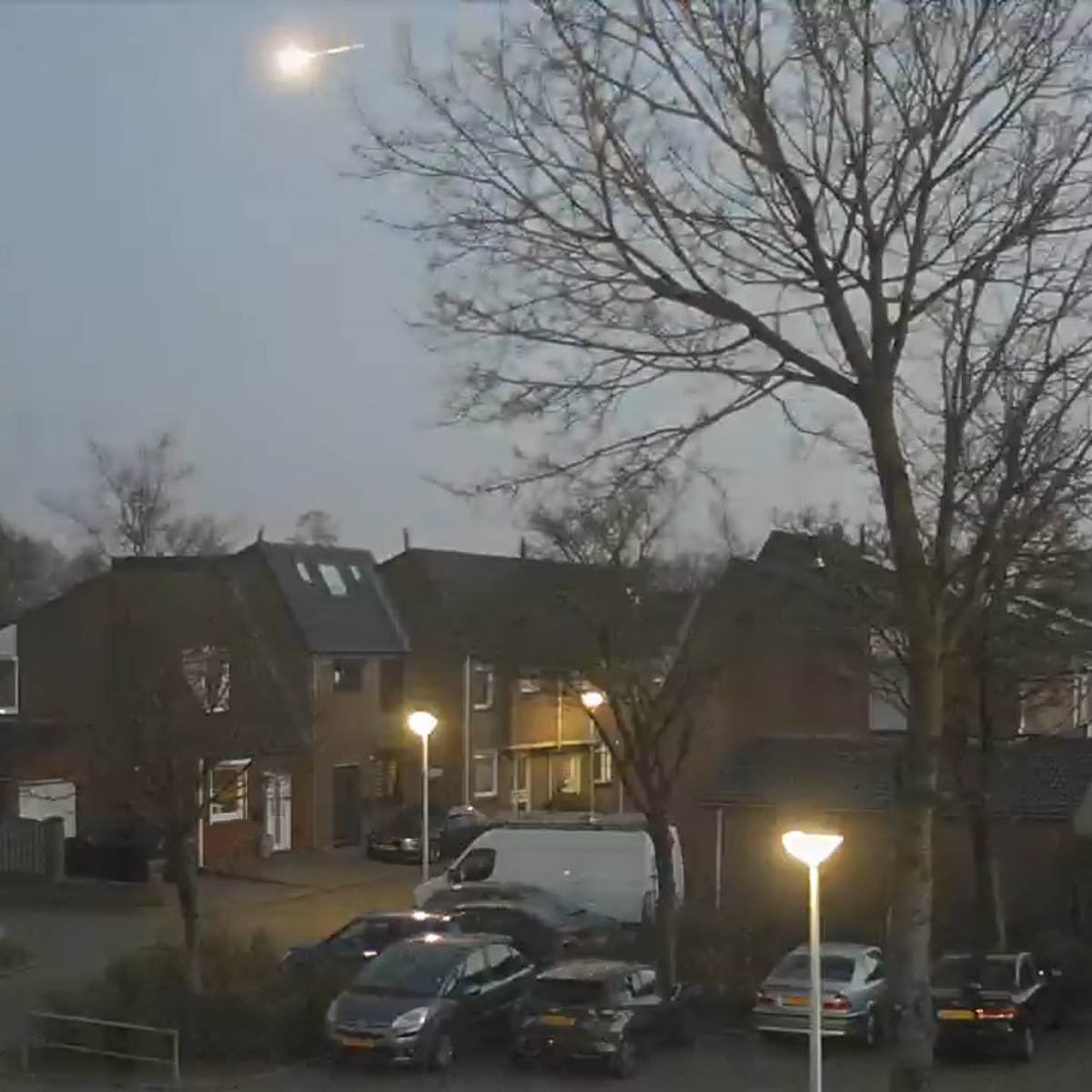
Meteorite video-bombs a boring parking lot in Heerlen, NL.

In the age of always-on dashboard cameras, ubiquitous smartphones, and other video recording devices, it’s hard for a shy meteorite to find a quiet spot out of the public eye. That makes them a lot easier to find than they were in the past. Indeed, the International Meteor Organization, which aggregates amateur meteor observations, received more than 3,200 reports of this one, including several with video documentation. Some are stunning, and others may not even be of the event at all.

By collecting reports from many locations, they can hope to piece together the meteorite’s trajectory. However, if you look at the individual reports, it’s clear that this is a difficult task. Nobody is expecting a bright fireball to streak across the night sky, so many of the reports are reasonably vague on the details and heavy on the awe.

This report from [Sophie Z], for instance, is typical. She records where she was and roughly the location in the night sky where the meteorite passed, along with the comment “I’ve never seen anything so amazing and large before in my life.” Other amateur observers are more precise. [David C] (“I have a Ph.D in physics”) managed to record the start and the end heading of the meteorite to a couple of decimal places. He must have had a camera.


Continue reading “German Fireball’s 15 Minutes Of Fame”

Choice, Control, And Interruption

We were talking about [Maya Posch]’s rant on smartphones, “The Curse of the Everything Device”. Maya’s main point is that because the smartphone, or computer, can do everything, it’s hard for a person to focus down and do one thing without getting distracted, checking their whatever feed, or getting an important push notification about the Oscars. She was suggesting tying your hands to the mast by using a device that can only accommodate the one function, like a dedicated writing tool or word processor.

[Kristina Panos] compared the all-singing, all-dancing black rectangle to an everything-device of old: the all-in-one stereo receiver with built-in tape player, record player, and not just FM, but also AM radio receiver. The point being, the hi-fi device also does a whole lot of things but isn’t similarly cursed. The tape player never interrupts your listening to the AM radio station. When the record is over, it doesn’t swap over to FM. Your agency is required.

Similarly, it’s probably not intrinsically problematic that the smartphone has a camera, a web browser, text messages, and heck even a telephone built in. It’s how they interact with each other and the user, each vying for user attention, and interrupting with popups and alarms. It’s maybe a simple matter of software! (Says the hardware guy.)

Where would a distraction-free, but fully featured, phone begin? With the operating system? It would be perverse to limit you to one app at a time, or to make switching between them more cumbersome. How about turning off notifications, and relying on changing context only when you think about it? Maybe that’s a middle ground. How do you cope with the endless distractions offered to you by your smartphone? By your main computer?

Get Your Green Power On!

Nobody likes power cords, and batteries always need recharging or replacing. What if your device could run on only the power it could gather together by itself from the world around it? It would be almost like free energy, although without breaking the laws of physics.

Hackaday’s 2026 Green-Powered Challenge asks you to show us your devices, contraptions, and hacks that can run on the power they can harvest. Whether it’s heat, light, vibration, or any other source of energy that your device gathers to keep running, we’d like to see it.

The top three entries will receive $150 shopping sprees courtesy of the contest’s sponsor, DigiKey, so get your entry in before April 24, 2026, to be eligible to win.

Honorable Mentions

As always, we have several honorable mention categories to get your creative juices flowing:

  • Solar: In terms of self-powered anything, photovoltaic cells are probably the easiest way to go, but yet good light-harvesting designs aren’t exactly trivial either. Let’s see what you can run on just the sun. (Or even room lighting?)
  • Anything But PV: Harnessing the light is too easy for you, then? How about piezo-electric power or a heat generator? Show us your best self-powering projects that work even when it’s dark out.
  • Least Power: Maybe the smartest way to make your project run forever is to just cut down on the juice. If your project can run on its own primarily because of clever energy savings, it’s eligible for this mention.
  • Most Power: How much of a challenge is building a solar-powered desk calculator in 2026? How about pushing it to the other extreme? Let’s see how much power you can consume while still running without batteries or cords. Does your off-grid shack count here? Let’s see it!

Prior Art

We’ve seen a lot of green-powered projects on Hackaday over the years, ranging from a solar-powered web server to a microcontroller powered by a BPW34 photodiode. Will your entry run off the juice harvested by an LED? It’s not inconceivable!

Solar cells only work when the sun shines, though. As long as your body is putting out heat, this Seebeck-effect ring will keep on running. (Matrix vibes notwithstanding!) Or maybe you want to go straight from heat to motion with a Stirling engine. And our favorite environmental-energy-harvester of all has to be the Beverly Clock and its relatives, running on the daily heat cycles and atmospheric pressure changes.

Your Turn

So what’s your energy-harvesting project? Batteries are too easy. Take it to the next level! All you have to do to enter is put your project up on Hackaday.io, pull down the “Submit Project to…” widget on the right, and you’re in. It’s that easy, and we can’t wait to see what you are all up to.

And of course, stay tuned to Hackaday, as we pick from our favorites along the way.

Art of 3D printer in the middle of printing a Hackaday Jolly Wrencher logo

The Joys Of 3D Printing

Al and I were talking on the podcast today about a sweet 3D printed wide-format camera build, and we got to musing on why we 3D-print.

For Al, it’s an opportunity to experiment with 3D printing itself: tweaking his machines to get the best performance out of them. Other people make small, functional objects that they need in their daily life, like bag clips or spare parts for broken appliances. Some folks go for the ornamental or the aesthetic. The kids in my son’s class all seem obsessed with sci-fi props and fidget toys. The initial RepRap ideal was to replace all commercial fabrication with machines owned by the individual, rather than by companies – it was going to be Marxist revolutionary.

But there’s another group of 3D printer enthusiasts that I think doesn’t get enough coverage, and I’m going to call them the hobbyist industrial designers. These are the people who design a custom dog-poop-bag holder that exactly fits their extra-wide dog leash, not because they couldn’t find one that fit in the pet store, but because it’s simply fun to design and fabricate things. (OK, that’s literally me.)

It’s fun to learn CAD tools, to learn about how things are designed, how they work, and how to manufacture them at least in quantity one. Dreaming, designing, fabricating, failing, and repeating until you get it right is a great joy. And then you get to use the poop-bag holder every day for a few years, until you decide to refine the design and incorporate the lessons learned on the tough streets of practical use.

Of course none of this is exclusive to 3D printing. There were always people who designed-and-built things in the metal machine shop, or made their creations out of wood. In that sense, the 3D printer is just another tool, and the real fun isn’t in using the 3D printer, but rather in the process of bringing things out of your mind and into the world. So maybe there is nothing new here, but the latitude that 3D printing affords the hobby designer is amazing, and that makes it all the more fun, and challenging.

So do you 3D print for necessity, to stick it to the man, to pimp your printer, for the mini-figs, or simply for the joy of the process of making things? It’s all good. 3D printing is a big tent.

In Praise Of The Proof Of Concept

Your project doesn’t necessarily have to be a refined masterpiece to have an impact on the global hacker hivemind. Case in point: this great demo of using a 64-point time-of-flight ranging sensor. [Henrique] took three modules, plugged them into a breadboard, and wrote some very interactive Python code that let him put them all through their paces. The result? I now absolutely want to set up a similar rig and expand on it.

That’s the power of a strong proof of concept, and maybe a nice video presentation of it in action. What in particular makes [Henrique]’s POC work is that he’s written the software to give him a number of sliders, switches, and interaction that let him tweak things in real time and explore some of the possibilities. This exploratory software not only helped him map out what directions to go, but they also work in demo mode, when he’s showing us what he has learned.

But the other thing that [Henrique]’s video does nicely is to point out the limitations of his current POC. Instantly, the hacker mind goes “I could work that out”. Was it strategic incompleteness? Either way, I’ve been nerd-sniped.

So are those the features of a good POC? It’s the bare minimum to convey the idea, presented in a way that demonstrates a wide range of possibilities, and leaving that last little bit tantalizingly on the table?

2026 Hackaday Europe Call For Participation: We Want You!

Here’s the Hackaday Europe 2026 announcement that you’ve all been waiting for. But wait! This year there’s a twist, or rather two. What absolutely hasn’t changed, though, is that we’d love to see you there, and we’d love to hear about what you’ve been up to, so get your talk or workshop proposal in before March 18th.

New Place, New Time

Hackaday Europe is moving in all four dimensions! We’ll be meeting up in the absolutely lovely Lecco, Italy — just about equidistant from Milan and Bergamo, and taking place May 16th and 17th, with the traditional pre-event meetup on the night of the 15th for those who are already in town. The location is the Politecnico Milano campus, a hub of engineering nestled in the mountains.

Who is going to be speaking at Hackaday Europe? You could be! We’re opening up the Call for Participation right now, both for talks and for workshops. Whether you’ve presented your work live before or not, you’re not likely to find a more appreciative audience for epic hacks, creative constructions, or you own tales of hardware, firmware, or software derring-do.

Workshop space is limited, but if you want to teach a group of ten or so people your favorite techniques, we’d love to hear from you.

All presenters get in free, of course, so firm up what you’d like to share, and get your proposal submitted ASAP.

The Badge

We’ll be bringing the 2025 Hackaday Supercon Communicator Badge with us to Europe, so this is also your chance to get your hands on the retro-styled super sexy keyboard, LoRa module, and fantastically oblong screen. At Supercon, we ran our own custom mesh network, and it worked flawlessly, even on microwatts. We’ll be continuing the experiment in Italy, on different frequencies of course, but maybe pushing some of the transmission parameters to see how far we can go.

The user side of the badge is very accessible as well, being programmed in Micropython and supported with a sweet plug-in architecture that makes adding your own apps a breeze, or at least reasonably straightforward. And when Hackaday Europe comes to a close, you can simply reflash the badge with new firmware, and you’ve got the sweetest Meshtastic device out there.

And it wouldn’t be a Hackaday badge if it weren’t meant to be modified.

The People

The real reason to come to Hackaday Europe, though, is the other folks who come to Hackaday Europe. You’ve never seen a more interested group of hardware hackers, and that’s coincidentally also why you’d like to give a presentation. You get to tell everyone what you’re up to — it’s the ultimate ice-breaker.

At the risk of saying it again: Get your proposal in before March 18th, and we look forward to seeing you on the shore of Lake Como. (Info on tickets and more pre-conference hype coming soon.)

Honor Thy Error

Musician Brian Eno’s Oblique Strategies are like a Tarot card deck full of whimsical ideas meant to break up a creative-block situation, particularly in the recording studio. They’re loads of fun to pick one at random and actually try to follow the advice, as intended, but some of them are just plain good advice for creatives.

One that keeps haunting me is “Honor thy error as a hidden intention”, which basically boils down to taking a “mistake” and seeing where it leads you if you had meant to do it. I was just now putting the finishing touches on this week’s Hackaday Podcast, and noticed that we have been honoring a mistake for the past 350-something shows. Here’s how it happened.

When Mike and I recorded the first-ever podcast, I had no idea how to go about doing it. But I grew up in Nashville, and know my way around the inside of a music studio, and I’ve also got more 1990s-era music equipment than I probably need. So rather than do the reasonable thing, like edit the recording on the computer, we recorded to an archaic Roland VS-880 “Digital Studio” which is basically the glorified descendant of those old four-track cassette Portastudios.

If you edit audio in hardware, you can’t really see what you’re doing – you have to listen to it. And so, when I failed to notice that Mike and I were saying “OK, are you ready?” and “Sure, let’s go!”, it got mixed in with the lead-in music before we started the show off for real. But somehow, we said it exactly in time with the music, and it actually sounded good. So we had a short laugh about it and kept it.

And that’s why, eight years later, we toss random snippets of conversations into the intro music to spice it up. It was a mistake that worked. Had we been editing on the computer, we would have noticed the extra audio and erased it with a swift click of the mouse, but because we had to go back and listen to it, we invented a new tradition. Honor thy error indeed.