2026 Hackaday Europe: First Round Of Speakers Announced!

Hackaday Europe is the continental version of the Ultimate Hardware Conference, taking place May 16th and 17th, and you need to be there! We’ll continue to announce speakers and workshops over the next couple weeks, because we got so many more great talks than we had anticipated that we’re negotiating for extra time.

This year, we’re moving to a new venue in Lecco, Italy, and it’s sure to be fantastic. Get your tickets now before it’s too late. And stay tuned for another round of talk reveals next week!

Continue reading “2026 Hackaday Europe: First Round Of Speakers Announced!”

Re-Learning How To Run

As I write this, four astronauts are on their way around the moon for the first time in 50 years. A lot us have asked ourselves just exactly why you’d send people out that far when the environment is so hostile and we have increasingly competent robots that could do the jobs in their place. If anything, that’s even more true now than it was back in the day of the Apollo program, when the remote operations capability was a lot more constrained. But having people, potentially in the near future, on the lunar surface remains qualitatively different.

I was recently re-watching some of the footage from Apollo 16 when the astronauts were driving around in the Lunar Roving Vehicle, and the discussions that they’re having about the lunar geology that they can see for the first time with their own eyes is very convincing. Having people in situ tightens the loop of “hey, that’s interesting”, “let’s take a closer look”, and “I wonder what that means” in a way that minutes or hours of transmission time, and sterile observation of photos on a computer monitor just break. In comparison, our Mars rovers move excruciatingly slowly, the data comes back through a very thin pipe, and it takes months or years to analyze.

Of course, there is danger to human life; it’s a lot more expensive to get people safely to, and importantly back from, the moon than it would be with a disposable robot. Comparison with the Mars rovers is also unfair because travel to Mars is another scale entirely. Even if it does make sense to send humans for exploration on the moon, it may not make sense to do the same on the red planet, in the near future or ever. Given all that, I’m stoked that we can see through the robots eyes, but if all else were equal, I’m sure that we’d learn more from human explorers.

While in a lot of ways the Artemis I and now the Artemis II missions are underwhelming in comparison to the many “firsts” of Apollo, I absolutely appreciate them for what they are: a shakedown trial of a set of technologies and practices that we used to grasp, but which have atrophied over the last five decades. If a new generation of scientists is to put feet onto regolith, we need to learn to walk before they can run, or rover. In that spirit, I’ll be crossing my fingers for the future of manned spaceflight over the next week and a half.

For Art’s Sake

Hackers can be a strange folk. Our idea of beauty, for instance, can be rather odd. This week, Hackaday saw a few projects that were not just functional – the aesthetics were the goal. I don’t think we’ll be taking over the fine art world any time soon, but I’m absolutely convinced that the same muse that guides the hand that holds the paintbrush sometimes also guides the hand holding the soldering iron.

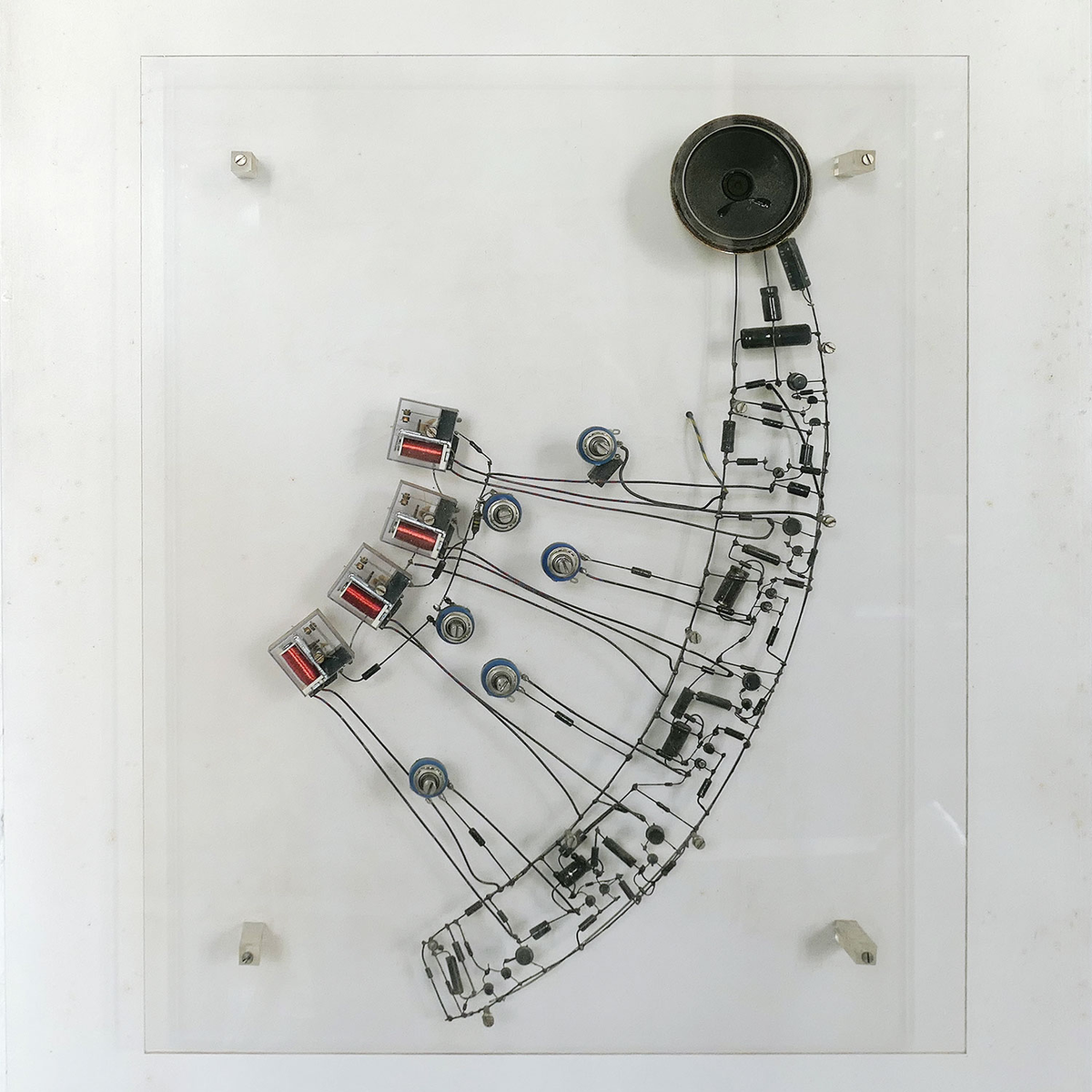
Take “circuit sculpture”, for instance. Heck, we even give it an art-inspired name that classifies it correctly. This week’s project that got me thinking about the aesthetics of hand-bent wire circuits was this marvelous clock build, but the works of Mohit Bhoite or Kelly Heaton are also absolute must-sees in this category.

Outside of the Hackaday orbit, one of my all-time favorite artists in this genre was Peter Vogel, who made complex audience-reactive sound sculptures that looked as good as they sound.

Is a wireframe animated moving jellyfish art? It was certainly intended to be beautiful, and I personally find it so. Watch some of the video clips attached to the project to get a better sense of it.

In the sculpture world, there is a sub-genre of kinetic art pieces where the work itself is secondary to the beauty of the motions that the pieces pull off. Think ballet, but mechanical. Perhaps my absolute favorite of these artists is Arthur Ganson. If you haven’t seen his work before, check out “Thinking Chair” for the beauty of movement, but don’t miss “Machine with Concrete” if you’re feeling more conceptual.

If you’re willing to buy an insane geartrain as art, what about these 3D printed wire strippers? Is this “art”? It’s clear that they were designed with real intent and attention to the aesthetics of the final form, and am I wrong for finding the way they move literally beautiful?

What’s your favorite offbeat hacker artform?

An Electric Jellyfish For Androids

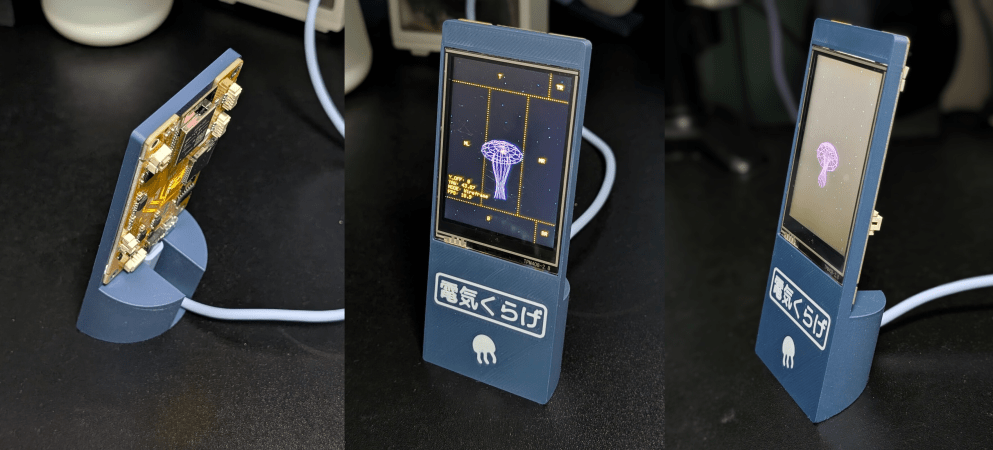
We have to admit, we didn’t know that we wanted a desktop electric jellyfish until seeing [likeablob]’s Denki-Kurage, but it’s one of those projects that just fills a need so perfectly. The need being, of course, to have a Bladerunner-inspired electric animal on your desk, as well as having a great simple application for that Cheap Yellow Display (CYD) that you impulse purchased two years ago.

Maybe we’re projecting a little bit, but you should absolutely check this project out if you’re interested in doing anything with one of the CYDs. They are a perfect little experimentation platform, with a touchscreen, an ESP32, USB, and an SD card socket: everything you need to build a fun desktop control panel project that speaks either Bluetooth or WiFi.

We love [likeablob]’s aesthetic here. The wireframe graphics, the retro-cyber fonts in the configuration mode, and even the ability to change the strength of the current that the electric jellyfish is swimming against make this look so cool. And the build couldn’t be much simpler either. Flash the code using an online web flasher, 3D print out the understated frame, screw the CYD in, et voila! Here’s a direct GitHub link if you’re interested in the wireframe graphics routines.

We’ve seen a bunch of other projects with the CYD, mostly of the obvious control-panel variety. But while we’re all for functionality, it’s nice to see some frivolity as well. Have you made a CYD project lately? Let us know!

The Unreasonable Power Density Of Lithium-Ion

We’re all used to it by now, but I’d just like to reflect on how insanely power-packed lithium ion batteries are, and everything that’s afforded us. I’m trying to think of a gadget, a hobby, or nearly anything in my house that’s not touched by the battery chemistry.

I’m looking at my portable wireless keyboard in front of me, with a LiPo pack inside. Oddly enough, I’m charging it with a LiPo-based power bank, simply because the cable to the nearest USB-C adapter is too short. A gaming console, cell phone, and a DSLR camera are all within arms reach and powered with lithium.

It’s not just consumer stuff either. I fly FPV quads and airplanes for fun when I can, and of course those are made entirely possible by the combination of smaller brushless DC motors and their drivers, and the high-power-density LiPo packs that power them. For field recharging, I have a huge self-made LiIon pack that can keep them all in the air all day. These days, LiPo and LiIon tech is the heart of hacker projects big and small. Heck, we even powered this year’s Hackaday Supercon badge with a LiPo that allowed it to run all weekend on a charge for many folks, where in the past swapping out AAs during the event was commonplace.

The application that still blows my mind is that we recently got a solar installation on our roof, which means a huge LiFePO battery in the basement. And while it’s one thing to power noisy little quads on the battery tech, it somehow seems another to power our entire house, for multiple hours per day, from a battery. Granted it’s not a couple of AAA cells in a little black plastic box, but it’s simply amazing to run a washing machine, the fridge, the stove, and even the heating off of what amounts to a battery pack.

Of course, I’m aware of the costs of producing the cells, both in terms of money and the environmental damage. It’s not a free lunch, and I’m looking forward to both cleaner and cheaper energy storage chemistries in the future. But for now, I’m still in awe of the many options that lithium-based battery chemistry has brought us. May your pillows remain non-spicy!

Hackaday Europe Tickets On Sale Now, CFP Extended

Hackaday Europe is approaching, and we’re putting tickets on sale now. “But wait, you haven’t selected the talks yet!” we hear you saying. Indeed! And that’s why we discount the first round of entries for our True Believers™ – the hard core who know that it’s going to be a fantastic event and turn up regardless. So if you want to come to Hackaday Europe on the cheap, go snap up your ticket before they’re gone.

Call for Participation Extended

Of course, giving a talk is always the best way to attend a hacker gathering like this. And we know that we said that today was the deadline for talk submissions. But we also know that many of you have advanced degrees in procrastineering, so we’re giving you a week’s extension.

Selected speakers get in free, and we’ll reserve you an early-bird ticket for putting together a legit talk proposal either way. So if you’re a first-time presenter or a wizened pro, and you have something that you’d like to say to an audience of like-minded hackers, we’d all like to hear from you. We won’t extend the deadline twice, though, so get your proposal in before March 25.

(A few people have reached out to us, wanting to avoid the Google login that the above form requires. If you’re in the same camp, write to us directly and let us know!)

Hackaday Europe

In case you don’t know, Hackaday Europe started out as a bi-annual event that we first held a decade ago in Belgrade. It has been such a success that we’re now doing it every year, and leap-frogging around Europe to spread the love. The last two three events have been in Berlin, and this is our first time in Lecco, Italy. This year, it runs the weekend of May 16th and 17th, with a pre-event on the evening of the 15th, to be announced.

What stays the same? We have a fantastic crowd who bring their passion projects with them, a fun badge to hack on, and of course food, drink, music, and merriment all along. Oh, and the talks. (You are submitting your talk, right?)

We’ll have more details coming your way in the next few weeks, so stay tuned. After March 25th, we’ll get to selecting talks, and let you all know. Get your tickets now – we can’t wait to see you all in eight-and-a-half weeks!

What Is A Computer?

On the podcast, [Tom] and I were talking about the new generation of smartphones which are, at least in terms of RAM and CPU speed, on par with a decent laptop computer. If so, why not just add on a screen, keyboard, and mouse and use it as your daily driver? That was the question posed by [ETA Prime] in a video essay and attempt to do so.

Our consensus was that it’s the Android operating system holding it back. Some of the applications you might want to run just aren’t there, and on the open side of the world, even more are missing. Is the platform usable if you can’t get the software you need to get your work done?

But that’s just the computer-as-a-tool side of the equation. The other thing a computer is, at least to many of our kind of folk, is a playground. It’s a machine for experimenting with, and for having fun just messing around. Android has become way too polished to have fun, and recent changes on the Google side of things actively prevent you from installing arbitrary software. The hardware is similarly too slimmed-down to allow for experimentation.

Looking back, these have been the same stumbling blocks for the last decade. In 2018, I was wondering aloud why we as a community don’t hack on cell phones, and the answer then was the same as it is now – the software is not friendly to our kind. You can write phone apps, and I have tried to do so, but it’s just not fun.

The polar opposites of the smartphone-as-computer are no strangers in our community. I’m thinking of the Linux single-board computers, or even something like a Steam Deck, all of which are significantly less powerful spec-wise than a flagship cell phone, but which are in many ways much more suitable for hacking. Why? Because they make it easy to do the things that we like to do. They’re designed to be fun computers, and so we use them.

So for me, a smartphone isn’t a computer, but oddly enough it’s not because of the hardware. It’s because what I want out of a computer is more than Turing completeness. What I want is the fun and the freedom of computering.