Mickey Shall Be Free!

The end of the year brings with it festive cheer, and a look forward into the new year to come. For those with an interest in intellectual property and the public domain it brings another treat, because every January 1st a fresh crop of works enter the public domain.

We’ll take a look at the wider crop around the day, but this year the big story is that Mickey Mouse, whose first outing was in 1928’s Steamboat Willie, is to get his turn to be released from copyright. [Jennifer Jenkins] from Duke University’s Center for the Study of the Public Domain, is using Mickey’s impending release to take a look at the law surrounding such a well-protected work.

Mickey has perhaps the greatest symbolism of all intellectual property when it comes to copyright terms, having been the reason for the Disney Corporation’s successive successful attempts to have copyright terms extended. Now even their reach is about to come to an end, but beware if you’re about to use him in your work, for the Mickey entering the public domain is an early outing, without gloves or the colours and eyes of his later incarnations. Added to that, Disney have a range of trademarks surrounding him. The piece makes for an interesting read as it navigates this maze, and makes some worthwhile points about copyright and the public domain.

Last year, we welcomed Fritz Lang’s Metropolis to the public domain. Meanwhile if you’re reading this in 2023, we believe our use of a header image featuring the 1928 Mickey to be covered by the doctrine of fair use.
Remembering Ed Roberts, The Home Computer Pioneer You Should Have Heard Of But Probably Haven’t

We’re pretty familiar with such names as Steve Wozniak, Bill Gates, Jack Tramiel, Nolan Bushnell, and the other movers and shakers of the 1970s home computer world. But there’s one person who towered among them for a few years before cashing out and leaving the computer business to pursue the life he’d always wanted. [Gareth Edwards] for Every has a fascinating profile of Ed Roberts, the man who arguably started the home computer boom but is now an obscure figure.

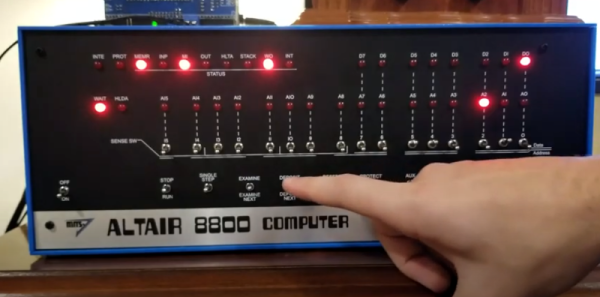
Even if you’ve never heard of Ed Roberts, you’ve likely heard of the product his company brought to market. The MITS Altair 8800 was the first computer to be sold as a home computer rather than for business or scientific use, and though its toggle switch interface now seems extremely quaint, its influence on every microcomputer that followed has been immense.

As followers of the retrocomputing scene, we know about the Altair, but perhaps more interesting is the story of MITS. Formed by a group of US Air Force veterans to produce rocket telemetry equipment, it pivoted to calculators, and as that market imploded in the early 1970s, the computer was a big gamble to save it from bankruptcy. It’s one that paid off, and as someone used to seeing technological cycles of boom and bust, Ed cashed out at the peak of the first wave. He followed his long-held ambition of becoming a doctor, and when, in 2010, he was near the end of his life, the hospital caring for him was shocked to find itself being visited by Bill Gates. It’s an article about a fascinating individual well worth reading.

The Altair, meanwhile, is a project that appears quite often here at Hackaday. Here’s a recreation of one as original as possible. The Mark 8 came out a little earlier but without complete kits or assembled units, so it didn’t get the traction — or the imitators — that the Altair did.

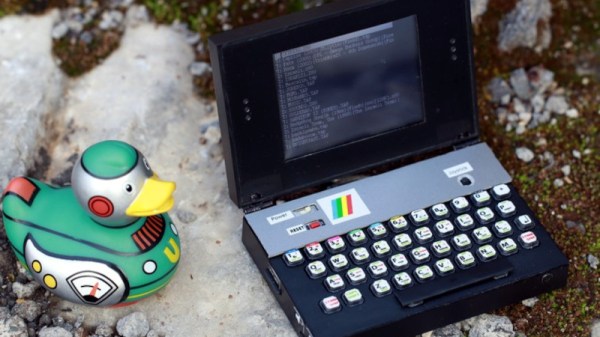
The Laptop Every British Kid Would Have Wanted For Christmas 1983

How can we convey to a world in which a 64-bit laptop can be a near-throwaway item, just how amazing a miniature laptop version of the 1980s Sinclair ZX Spectrum could have been? perhaps we don’t need to, because here in 2023 there’s a real one for all middle-aged geeks who had the original to drool over.

8-bit home computers were super-exciting for the kids of the day, but they were in no way portable and relied on a TV, frequently the family model in the living room. It’s safe to say that a portable version of one of those home computers, not in an Osborne-style luggable case but in a clamshell palmtop, would have been mind-blowing, so four decades later we’re fascinated by [Airrr17]’s portable Sinclair ZX Spectrum.

At its heart is a dev board using one of the STM32F4 series microcontrollers, and running the Spectrum as an emulator. Alongside that is an LCD, and perhaps what is physically the best part of this, a Spectrum keyboard complete with BASIC keyword decals, made with large-button tactile switches that have we think, printed paper on top. Add in a small lithium-polymer cell and associated electronics in a cute little palmtop case, and it’s about as good a portable Sinclair as we could have imagined. All the details can be found in a GitHub repository, and as if that weren’t enough there’s an assembly video we’ve placed below the break.

Continue reading “The Laptop Every British Kid Would Have Wanted For Christmas 1983”

Take The Minimal Pain Out Of ESP32 Programming

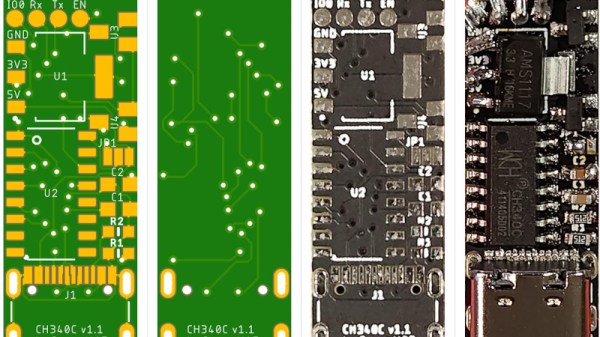
Perhaps without many of us realising it, our single board computers perform the task of making programming their processor or SoC a lot easier. They take care of setting the right lines or commands to put the chip in programming mode, they deal with timings, such that we simply fire our code from our dev environment without having to expend much thought. It’s not as though it’s difficult to program most microcontrollers, but there is usually a procedure to set the chip in programming mode. Tired of pressing buttons to achieve this with the ESP32, [DoganM95] took the time to create an all-in-one USB ESP32 programming board.

It’s a straightforward enough CH340C design that also has a USBC-PD chip on-board allowing powering of an attached ESP32 from PD sources. It’s all the stuff you’d find incorporated on a little dev board, without the ESP32, so while it’s nothing earth-shattering it’s also a neat and useful little addition to your arsenal. Unsurprisingly it’s not the first time someone’s created a similar board for a commercially available ESP32 module.

It’s A Microphone And A Spring Reverb All In One

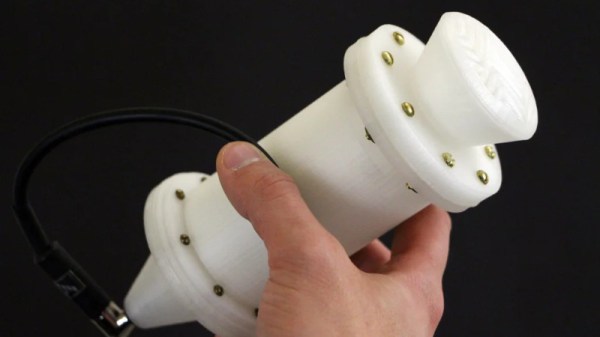
We’re so used to reverb effects being simply another software plugin that it’s easy to forget the electromechanical roots of the effect. Decades ago, a reverb would have been a metal spring fed at one end with a speaker and attached at the other to a microphone. You may not see them often in the 2020s, which is probably why [Ham-made] has produced one. It’s not the type with a speaker providing the sound, though. Instead, this is a microphone in its own right with a built-in spring line.

Perhaps it’s not the best microphone possible, with a somewhat heavy diaphragm and 3D printed body. But the hand-wound spring transmits the sound down to a piezo disk which serves as the electrical element, and the whole thing screws together into quite the usable unit. There are a selection of sample MP3 files that provide an interesting set of effect-laden sounds, so if you fancy building one yourself, you can judge the results.

We think this may be the first reverb microphone we’ve seen, but we’re certainly no stranger to reverb projects. More common by far, though, are plate reverbs, in which the physical element in the system is a metal plate rather than a spring. We like it when the sound source is a Commodore 64.

Polish Train Manufacturer Threatens Hackers Who Unbricked Their Trains

A week ago we covered the story of a Polish train manufacturer who was caught using software to brick their products after they had been repaired by in independent railway workshop. Now 404 Media has a follow-up story with more information, including the news that the hackers responsible for the discovery are now being threatened by the manufacturer.

The more we learn about this story the more interesting it becomes, as the Newag trains in question began failing after service as far back as 2021. In desperation after services were affected by the number of non-functional units, an employee searched online for Polish hackers and found a group called Dragon Sector. The group was able to find the issue, and are now being threatened with legal action by the manufacturer, who are citing possible safety issues.

It’s clear from where we are standing that Newag have been caught red-handed in some extremely dubious practices, and seem to have little sense of how their actions might not be the best in terms of protecting their reputation. We are guessing that the European regulators will become very interested in this case, and that meanwhile the order books of a company which puts DRM in its trains will start to look very empty indeed. You can catch our original coverage as the story broke, here.

Thanks [JohnU] for the tip.

Raspberry Pi Changes HATs

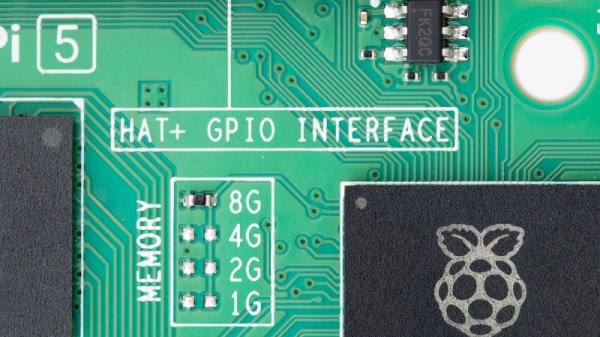
Following on the heels of their Raspberry Pi 5 launch and some specifications for their RP1 all-in-one peripheral chip, the Raspberry Pi folks have now released an update to the HAT peripheral hardware specification reflecting the new model. Called the HAT+, it represents a major step forward with some significant changes.

Most visible will be changes to the mechanical specification, for while the original HAT specification was very rigid this new version is much looser. A HAT+ must only mate with the 40-pin connector, including the ID pins, and line up with only a single mounting hole compared to the four on the original. Electrically, a HAT+ must recognise the standby power state in which the 3.3-volt line is powered down while the 5-volt line remains active, while software-wise, there are changes to the content of the ID EEPROM including the ability to inform about stackable smaller HATs.

Continue reading “Raspberry Pi Changes HATs”