A Die-Cast Car Subframe, Pushing The Limit Too Far?

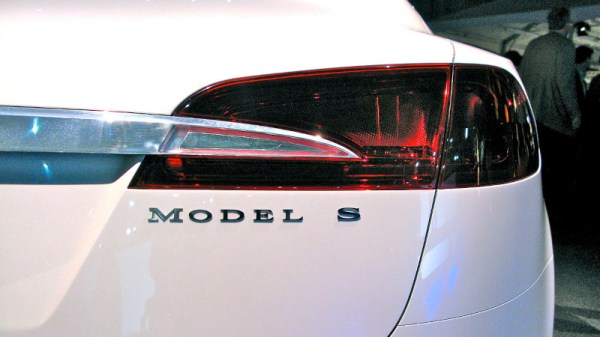
A piece of manufacturing news from Tesla Motors caught our eye, that Elon Musk’s car company plans to die-cast major underbody structures — in effect the chassis — for its cars. All the ingredients beloved of the popular tech press are there, a crazy new manufacturing technology coupled with the Musk pixie dust. It’s undeniably a very cool process involving a set of huge presses and advanced 3D-printing for the sand components of the mould, but is it really the breakthrough it’s depicted as? Or has the California company simply scored another PR hit?

We produced an overview of die casting earlier in the year, and the custom sand moulding in the Tesla process sounds to us a sort of half-way house between traditional die casting and more conventional foundry moulding. I don’t doubt that the resulting large parts will be strong enough for the job as the Tesla engineers and metallurgists will have done their work to a high standard, but I’m curious as to how this process will give them the edge over a more traditional car manufacturer building a monocoque from pressed steel. The Reuters article gushes about a faster development time which is no doubt true, but since the days of Henry Ford the automakers have continuously perfected the process of making mass-market cars as cheaply as possible. Will these cast assemblies be able to compete with pressed steel when applied to much lower-margin small cars? I have my doubts.

Aside from the excessive road noise of the Tesla we had a ride in over the summer, if I had a wish list for their engineers it would include giving their cars some longevity.

Header: Steve Jurvetson, CC BY 2.0.
New LoRA Distance Record: 830 Miles!

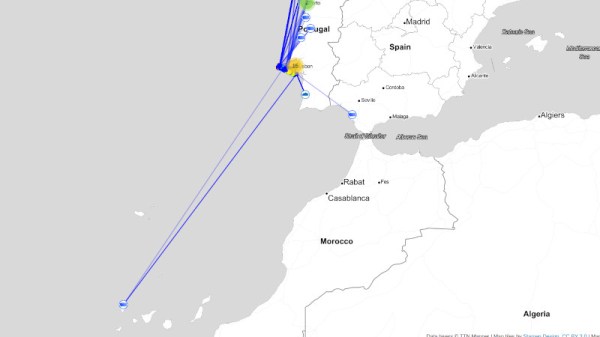
The LoRa radio communication system is useful for low-bandwidth communication, and as many readers will be aware its special skill lies in delivering long range. For most of us that range tops out at a few miles, but pushing the limits of what is possible for LoRa has resulted in some significant records falling. Most recently this has reached an impressive distance of 1336 kilometres, or 830 miles.

The record in question was set from near the Portuguese coast, from where LoRa beacons on a fishing boat and its buoys were able to open up a gateway on the Spanish Canary islands. The conductive surface of the sea makes an excellent aid to propagation, and from amateur radio experience we’d guess that tropospheric conditions aided by the summer weather would have something to do with it too.

Radio amateurs on those coasts and islands chase those conditions and live in hope of making a rare UHF contact across the ocean to the Americas or the Caribbean. The difference in their respective frequency allocations notwithstanding, we wonder whether the same might be possible using LoRa given a fortuitous atmosphere. We’re not quite sure whether a set of dual-band LoRa gateways could be made to test this idea though.

This record breaks a previous one set between Germany and Poland. If you think you’ve seen a far greater LoRa record here before you’d be correct, but only in the modulation scheme and not the frequency.

How Three Letters Brought Down UK Air Traffic Control

The UK bank holiday weekend at the end of August is a national holiday in which it sometimes seems the entire country ups sticks and makes for somewhere with a beach. This year though, many of them couldn’t, because the country’s NATS air traffic system went down and stranded many to grumble in the heat of a crowded terminal. At the time it was blamed on faulty flight data, but news now emerges that the data which brought down an entire country’s air traffic control may have not been faulty at all.

Armed with the official incident report and publicly available flight data, Internet sleuths theorize that the trouble was due to one particular flight: French Bee flight 731 from Los Angeles to Paris. The flight itself was unremarkable, but the data which sent the NATS computers into a tailspin came from two of its waypoints — Devil’s Lake Wisconsin and Deauville Normandy — having the same DVL identifier. Given the vast distance between the two points, the system believed it was looking at a faulty route, and refused to process it. A backup system automatically stepped in to try and reconcile the data, but it made the same determination as the primary software, so the whole system apparently ground to a halt.

It’s important to note that there was nothing wrong with the flight plan entered in by the French Bee pilots, and that early stories blaming faulty data were themselves at fault. However we are guessing that air traffic software developers worldwide are currently scrambling to check their code for this particular bug. We’re fortunate indeed that safety wasn’t compromised and only inconvenience was the major outcome.

Air traffic control doesn’t feature here too often, but we’ve previously looked at a much earlier system.

Header image: John Evans, CC BY-SA 2.0.

Portrait Of A Long Wave Station In Its Twilight Years

There’s a quirk of broadcasting in Europe left over from the earliest days of the medium, which our American readers may not have encountered. As well as the familiar AM band, Europeans and Africans also have a so-called long wave band, on which you’ll find AM broadcast stations between about 150 and 280 kHz. Long wave transmissions were an ideal solution in the 1920s and 1930s to the problem of achieving national coverage from a single transmitter, and were widely used by state broadcasters. In an age of digital streaming they are increasingly irrelevant, and [Ringway Manchester] takes a look at one of Britain’s last long wave transmitter sites at Droitwich not too far from Birmingham.

The site covers around 50 acres, and is home to a variety of both medium wave (AM, for Americans), and a single long wave transmitter carrying BBC Radio 4 on 198 kHz. As he takes us through its history in the video below the break we hear a rundown of most of the major events in British broadcasting, while few Brits will have visited this unassuming field it’s likely most of us will have listened to something sent from here.

The long wave antenna is a T-shaped affair strung between two masts. We’re guessing that the radiator is the vertical portion, with the bar of the T forming a capacitance with the ground to make up for the radiator being a fraction of the 1515 meter wavelength. The video is something of a tribute to this once-vital station, as the Radio 4 transmissions are likely to stop in 2024 and the medium wave ones over the following years. We have to admit to catching our BBC transmissions online these days, but we still have to admit a pang of sadness at its impending end.

This reminds us, we’ve taken a fond look at AM radio in the past.

Continue reading “Portrait Of A Long Wave Station In Its Twilight Years”

A Virus For The BBC Micro

If you work at all with British software or hardware engineers, you’ll find that there’s an entire generation perhaps now somewhere between their mid-40s and mid-50s, who stand slightly apart from their peers in their background and experience. These were the lucky teenagers who benefited from the British government’s 1980s push to educate youngsters in computing, and who unlike those before or who followed, arrived at university engineering courses fresh from school fully conversant with every facet of a computer from the hardware upwards.

[Alan Pope] is from that generation, and he relates a tale from his youth that wasn’t so out of place back in those days, of how he wrote what we’d now call a simple virus for the BBC Micro. Better still, he’s re-created it.

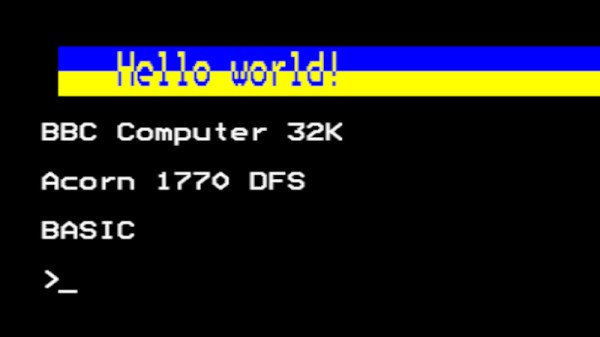
The post is as much a delightful trip back through that era of microcomputing, including an entertaining aside as he shared an airline journey with BBC Micro designer Chris Turner, and it serves as a reminder of how the BBC Micro’s disk operating system worked. There was a !boot file, which was what would be run from the disk at startup, and his bit of code would subvert that and hide itself in the machine’s so-called sideways RAM. The payload was pretty simple, every 32 soft reboots it would print a “Hello world” message, but it seems that was enough back in 1989 to get him into trouble. The 2023 equivalent works, but we’re guessing no teacher will come for him this time.

If you can’t find a real BBC Micro but still want one on hardware, we’ve brought you an FPGA version in the past.

Your Car Is A Privacy Nightmare On Wheels

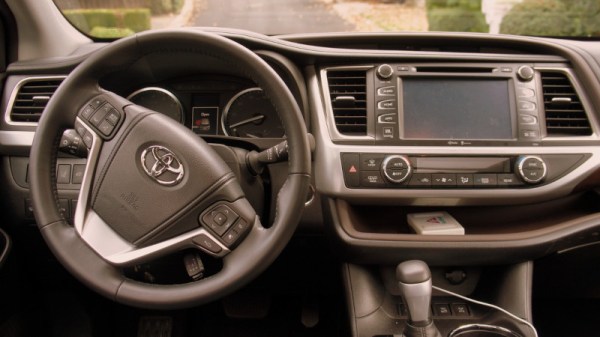
There was a time when a car was a machine, one which only came to life when its key was turned, and functioned simply as a way to get its occupants from point A to B. For most consumers that remains the case, but unfortunately in the last decade its function has changed from the point of view of a car manufacturer. Motor vehicles have become a software product as much as a hardware one, and your car now comes with all the privacy hazards you’d expect from a mobile phone or a computer. The Mozilla Foundation have taken a look at this problem, and their disturbing finding was that every one of the 25 major automotive brands they tested had significant failings.

Their quote that the cars can collect “deeply personal data such as sexual activity, immigration status, race, facial expressions, weight, health and genetic information, and where you drive.” had us wondering just exactly what kind of sensors they incorporate in today’s vehicles. But beyond mild amusement at some of the possibilities, it’s clear that a car manufacturer can glean a significant amount of information and has begun doing so largely without the awareness of the consumer.

We’ve railed about unnecessary over-computerisation of cars in the past, but from an obsolescence and reliability perspective rather than a privacy one, so it’s clear that the two issues are interconnected. There needs to be some level of public awareness that cars can do this to their owners, and while such things as this Mozilla investigation are great, the message needs to appear in more consumer-focused media.

As well as the summary, Mozilla also provide a detailed report broken down by carmaker.

Header: Michael Sheehan, CC BY 2.0.

Zinc-Air, The Next Contender In Vehicle Batteries?

If you’ve got an interest in technology, it’s inevitable that your feed will feature a constant supply of stories with titles in the vein of “New battery breakthrough offers unlimited life and capacity!”. If we had a pound, dollar, or Euro for each one, we’d be millionaires by now. But while the real science behind the breathless headlines will undoubtedly have provided incremental battery improvements, we’re still waiting for the unlimited battery.

It’s not to say that they don’t conceal some interesting stories though, and there’s an announcement from Australia proving this point admirably. Scientists at ECU in Perth have created a new cathode compound for rechargeable zinc-air batteries, which it is hoped will make them much safer and cheaper competitors for lithium-ion cells.

Most of us think of zinc-air batteries as the tiny cells you’d put in a camera or a hearing aid, but these conceal a chemistry with significant potential that is held back by the difficulty of creating a reliable cathode. In these batteries the cathode is a porous support in which a reaction between zinc powder wet paste and oxygen in the air occurs, turning zinc into zinc oxide and releasing electrons which can be harvested as electricity. They have a very high power density, but previous cathode materials have quickly degraded performance when presented with significant load.

The new cathode support is a nano-composite material containing cobalt, nickel, and iron, and is claimed to offer much better performance without the degradation. Whether or not it can be mass-produced remains to be seen, but as a possible alternative to lithium-ion in portable and transport applications it’s of great interest.