Superconducting Tape Leads To A Smaller Tokamak

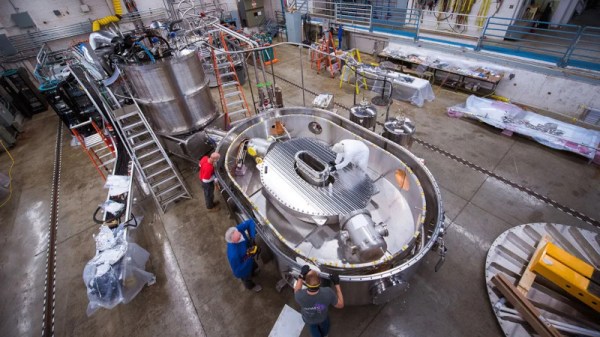
Attempts to make a viable nuclear fusion reactor have on the whole been the domain of megabucks projects supported by countries or groups of countries, such as the European JET or newer ITER projects. This is not to say that smaller efforts aren’t capable of making their own advances, operations in both the USA and the UK are working on new reactors that use a novel superconducting tape to achieve a much smaller device.

The reactors in the works from both Oxfordshire-based Tokamak Energy and Massachusetts-based Commonwealth Fusion Systems, or CFS, are tokamaks, a Russian acronym describing a toroidal chamber in which a ring of high-temperature plasma is contained within a spiral magnetic field. Reactors such as JET or ITER are also tokamaks, and among the many challenges facing a tokamak designer is the stable creation and maintenance of that field. In this, the new tokamaks have an ace up their sleeve, in the form of a high-temperature superconducting tape from which those super-powerful magnets can be constructed. This makes the magnets easier to make, cheaper to maintain at their required temperature, and smaller than the low-temperature superconductors found in previous designs.

The world of nuclear fusion is a particularly exciting one to follow in these times of climate crisis, with competing approaches from laser-based devices racing with the tokamak projects to produce the research which will eventually lead to safer carbon-free power. If the CFS or Tokamak Energy reactors lead eventually to a fusion power station on the edge of our cities then it may just be some of the most important work we’ve ever reported.

Steel For Your Fighting Robot

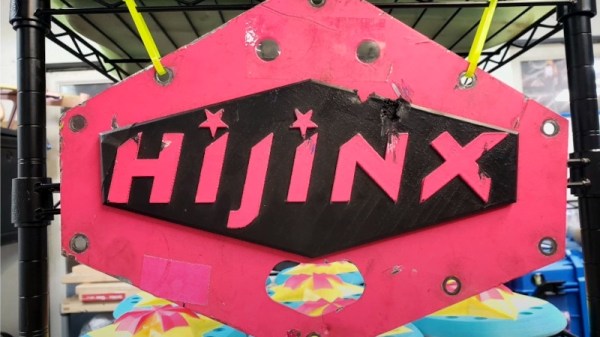
The job of processing video after a large event must be a thankless one for whichever volunteer upon whose shoulders it falls, and thus it’s not unusual for talks at larger events to end up online much later than the event itself. Electromagnetic Field 2022 was last year, but they have continued to drop new videos. Among the latest batch is one from [Jennifer Herchenroeder], in which she discusses the steel used in her team’s BattleBot, Hijinx (Edit: her EMF talk was cut short due to time pressures, so she re-recorded it in full after the event and we’ve replaced the link. The EMF video meanwhile is here). The result is a fascinating introduction to the metallurgy of iron and steel, and is well worth a watch.

To fully understand the selection of armor steel it’s necessary to start from first principles with iron, to look at its various allotropes, and understand something of how those allotropes form and mix in the steel making and metalworking processes. We’re treated to a full description of the various tempering and hardening processes, before a panel-by-panel rundown of the various steels used by Hijinx.

For a Hackaday writer with a past in robot combat it’s fascinating to see how the design of robots has evolved over the decades since the British Robot Wars, and it’s particularly nice to see the current generation as part of our community. However, if you’ve tempted yourself, bear in mind that it’s not all plain sailing.

Continue reading “Steel For Your Fighting Robot”

Root, On An Amazon Echo Dot

The Amazon Echo has become an indispensable device for many people unconcerned by its privacy implications. It’s easy to forget that it’s not quite a new product anymore, with the oldest examples now long in the tooth enough to no longer receive security updates. A surprise is that far from being mere clients to Amazon cloud services, they in fact run a version of Android. This makes old dots interesting to experimenters, but first is it possible to gain root access? [Daniel B] has managed it, on a second-generation Echo Dot.

In a sense, this is nothing new, as root has previously been achieved on an Echo Dot through means of a patched kernel. Echo devices use a chain of trust boot process in which each successive step must verify the Amazon signing of the previous one. The kernel patch method breaks the ability to reboot the device with root access. [Daniel’s] method bypasses that chain of trust by using a custom pre-loader injected over USB through an exploit.

As an example, [Daniel] created a web server on his Dot, which can serve audio captured by the device. Don’t panic just yet — an analysis of the other security features suggests that this is not the dangerous exploit it might seem. It does however open up these powerful but now pretty cheap devices as potentially usable for other purposes, which can only be a good thing.

We’ve previously brought you [Daniel]’s work freeing the WiFi details from a Dot.

When Is Open Source AI Not Open Source AI?

The world of AI is abuzz, or at least parts of it are, at the news of Meta’s release of Llama 2. This is an AI text model which is thought to surpass ChatGPT in capabilities, and which the social media turned VR turned own all your things company wants you to know is open to all. That’s right, the code is open source and you can download the model, and Meta want you to feel warm and fuzzy about it. Unfortunately all is not as it seems, because of course the model isn’t open-source and is subject to a licensing restriction which makes it definitely not free of charge for larger users. This is of course disappointing to anyone hoping for an AI chatbot without restrictions, but we’re guessing Meta would prefer not to inadvertently enable a competitor.

Happily for the open source user large or small who isn’t afraid of a little work there’s an alternative in the form of OpenLLaMA, but we understand that won’t be for all users. Whichever LLM you use though, please don’t make the mistake of imagining that it possesses actual intelligence.

Thanks to the CoupledAI team for the tip!

Do You Have An Old Hitachi Computer? You Might Just Have BeOS Without Realizing It

There was a moment in the years spanning the move from 16-bit platforms to 32-bit, during which it looked for a moment as though there might be a few new operating system contenders making a mark on the desktop.

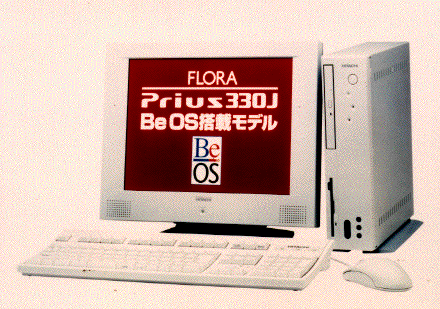
A 1990s Hitachi Flora Prius PC, from the Hitachi press release.
Does this PC look familiar to you?

This was the period that gave rise to the “Year of Linux on the desktop” meme as the open source contender just wasn’t ready for the general public, but we all know what happened. The various commercial contenders slipped by the wayside or survived by the skin of their teeth as enthusiast or niche platforms, while Microsoft Windows steamrollered all before it except for the walled garden of Apple users.

One of the players was BeOS, a powerful multimedia OS that might have had a chance if it could have persuaded OEMs to ship it on some PCs, but in that endeavour it had no luck. Or so everyone thought, but [Thom Holwerda] reports on the fascinating tale of a PC that shipped with BeOS, but not in a way anyone could easily use.

It seems that even being seen to talk to the folks from Be was enough to ensure an OEM received a visit from Microsoft goons sales representatives so even though the rival OS was offered for free it received no PC takers. This was the received opinion, but it turns out that the one manufacturer which did include BeOS was Hitachi, in Japan. Their Flora Prius PC was a Pentium II equipped white box typical of late-90s multimedia hardware, and though it booted into Windows it also had a BeOS installation on board that probably very few owners would have even realised existed. It seems Hitachi did the deal with Be but didn’t install the required bootloader to use the Be partition. A Flora Prius owner could run the software if they were prepared to follow some instructions on the Be website and download a floppy image, but it seems very few did so.

All this leads to a fascinating challenge for today’s BeOS enthusiasts, to locate a surviving Flora Prius PC if any can still be found with an intact BeOS partition, and activate the only factory PC BeOS install. We know we have readers in Japan who almost certainly have an eye for an old computer, can any of you help them in this quest?

We’ve touched on BeOS in the past on its own BeBox platform and the elusive Sony eVilla internet appliance.

A Current Sensing Coil That’s Open Ended

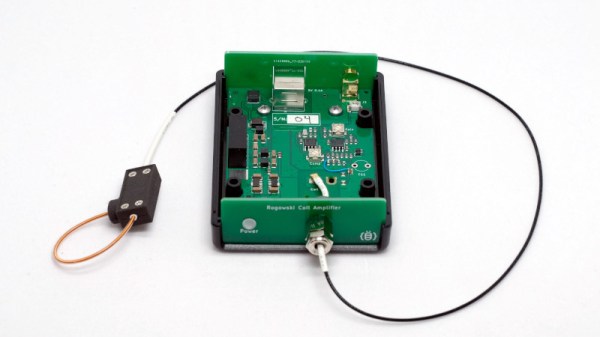
One of the joys of writing for Hackaday comes in learning new things which even after a long engineering background haven’t yet come your way. So it is with the Rogowski coil, an AC current sensing coil which is unlike conventional current transformers in that it’s open ended — in other words not needing to be closed around the conductor it’s measuring. [Weston Braun] has an interesting introduction to the subject, as part of his open source Rogowski coil based current probe.

The project itself is an amplifier and integrator that provides a voltage output proportional to the current sensed by the coil, but the real meat is in discovering the coils themselves. They’re a many-turn coil wound on a flexible former, forming in effect a toroidal inductor with a gap in it when bent into a circle. They’re for high frequencies only though, with the one in this project having a bandwidth from 888 Hz to 25 MHz. We don’t have any immediate need to non-intrusively measure current at those frequencies, but it’s something to know that we could.

This isn’t the first time a Rogowski coil has turned up on Hackaday though, back in 2011 we saw one used to measure a steep current impulse.

The Another World Chip

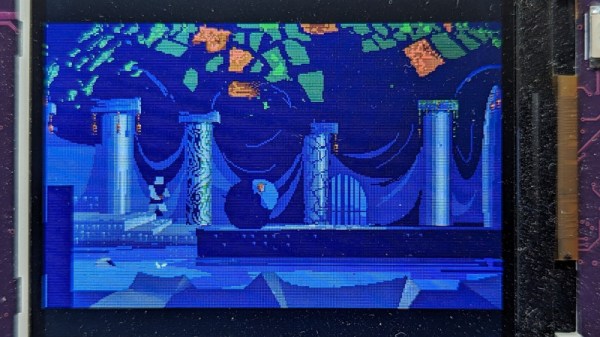
We cover many recreations of classic computer games on these pages, sometimes on original hardware, other times through ports to newer hardware, or even on emulators. But [Sylefeb]’s version of the Amiga classic Another World is in a class of its own. It doesn’t recreate an Amiga or run an emulator, instead it implements the game itself on a relatively modest Lattice UP5K FPGA.

This feat is possible because of the game’s architecture, it runs on a quite minimalist virtual machine that only needs blitter and rasterising hardware. This makes it a good candidate for the FPGA treatment. [Sylefeb] goes into a deep discussion of the hardware implemented in the FPGA, which makes a solid primer for how some of the 16-bit era games worked. In particular, we needed to read over the section about the rasterisation of polygons more than once. But it’s worth it.

The game can be run on a few dev boards featuring this FPGA, among which we’re particularly pleased to see the MCH 2023 conference badge. It requires a copy of the original to be owned for the game files, but we suspect if you’re this deep in you’d probably see that as a small price to pay.