Did You See A John Deere Tractor Cracked At DEF CON?

The Internet, or at least our corner of it,  has been abuzz over the last few days with the news of a DEF CON talk by [Sick.Codes] in which he demonstrated the jailbreaking of the console computer from a John Deere tractor. Sadly we are left to wait the lengthy time until the talk is made public, and for now the most substantive information we have comes from a couple of Tweets. The first comes from [Sick.Codes] himself and shows a game of DOOM with a suitably agricultural theme, while the second is by [Kyle Wiens] and reveals the tractor underpinnings relying on outdated and un-patched operating systems.

You might ask why this is important and more than just another “Will it run DOOM” moment. The answer will probably be clear to long-term readers, and is that Deere have become the poster child for improper use of DRM to lock owners into their servicing and deny farmers the right to repair. Thus any breaches in their armor are of great interest, because they have the potential to free farmers world-wide from this unjust situation. As we’ve reported before the efforts to circumvent this have relied on cracked versions of the programming software, so this potential jailbreak of the tractor itself could represent a new avenue.

As far as we’re aware, this has so far taken place on the console modules in the lab and not in the field on a real tractor. So we’re unsure as to whether the door has been opened into the tractor’s brain, or merely into its interface. But the knowledge of which outdated software can be found on the devices will we hope lead further to what known vulnerabilities may be present, and in turn to greater insights into the machinery.

Were you in the audience at DEF CON for this talk? We’d be curious to know more. Meanwhile the Tweet is embedded below the break, for a little bit of agricultural DOOM action.

Continue reading “Did You See A John Deere Tractor Cracked At DEF CON?”
USB-C Charging Mod Brings In The Juice

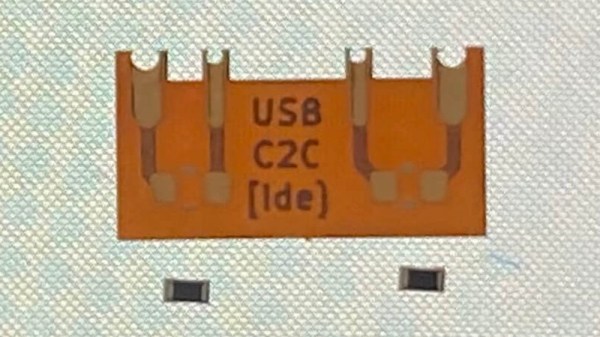
By now we’re well under way with the consolidation of low-voltage power supplies under the USB-C standard, and the small reversible connector has become the de facto way to squirt some volts into our projects. But for all this standardization there are still a few places where the harmony of a unified connector breaks down, and things don’t work quite the way they are supposed to. One such case has occupied [James Ide] — devices which will accept power from a USB-A to USB-C cable, but not from a USB-C to USB-C one. His solution? A small flexible PCB upgrade.

The problem lies with how different power supplies and peripherals identify each other, and quite likely in device manufacturers skimping on a few components here and there. A compliant USB-C power supply expects to see pull-down resistors on the data lines, and will thus refuse to serve power to devices that don’t possess them. Meanwhile the USB-A supply will quite happily serve juice without such checks, which is what the manufacturer is relying on. The solution is a tiny flexible PCB with the resistors, designed to be retrofitted behind a USB-C socket. On one hand it’s probably one of the simplest circuits we’ve ever shown you, and on the other it’s a cleverly designed solution to the issue at hand.

If the nitty-gritty of USB-C interests you, then we’ve taken a much closer look in the past.

Thanks to [Andrea] for the tip.

Why Do Brits Drink Warm Beer?

Traveling through mainland Europe on a British passport leads you to several predictable conversations. There’s Marmite of course, then all the fun of the Brexit fair, and finally on a more serious note, beer. You see, I didn’t know this, but after decades of quaffing fine ales, I’m told we do it wrong because we drink our beer warm. “Warm?”, I say, thinking of a cooling glass of my local Old Hooky which is anything but warm when served in an Oxfordshire village pub, to receive the reply that they drink their beers cold. A bit of international deciphering later it emerges that “warm” is what I’d refer to as “cold”, or in fact “room temperature”, while “cold” in their parlance means “refrigerated”, or as I’d say it: “Too cold to taste anything”. Mild humour aside there’s clearly something afoot, so it’s time to get to the bottom of all this. Continue reading “Why Do Brits Drink Warm Beer?”

A Simple Streaming Radio Receiver

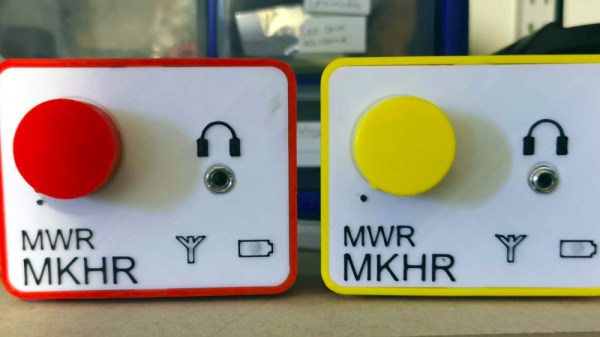
For those interested in a career in broadcast radio there aren’t many routes into the business. Student radio, pirate radio, and hospital radio usually feature somewhere near the start of any DJ’s resumé. Hospital radio stations often don’t have a transmission license and have historically relied on wired systems, but since those can’t reach everywhere they are now more likely to look to the Internet. [AllanGallop] has created the Mini Web Radio for the hospital station in the British city of Milton Keynes, a compact battery-powered single station streaming radio receiver that can pick up those tunes anywhere with a wireless network connection.

Inside the neatly designed 3D printed box the hardware is quite straightforward, a WeMos ESP32 board and a MAX98357A I2S digital amplifier module all powered by an 18650 cell. There’s a volume control and headphone socket, which is all that’s needed for the user interface. The software has code for both Arduino and Platform.io and is configured as you might expect through a web interface. Everything can be found in a handy GitHub repository should you wish to build one yourself. Meanwhile, it’s particularly pleasing as a Hackaday scribe to feature a project with roots in one’s own hackerspace, in this case, Milton Keynes Makerspace.

Thanks [Cid] for the tip!

Remember DAB Radio? The Psion WaveFinder Gets A Teardown

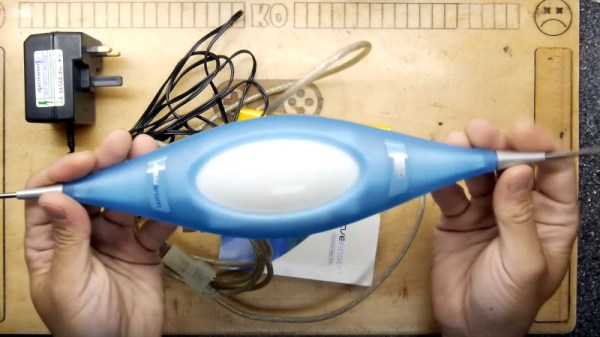
With digital music making a clean sweep in the 1990s over almost all listening media, it’s a surprise to find that there’s one area in which an analog hold-out is still very much alive and kicking. We’re talking not of a vinyl resurgence here but of FM radio, which has managed to effectively hold off its digital competition for a few decades now. Twenty years ago its days seemed numbered though, and in Europe the first generation of DAB digital radios looked ready to conquer the airwaves. Among them was a true oddity and one of Psion’s last significant consumer products, the WaveFinder USB DAB radio receiver. [Backofficeshow] has one, and has given it a teardown for our entertainment. He describes it as the first consumer SDR product which may be a little hyperbolic, but nevertheless, it’s an interesting look at what would become one of computing’s backwaters.

Inside the peak-90s-style translucent blue case is a single PCB with a lot of screening, on which sits a USB controller and a bunch of DSP chips. Radio demodulation was done in hardware, but signal demodulation was apparently done on the host PC. At the time its £299 price made it the affordable end of DAB reception, and The Register opined that its ability to download broadcast broadband data made it a revolutionary product, but sadly neither consumers nor broadcasters agreed and it was heavily discounted before making an ignominious exit. DAB itself would struggle to meet the expectations, and a multiplex-based licensing model for broadcasters making it unattractive to local stations means that even now FM is still full of stations. Perhaps as listening moves inexorably to streaming its time has passed, indeed Ireland has gone so far as to abandon DAB altogether.

If you’d like to know more about DAB, we took a look at the technology a while back.

Continue reading “Remember DAB Radio? The Psion WaveFinder Gets A Teardown”

The 286 Gives Up One Of Its Final Secrets

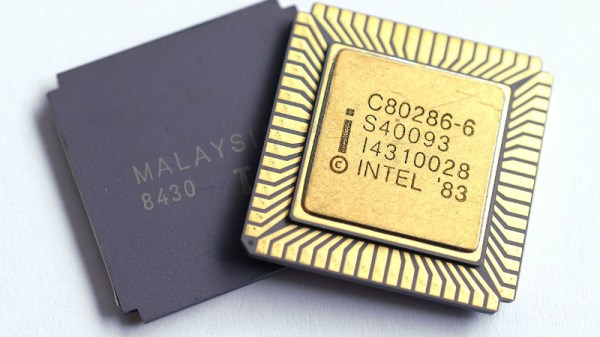
Though it is largely forgotten today, the Intel 80286 was for a while in the 1980s the processor of choice and designated successor to the 8086 in the world of PCs. It brought a new mode that could address up to 16 Mb of memory, and a welcome speed boost over machines using an 8086 or 8088. As with many microprocessors, it has a few undocumented features, and it’s a couple of these that [rep lodsb] takes a look at. Along the way we learn a bit about the 286, and about why Intel had some of these undocumented instructions in the first place.

If you used a 286 it was probably as an end-user sitting in front of a PC-AT or clone. During manufacture and testing though, the processor had need of some extra functions, both for testing the chip itself and for debugging designs using it. It’s in these fields that the undocumented instructions sit, and they relate to an in-circuit emulator, a 286 with a debug port on some of its unused pins, which would have sat on a plug-in daughterboard for systems under test. The 286 was famous for its fancy extended mode taking rather a long time to switch to, and these instructions relate to loading and saving states before and after the switch.

The 286s time as the new hotness was soon blasted away by the 386 with its support for virtual memory, so for most of us it remains as simply a faster way that we ran 8086 code for a few years. They appear from time to time here, even being connected to the internet.

286 image: Thomas Nguyen (PttNguyen.net), CC BY-SA 4.0.

An Amstrad NC100 Has A New Purpose In Life

We’re used to laptop computers featuring flip-up screens; this article is being written on one and it’s probable you’re reading it on another one. But there’s another laptop form factor that has gained legions of fans ever since the days of the TRS-80 Model 100, the flat slab with no hinge and both keyboard and display on its upper surface. It’s surfaced most recently in the DevTerm, which inspired [0x17] to have a go at building his own. Instead of starting from scratch though, he’s chosen to use the shell of an Amstrad NC100 from the 1990s.

This series of Amstrad portables followed the company’s tried and tested course of repackaging decade-old technology for the consumer market, and were Z80-based machines that shared much with the company’s PCW series of desktop wordprocessors. The character LCD, mainboard, and keyboard were replaced with a modern LCD, a Raspberry PI, and a custom ergonomic layout keyboard with all associated modules and cables.

The result is undeniably a neat flat form factor laptop computer, and one we could see ourselves using. There may be some questions relating to the repurposing of a retrocomputer when the same result could have been achieved with a bit of CAD work and a 3D printer, but perhaps the machine should speak for itself on that.

Meanwhile this isn’t the first Amstrad laptop we’ve seen recently, the company also did some unusually-shaped PCs in the 1990s.