A Pi Pico Oscilloscope

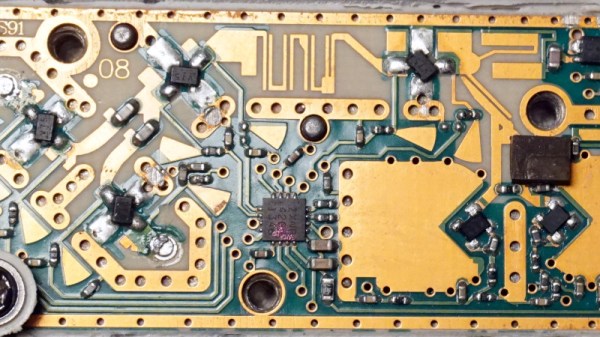
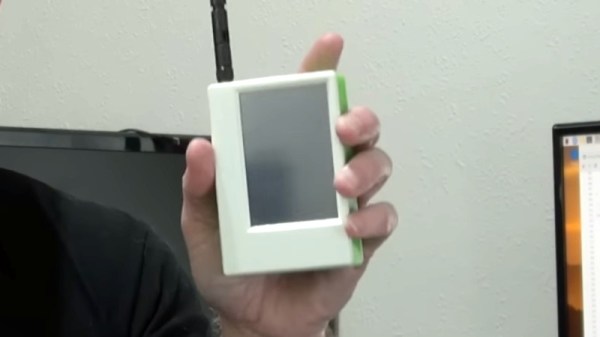
At the budget end of the oscilloscope range lie the so-called pocket ‘scopes. About the size of a deck of cards, they combine a microcontroller and an LCD screen to make an instrument with a bandwidth in the tens of kilohertz and a not-too-sparkling performance. They’re something of a toy, but then again, if all that’s needed is a simple ‘scope for audio frequencies, they make a passable choice in a small package. Now [jgpeiro] has made one which is light years ahead of the toy kits, using a Raspberry Pi Pico, a 100 MHz ADC, and an effort to design a better input circuit.

At its simplest this could be a straightforward op-amp and ADC circuit feeding the Pico, but instead it has multiple stages carefully designed to offer the full bandwidth, and with gain, offset, and trigger settings being set by a series of DAC chips under software control. This and the decent bandwidth make this a much more viable oscilloscope, and one we’d like to see further developed.

By comparison, we took a look at the best of the competition a few years ago.

Wall Art With A Moving Coil Or Two

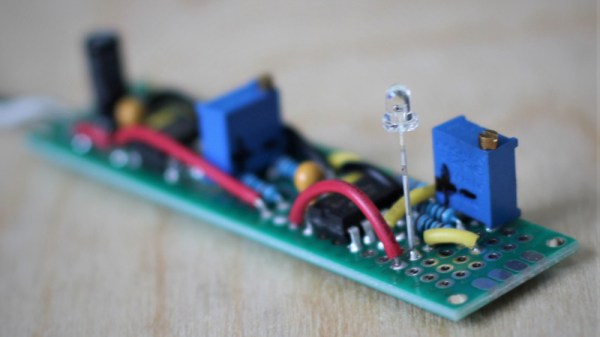
Almost every type of retro indicator technology from a Nixie tube to a flipdot with everything else in between has found itself on these pages in some form of artwork or decoration. It’s pleasing then to see one that hasn’t appeared so much over the years, and particularly at the hands of our colleague [Voja Antonic]. He’s taken a large array of moving-coil panel meters and hooked them up to a microcontroller board that’s triggered by a PIR sensor. Normally the readings are random, but get too close to it and all those needles start moving, making for a very different take on an electronic wall display.

He’s not given us the details of the control circuit he’s used, but in a sense that matters little. We think any Hackaday reader who knows one end of a soldering iron from the other should be able to produce a small DC current from a DAC to drive a meter, and we don’t think the software to make random readings would trouble many of you either.

Meanwhile [Voja] has produced so many interesting projects over the years, not least the 2022 Superconference badge. Here’s one from a few years ago.


When Only A TO92 Will Do

As through-hole components are supplanted by their surface-mount equivalents, we’re beginning to see the departure of once-common component form factors. Many such as the metal can transistors became rare years ago, while others still hang on albeit in fewer and fewer places. One of these is the once-ubiquitous TO92 moulded plastic transistor, which we don’t see very much of at all in 2022. [Sam Ettinger] is a fan of the D-shaped plastic blobs, and has gone as far as to recreate them for a new generation to enjoy.

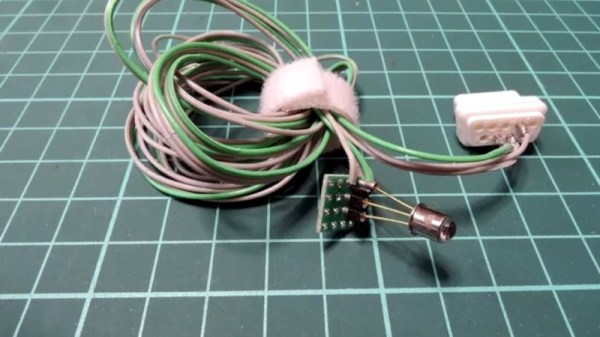
Though a TO92 was a relatively miniature package in its day, it’s still large enough to easily fit a SOT23 or similar SMD packaged device on a small PCB. So the tiny board with just enough space for the part and the three wires was fabricated, ready for encapsulating. Epoxy moulding a TO92 gave very poor results, so instead an SLA print of a T092 shell was made. It fits neatly over the PCB, producing a perfect TO92 package. We’re sure a translucent pink package would have raised a few eyebrows back in the 1960s though.

There will come a time when restorers of old electronics will use and refine this technique to replace dead components. We’ve seen the technique before, after all.

Pieca Is A Pi Camera With Some Very Nice Lenses

The advent of the high-quality version of the Raspberry Pi camera has given experimenters a good-enough quality camera system that they can use it to create better devices than mere snapshot cameras. It’s been used by experimenters for some exciting projects, but so far, very few of them have broken away from the Pi camera’s C-mount lens system. [Tom Schucker]’s Pieca is an interesting departure then, because it takes the Pi HQ camera into new territory by using Leica rangefinder lenses.

There are enough Pi camera projects that by now the process of setting one up should be pretty well known. This one is a bit different in its use of a focal length reducer, mounted inside a 3D-printed Leica lens mounting plate. The result is that the Leica lens is better matched to the much smaller size of the Pi camera sensor compared to a 35mm frame.

The camera’s aesthetic design is on the chunky side, probably because of the choice of a Pi 4 rather than a Pi Zero. It remains very usable though, and produces photographs with a distinctive feel. You can see more in the video below the break. Meanwhile if you aren’t lucky enough to own a stable of Leica lenses, perhaps you could think about adapting more common optics? We’ve seen it before with the original Pi camera.

Continue reading “Pieca Is A Pi Camera With Some Very Nice Lenses”

Three Computers, One Keyboard With USB Triplexer

Many of us will have the problem of several computers on the same desk, and to avoid clutter we’ll use a KVM switch to share the peripherals. [The Turbanned Engineer] has an interesting solution to this problem in the form of a USB triplexer. It’s a device that routes USB data lines depending upon which of its connections is powered up.

The circuit is simple enough: a CMOS analogue multiplexer does the routing, and a set of opto-couplers do the selecting based on the power inputs. A set of USB A sockets connect to the computer, and a USB B socket connects to the peripheral.

We’re not entirely sure whether an analogue multiplexer chip would be good for the higher-speed USB data rates, but since keyboards and mice talk at the slowest data rates, we think he’ll get away with it. Either way making a USB switch however basic with such mundane components has something of the hack about it. What he does with the display we’re not so sure about, but at least his keyboard and mouse woes are dealt with.

Other similar switches we’ve featured have been somewhat more basic.

End Of An Era, As LEGO To Discontinue Mindstorms

When there are so many single board computers and other products aimed at providing children with the means to learn about programming and other skills, it is easy to forget at time before the Arduino or the Raspberry Pi and their imitators, when a computer was very much an expensive closed box.

Into this late-’90s vacuum left in the wake of the 8-bit home computer revolution came LEGO’s Mindstorms kits, a box of interlocking goodies with a special programmable brick, which gave kids the chance to make free-form computerized robotic projects all of their own. The recent news that after 24 years the company will discontinue the Mindstorms range at the end of the year thus feels like the end of an era to anyone who has ridden the accessible microcontroller train since then.

What became Mindstorms has its roots in the MIT Media Lab’s Programmable Brick project, a series of chunky LEGO bricks with microcontrollers and the Mindstorms LEGO brick contacts for motors and sensors. Their Logo programming language implementation was eschewed by LEGO in favor of a graphical system on a host computer, and the Mindstorms kit was born. The brand has since been used on a series of iterations of the controller, and a range of different robotics kits.

In 1998, a home computer had morphed from something programmable in BASIC to a machine that ran Windows and Microsoft Office. Boards such as Parallax’s BASIC Stamp were available but expensive, and didn’t come with anything to control. The Mindstorms kit was revolutionary then in offering an accessible fully programmable microcontroller in a toy, along with a full set of LEGO including motors and sensors to use with it.

We’re guessing Mindstorms has been seen off by better and cheaper single board computers here in 2022, but that doesn’t take away its special place in providing ’90s kids with their first chance to make a proper robot their way. The kits have found their place here at Hackaday, but perhaps most of the projects we’ve featured using them being a few years old now underlines why they are to meet their end. So long Mindstorms, you won’t be forgotten!

Header image: Mairi, (CC BY-SA 3.0).

Bye Bye Linux On The 486. Will We Miss You?

A footnote in the week’s technology news came from Linus Torvalds, as he floated the idea of abandoning support for the Intel 80486 architecture in a Linux kernel mailing list post. That an old and little-used architecture might be abandoned should come as no surprise, it’s a decade since the same fate was meted out to Linux’s first platform, the 80386. The 486 line may be long-dead on the desktop, but since they are not entirely gone from the embedded space and remain a favourite among the retrocomputer crowd it’s worth taking a minute to examine what consequences if any there might be from this move.

Is A 486 Even Still A Thing?

Block diagram of the ZFx86 SoC
An entire 486 PC in a chip that only uses 1W, that would have been amazing in 1994!

The Intel 80486 was released in 1989, and was substantially an improved version of their previous 80386 line of 32-bit microprocessors with an on-chip cache, more efficient pipelining, and a built-in mathematical co-processor. It had a 32-bit address space, though in practice the RAM and motherboard constraints of the 1990s meant that a typical 486 system would have RAM in megabyte quantities. There were a range of versions in clock speeds from 16 MHz to 100 MHz over its lifetime, and a low-end “SX” range with the co-processor disabled. It would have been the object of desire as a processor on which to run WIndows 3.1 and it remained a competent platform for Windows 95, but by the end of the ’90s its days on the desktop were over. Intel continued the line as an embedded processor range into the 2000s, finally pulling the plug in 2007. The 486 story was by no means over though, as a range of competitors had produced their own take on the 486 throughout its active lifetime. The non-Intel 486 chips have outlived the originals, and even today in 2022 there is more than one company making 486-compatible devices. RDC produce a range of RISC SoCs that run 486 code, and according to the ZF Micro Solutions website they still boast of an SoC that is a descendant of the Cyrix 486 range. There is some confusion online as to whether DM&P’s Vortex86 line are also 486 derivatives, however we understand them to be descendants of Rise Technology’s Pentium clone. Continue reading “Bye Bye Linux On The 486. Will We Miss You?”