Mechanical Keyboards Are Over, This Device Has Won

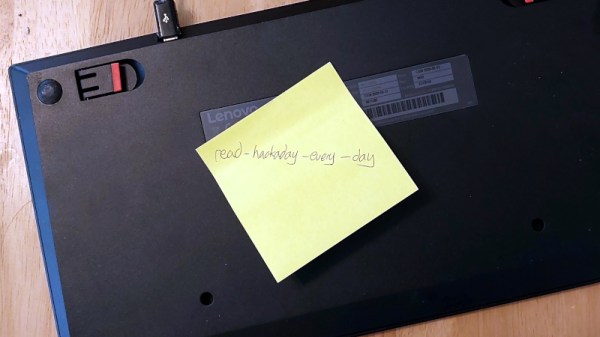
The desk of any self-respecting technology enthusiast in the 2020s is not complete without a special keyboard of some sort, be it a vintage IBM Model M, an esoteric layout or form factor, or just a standard keyboard made with clacky mechanical switches. But perhaps we’ve found the one esoteric keyboard to rule them all, in the form of [HIGEDARUMA]’s 8-bit keyboard. You can all go home now, the competition has been well and truly won by this input device with the simplest of premises; enter text by setting the ASCII value as binary on a row of toggle switches. No keyboard is more retro than the one you’d find on the earliest microcomputers!

Jokes aside, perhaps this keyboard may be just a little bit esoteric for many readers, but it’s nevertheless a well-executed project. Aside from the row of binary inputs there is a keypress button which sends whatever the value is to the computer, and a stock button that allows for multiple inputs to be stored and sent as one. If you pause for a moment and think how often you use Ctrl-C and Ctrl-V for example, this is an essential function. There’s more information on a Japanese website (Google Translate link), which reveals that under the hood it’s a Bluetooth device running on an ESP32.

We can imagine that with a bit of use it would be possible to memorize ASCII as binary pretty quickly, in fact we wouldn’t be at all surprised to find readers already possessing that skill. But somehow we can’t imagine it ever being a particularly fast text input device. Take a look for yourselves, it’s in the video below the break.

Continue reading “Mechanical Keyboards Are Over, This Device Has Won”

What Do You Get When A Raspberry Pi Pico Flashes A Nintendo 64

The joke was when the Nintendo 64 first hit the streets around a quarter century ago, that the 64 in the name referred not to the technology on board, but to the excessive cost of the cartridges. Whatever the truth in that, it’s something now completely laid to rest by [Konrad Beckmann] with his Nintendo 64 flash cart powered by a Raspberry Pi Pico (Nitter Link).

The schematic is surprisingly simple, in that the Pico does everything required to both interface to the N64 and to an SD card to hold the software. The clever work is done by the RP2040 firmware, which can be found along with the hardware details in the “develop” branch of the project’s GitHub repository. And while the earliest version was a Raspberry Pi Pico with a host of jumper wires, the more polished version focuses on a custom PCB and bare RP2040 chip.

Perhaps the N64 hasn’t received the attention it should have over the years, overshadowed as it was by its competitors such as the original PlayStation, but it’s projects like this one which remind us that there’s still life in Nintendo’s ’90s flagship. Speaking of which, if you were on Team Sony back in the day but still want to put your Pi Pico to use, check out this DIY PlayStation Memory Card we covered recently.

HDMI Is An Attack Surface, So Here’s An HDMI Firewall

Many years of using televisions, monitors, and projectors have conditioned us into treating them as simple peripherals whose cables carry only video. A VGA cable may have an i2c interface for monitor detection, but otherwise it presents little security risk. An HDMI interface on the other hand can carry an increasing number of far more capable ports, meaning that it has made the leap from merely a signal cable to being a connector stuffed with interesting attack vectors for a miscreant. Is it time for an HDMI firewall? [King Kévin] thinks so, because he’s made one.

It’s a surprisingly simple device, because the non-signal capabilities of HDMI rely on a set of conductors which are simply not connected. This of course also disconnects the on-board EEPROM in the device being connected, so there’s an EEPROM on the firewall board to replace it which must be programmed with the information for the device in question.

The premise of HDMI as an attack surface is a valid one, and we’re sure there will be attacks that can be performed on vulnerable displays which could potentially in turn do naughty things to anything which connects to them. The main value for most readers here probably lies though in the introduction it gives to some of what goes into an HDMI interface, and in accessing the i2c interface therein.

It comes as a surprise to realise that HDMI is nearing 20 years old, so it’s hardly surprising that its hacking has quite a history.

How Far Can You Push A £500 Small Electric Car; Four Years Of The Hacky Racer

Four years ago when the idea of a pandemic was something which only worried a few epidemiologists, a group of British hardware hackers and robotic combat enthusiasts came up with an idea. They would take inspiration from the American Power Racing Series to create their own small electric racing formula. Hacky Racers became a rougher version of its transatlantic cousin racing on mixed surfaces rather than tarmac, and as an inaugural meeting that first group of racers convened on a cider farm in Somerset to give it a try. Last weekend they were back at the same farm after four years of Hacky Racer development with racing having been interrupted by the pandemic, and Hackaday came along once more to see how the cars had evolved. Continue reading “How Far Can You Push A £500 Small Electric Car; Four Years Of The Hacky Racer”

A 3D-Printed Nixie Clock Powered By An Arduino Runs This Robot

While it is hard to tell with a photo, this robot looks more like a model of an old- fashioned clock than anything resembling a Nixie tube. It’s the kind of project that could have been created by anyone with a little bit of Arduino tinkering experience. In this case, the 3D printer used by the Nixie clock project is a Prusa i3 (which is the same printer used to make the original Nixie tubes).

The Nixie clock project was started by a couple of students from the University of Washington who were bored one day and decided to have a go at creating their own timepiece. After a few prototypes and tinkering around with the code , they came up with a design for the clock that was more functional than ornate.

The result is a great example of how one can create a functional and aesthetically pleasing project with a little bit of free time.

Confused yet? You should be.

If you’ve read this far then you’re probably scratching your head and wondering what has come over Hackaday. Should you not have already guessed, the paragraphs above were generated by an AI — in this case Transformer — while the header image came by the popular DALL-E Mini, now rebranded as Craiyon. Both of them were given the most Hackaday title we could think of, “A 3D-Printed Nixie Clock Powered By An Arduino Runs This Robot“, and told to get on with it. This exercise was sparked by curiosity following the viral success of AI generators, which posed the question of whether an AI could make a passable stab at a Hackaday piece. Transformer runs on a prompt model in which the operator is given a choice of several sentence fragments so the text reflects those choices, but the act of choosing could equally have followed any of the options.

The text is both reassuring as a Hackaday writer because it doesn’t manage to convey anything useful, and also slightly shocking because from just that single prompt it’s created meaningful and clear sentences which on another day might have flowed from a Hackaday keyboard as part of a real article. It’s likely that we’ve found our way into whatever corpus trained its model and it’s also likely that subject matter so Hackaday-targeted would cause it to zero in on that part of its source material, but despite that it’s unnerving to realise that a computer somewhere might just have your number. For now though, Hackaday remains safe at the keyboards of a group of meatbags.

We’ve considered the potential for AI garbage before, when we looked at GitHub Copilot.

The Sub-$100 Easythreed X1 3D Printer, Is It More Than A Novelty?

There was a time when a cheap 3D printer meant an extremely dubious “Prusa i3” clone as a kit of parts, with the cheapest possible components which, when assembled, would deliver a distinctly underwhelming experience. Most hackerspaces have one of these cheap printers gathering dust somewhere, usually with a rats-nest of wires hanging out of one side of it. But those awful kits have been displaced by sub-$200 printers that are now rather good, so what’s the current lowest end of the market? The answer lies in printers such as the sub-$100 Easythreed X1, which All3DP have given a review. We’ve been curious about this printer for a while, but $100 is a bit much to spend on a toy, so it’s interesting to see their take on it.

It’s a tiny printer marketed as a kid’s toy with an unheated bed and a miniature 100 mm cubic print volume, so we don’t blame them for pitching their expectations low. They found the supplied slicer to be buggy, but the printer itself to be surprisingly better than they expected. It seems that the Easythreed can deliver reasonable but not superlative small prints amid the occasional disaster, but for under $100, we’d guess that any print is a result. Still, we’ll join them in their assessment that it’s worth spending a bit more on a better printer.

We’ve seen another tiny Easythreed model before, when someone made a novelty wrist-mounted wearable version.

Will The Real Commodore Please Stand Up?

The Commodore 64 is a much-loved 8-bit retro computer that first appeared in 1982 and finally faded away around a decade later. The Commodore company started by [Jack Tramiel] went on to make the Amiga, and eventually ceased trading some time in the late 1990s. All history, now kept alive only by enthusiasts, right? Well, not quite, as the C64 has been the subject of a number of revivals both miniature and full-sized over the years. The latest came in the form of a Kickstarter for the C64x, a seemingly legitimately-branded Commodore 64-shaped PC, but it seems that has now been paused due to a complaint from an Italian company claiming to be the real heirs of Commodore. So will the real Commodore please stand up?

The origin of the Kickstarter C64x breadbin C64 PC is well enough documented, having its roots in a legitimate 2010 offering for which the person behind the C64x appears to have gained the rights. The Italian company is also called Commodore and uses the familiar branding from the glory days to sell some Commodore-themed games, novelties, and a tablet computer, but its website is a little tight-lipped about how it came by the use of that IP. Could it have come upon those rights through the 1990s German owner of the brand, Escom? We’d be fascinated to know.

Continue reading “Will The Real Commodore Please Stand Up?”