Neon, Ukraine, And The Global Semiconductor Industry

On our news feeds and TV channels at the moment are many stories concerning the war in Ukraine, and among them is one which may have an effect on the high-tech industries. It seems that a significant percentage of the world’s neon gas is produced in Ukrainian factories, and there is concern among pundits and electronics manufacturers that a disruption of this supply could be a further problem for an industry already reeling from the COVID-related chip shortage. It’s thus worth taking a quick look at the neon business from an engineering perspective to perhaps make sense of some of those concerns.

As most readers will know from their high school chemistry lessons, neon is one of the so-called inert gasses, sitting in the column at the extreme right of the Periodic table. It occurs in nature as a small percentage of the air we breathe and is extracted from the air by fractional distillation of the liquid phase. The important point from the above sentences is that the same neon is all around us in the air as there is in Ukraine, in other words, there is no strategic neon mine in the Ukrainian countryside about to be overrun by the Russian invaders.

So why do we source so much neon from Ukraine, if we’re constantly breathing the stuff in and out everywhere else in the world? Since the air separation industry is alive and well worldwide for the production of liquid nitrogen and oxygen as well as the slightly more numerous inert gasses, we’re guessing that the answer lies in economics. It’s a bit harder to extract neon from air than it is argon because there is less of it in the air. Since it can be brought for a reasonable cost from the Ukrainians who have made it their business to extract it, there is little benefit in American or Western European companies trying to compete. Our take is that if the supply of Ukrainian neon is interrupted there may be a short period of neon scarcity. After that, air extraction companies will quite speedily install whatever extra plant they need in order to service the demand. If that’s your area of expertise, we’d love to hear from you in the comments.

Here at Hackaday we are saddened beyond words at what has happened in Ukraine, and we hope our Ukrainian readers and those Ukrainian hackers whose work we’ve featured make it through safely. We sincerely hope that this madness can be ended and that we can mention the country in the context of cool hacks again rather than war.

If you are interested in the strategic value of inert gasses, have a read about the global helium supply.

Header image: Lestat (Jan Mehlich), CC BY-SA 3.0.
Surgically Implanted Bluetooth Devices Don’t Help Would-Be Exam Cheats

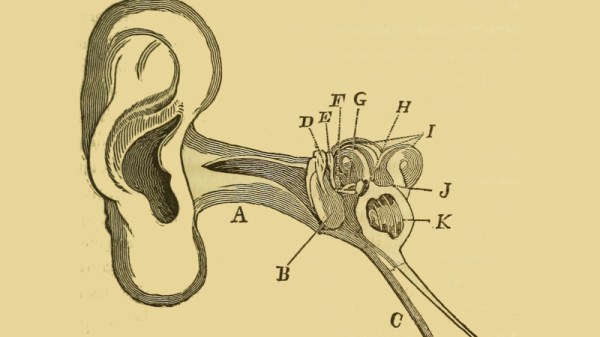
A pair of would-be exam cheats were caught red-handed at the Mahatma Gandhi Memorial Medical College in Indore, India, as they tried to use Bluetooth devices surgically implanted in their ears for a bit of unauthorised exam-time help.

It’s a news story that’s flashed around the world and like most readers we’re somewhat fascinated by the lengths to which they seem to have been prepared to go, but it’s left us with a few unanswered questions. The news reports all have no information about the devices used, and beyond the sensationalism of the story we’re left wondering what the practicalities might be.

Implanting anything is a risky and painful business, and while we’ve seen Bluetooth headphones and headsets of all shapes and sizes it’s hardly as though they’re readily available in a medically safe and sterile product. Either there’s a substantial rat to be smelled, or the device in question differs slightly from what the headlines would lead us to expect.

Continue reading “Surgically Implanted Bluetooth Devices Don’t Help Would-Be Exam Cheats”

A Ball Lens For Optical Fiber Coupling On The Cheap

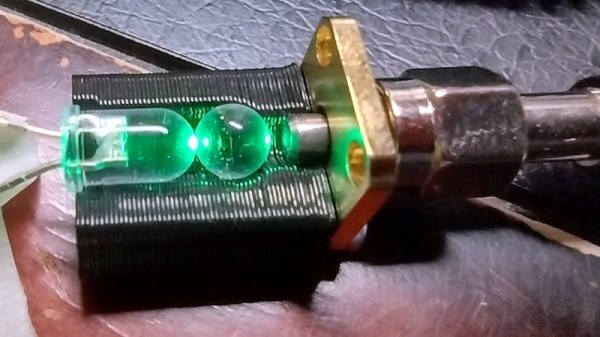
It’s fair to say that for most of us, using a fiber optic cable for digital audio or maybe networking will involve the use of an off-the-shelf termination. We snap the cable into the receptacle, and off we go. We know that inside there will be an LED and some lenses, but that’s it. [TedYapo] though has gone a little further into the realm of fibers, by building his own termination. Faced with the relatively high cost of the ball lenses used to focus light from an LED into the end of the fiber he started looking outside the box. He discovered that spherical glass anti-bumping balls used when boiling fluids in laboratories make an acceptable and much cheaper alternative.

A ball lens has an extremely short focal length, meaning that this same property which allowed Antonie van Leeuwenhoek to use them in his microscopes is ideal for LED focusing in a small space at the end of a fiber. Chromatic aberrations are of no consequence for light of a single wavelength. It seems that the glass balls are uniformly spherical enough to do the job. Fitted with the LED and fiber termination in a 3D-printed block, the relative position of the ball can be controlled for optimum light transfer. It’s a relatively simple hack mentioned in passing in a Twitter thread, but we like it because of its cheapness and also for an insight into the world of optical fiber termination.

Curious to know more about optical fibers? We covered just the video for you back in 2011.

Immersive Stereo Sound Recording With This Binaural Microphone

Sound recording has been a consumer technology for so long now that it is ubiquitous, reaching for a mobile device and firing up an app takes only an instant. Anyone who takes an interest in audio recording further will find that while it’s relatively straightforward to make simple recordings. But, as those among you who have fashioned a pair of Shure SM58s into an X configuration with gaffer tape will know, it can be challenging to create a stereo image when recording outside the studio. In the quest to perfect this, [Kevin Loughin] has created a binaural microphone, which simulates a human head with microphones placed as ears to produce ambient recordings with an almost-immersive stereo image.

Commercial binaural microphones can cost thousands of dollars, but this one opts for a more budget design using an off-the-shelf mannequin head sold for hairdressers. It’s filled with high-density foam, and in its ears [Kevin] placed 3D-printed ear canals with electret microphone capsules. On the back goes a battery and a box for the bias circuitry.

The results as you can hear in the video below the break are impressive, certainly so for the cost. It’s not the first such microphone we’ve shown you, compare it with one using a foam-only head.

Continue reading “Immersive Stereo Sound Recording With This Binaural Microphone”

It’s Bad Apple, But On A 32K EPROM

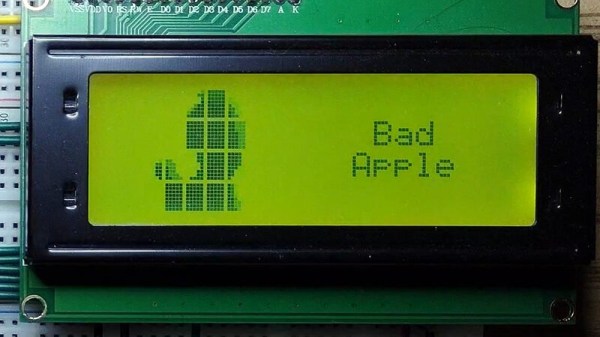
The Bad Apple!! video with its silhouette animation style has long been a staple graphics demo for low-end hardware, a more stylish alternative to the question “Will it run DOOM?”. It’s normal for it to be rendered onto a screen by a small microcomputer or similar but as [Ian Ward] demonstrates in an unusual project, it’s possible to display the video without any processor being involved. Instead he’s used a clever arrangement involving a 32K byte EPROM driving a HD44780-compatible parallel alphanumeric LCD display.

While 32K bytes would have seemed enormous back in the days of 8-bit computing, even when driving only a small section of an alphanumeric LCD it’s still something of a struggle to express the required graphics characters. This feat is achieved by the use of a second EPROM, which carries a look-up table.

It’s fair to say that the result which can be seen in the video below the break isn’t the most accomplished rendition of Bad Apple!! that we’ve seen, but given the rudimentary hardware upon which it’s playing we think that shouldn’t matter. Why didn’t we think of doing this in 1988!

Continue reading “It’s Bad Apple, But On A 32K EPROM”

Mon Dieu! French Parent Kills Cell Service For An Entire Town To Stop Kids Surfing

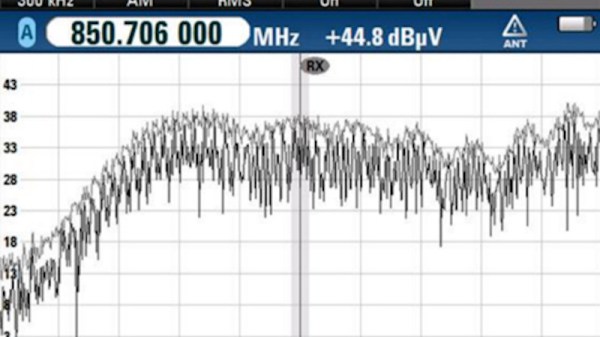
It used to be that having technical skills meant that fixing the computer problems of elderly relatives was a regular occurrence. Over the last few years this has been joined by another request on our time; friends with teenage children requesting help configuring their routers such that Internet access is curtailed when the kids should sleeping. In France a desperate parent took more extreme measures, buying a wideband frequency jammer to ensure les petits anges can’t waste the night away on social media sites through their cellular connections. It had the intended effect, but sadly it also interrupted cellular coverage over a wide area The French spectrum regulator ANFR sent in their investigators (French, Google Translate link), and now the unfortunate parent faces the prospect of up to 6 months imprisonment and €30,000 fine for owning and using a device that’s illegal in France.

A cursory search of everybody’s favourite online electronics bazaars will find plenty of these devices, so perhaps what’s surprising is that we don’t see more of these devices even if it’s not the first tale of interference tracking that we’ve seen. Judging by the strategies our friends with kids take, we’d suggest meanwhile to the unfortunate French person, that they simply equip their kids with restricted data plans.

Teardown: Alcatel Telic 1 Minitel Terminal

For British teenagers in the 1980s, the delights of 8-bit computers such as the Sinclair Spectrum, Commodore 64, or BBC Micro were firmly restricted to the offline arena. We would read about the BBS scene on the other side of the Atlantic, but without cheap local calls and with a modem costing a small fortune, the chances of us ever experiencing one was zero. When we took the British school rite of passage of a trip to France though, we were astounded to see that every French person was not merely online, but that they were doing so with a neat little all-in-one terminal. We’d just been introduced to the French Minitel system, and in that minute shared a glimpse of the future.

Un Réseau Trés Français

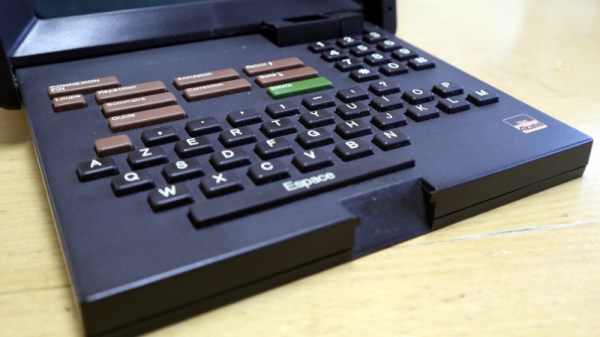
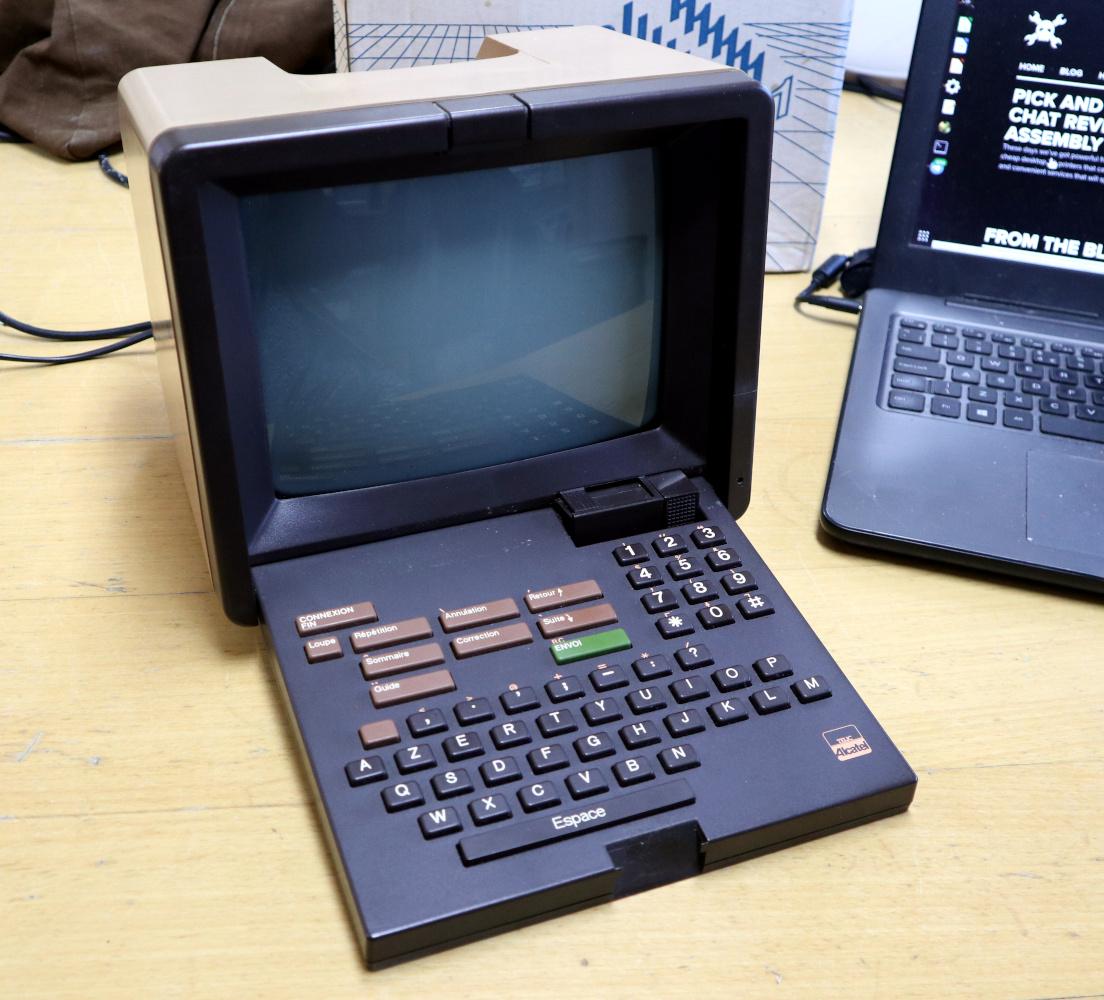
The Minitel terminal is a small CRT monitor with a fold-down alphanumeric keyboard.
My Alcatel Minitel terminal

In the 1970s and 1980s, so-called videotext systems, terminal-based phoneline access to information services on central computers, were seen as an obvious next step for telephone network operators with an interest in profitable new products. In most countries this resulted in services such as the UK’s Prestel, a subscription service relying on costly hardware, but France Télécom instead pursued the bold path of making the terminals free to subscribers with free access to phone listings and yellow pages, but a business model based on pay-to-use premium services.

Thus, through the 1980s all French households had a Minitel terminal beside the phone, and the service became a runaway success. Ever since seeing Minitel terminals as a tourist I’d been fascinated by the service, so here in the 2020s when a friend was visiting their family in France I asked whether he could pick up an old Minitel terminal for me. Thus I found myself parting with around $25 and being rewarded with a slightly battered Minitel cardboard box containing one of the familiar brown Alcatel terminals. I certainly wasn’t expecting one in its original packaging. Continue reading “Teardown: Alcatel Telic 1 Minitel Terminal”